Satoshi Nakamoto Statue at NYSE: Bitcoin’s Vanishing Tribute Sparks Debate
 LTB
LTB Satoshi Nakamoto Statue at NYSE: A Disappearing Tribute to Bitcoin’s Creator
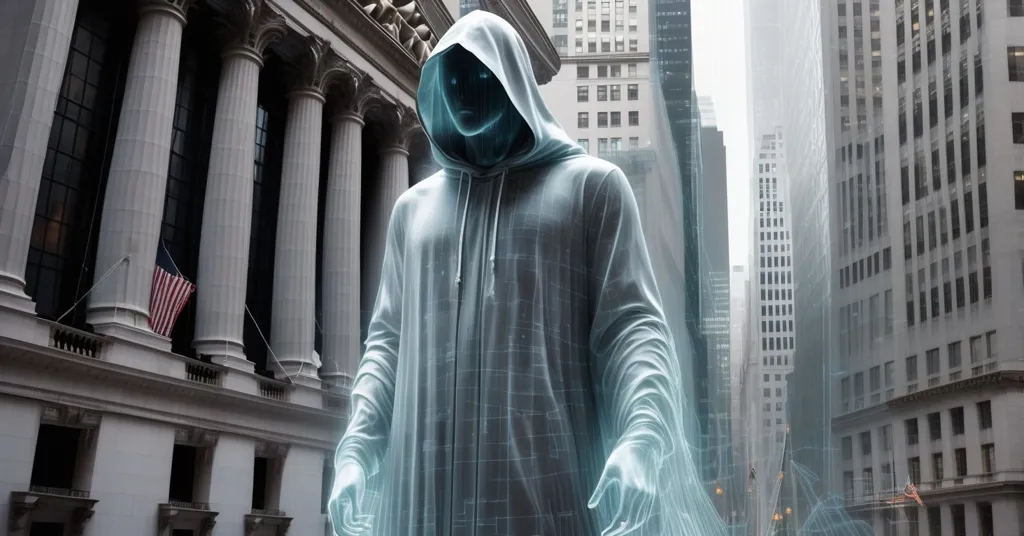
On December 10, 2025, the New York Stock Exchange (NYSE), a bastion of traditional finance, became the unlikely home to a ghostly tribute to Bitcoin’s enigmatic founder. A “disappearing” statue of Satoshi Nakamoto, commissioned by investment firm Twenty One Capital and designed by Italian artist Valentina Picozzi, now stands—or vanishes—before the eyes of Wall Street’s daily grind, marking a surreal collision of decentralized rebellion and corporate power.
- NYSE hosts a unique “disappearing” statue of Satoshi Nakamoto, symbolizing Bitcoin’s mysterious origins.
- Commissioned by Twenty One Capital, it’s the sixth of 21 planned global monuments, taking 21 months to craft.
- Reactions are mixed, with cultural buzz clashing against a 19% share drop for the sponsoring firm.
A Vanishing Symbol of Rebellion
This isn’t your grandfather’s bronze monument. Using overlapping metal sheets, Picozzi’s creation plays a visual trick, appearing to vanish from certain angles. It’s a brilliant nod to Satoshi Nakamoto, the pseudonymous creator of Bitcoin who introduced the world’s first decentralized cryptocurrency in 2009 and then vanished from public view. For the uninitiated, Satoshi’s identity remains one of the greatest mysteries in tech—whether a lone genius or a collective, no one knows. This statue captures that elusiveness, embodying the ethos of privacy and resistance to centralized control that Bitcoin champions. The design process itself, spanning 21 months, mirrors the symbolic importance of the number 21 in crypto culture, tied to Bitcoin’s halving cycles—a mechanism that occurs roughly every four years, slashing mining rewards to enforce scarcity akin to gold.
Picozzi, known for exploring themes of identity and impermanence in her art, reportedly chose this disappearing effect to challenge viewers’ perceptions of power and presence. It’s a direct parallel to Satoshi’s unseen influence: a figure who reshaped finance without ever stepping into the spotlight. But let’s not get too poetic—it’s also just damn cool to see a statue that messes with your head while walking past Wall Street’s pinstripes and profit margins. If you’re curious about this unique installation, check out more details on the vanishing Satoshi monument at NYSE.
Wall Street Meets Crypto Culture
Placing this Bitcoin statue at the NYSE isn’t just a quirky art drop; it’s a cultural statement. This is where the old financial guard—banks, brokers, and billionaires—have called the shots for over a century. Now, a symbol of a technology built to dismantle their middleman monopolies looms over their turf. It’s a visual metaphor for Bitcoin’s slow, stubborn creep into the mainstream, suggesting even the most rigid institutions can’t ignore the tidal wave of cryptocurrency any longer. The NYSE itself acknowledged this shift on social media, framing it as a bridge between worlds.
“From code to culture, the placement [of the Satoshi Nakamoto statue at NYSE] marks a shared ground between emerging systems and established institutions.”
That shared ground feels more like a tightrope when you dig into the backstory. Bitcoin was born from cypherpunk ideals, a middle finger to centralized banking and government overreach, powered by blockchain—a public, immutable ledger that records transactions without needing a trusted third party. Satoshi’s anonymity isn’t just trivia; it’s a proof of concept that you can spark a financial revolution without bowing to surveillance or authority. Seeing their ghost on Wall Street is either a triumph of cultural impact or a sad sign that Bitcoin’s punk roots are being manicured for corporate lawns. Are we honoring the vision, or diluting it?
Market Fallout and Mixed Signals
Not everyone’s clapping for this crypto-art crossover. Twenty One Capital, the investment firm bankrolling the project, took a brutal hit with a 19% nosedive in share value on their trading debut shortly after the unveiling. Apparently, Wall Street isn’t ready to bet big on ghostly tributes—investors dumped stock faster than a leveraged altcoin trade gone south. Are they spooked by the audacity of funneling funds into symbolic art over tangible blockchain innovation? Or do they still see Bitcoin as a volatile pariah, scarred by past crashes like 2018 or 2022? Whatever the reason, it’s a cold reminder that cultural stunts don’t always cash out in market confidence.
Bitcoin maximalists—those who believe BTC is the only true decentralized currency and altcoins are mostly noise—might revel in seeing Satoshi’s specter haunt Wall Street. But let’s play devil’s advocate: every dollar spent on vanishing statues is a dollar not spent on layer-2 solutions like the Lightning Network, which tackles Bitcoin’s scaling woes (think transaction fees spiking over $50 during bull runs). Are we fetishizing mystery over progress? It’s a question worth chewing on, especially when practical hurdles like these still slow adoption.
Global Statues, Global Controversies
This NYSE installation is just one stop on a larger journey. It’s the sixth in a series of 21 planned Satoshi monuments worldwide, each a cultural experiment testing how the public grapples with Bitcoin’s symbolism. A prior statue in Lugano, Switzerland—a city that’s embraced crypto with initiatives like accepting Bitcoin for taxes—met a darker fate. In August 2025, it was stolen, only to be dredged up in pieces from Lake Lugano after a 0.1 BTC reward spurred its recovery. The incident exposes the raw, polarizing nature of these symbols. They’re not just art; they’re lightning rods for love, hate, or plain opportunism. Satoshigallery, an art collective tied to the project, fired back with defiance after the theft.
“You can steal our symbol but you will never be able to steal our souls.”
Even they seemed floored by the NYSE placement, expressing disbelief at the milestone on social media.
“This is such an achievement, even in our wildest dream we wouldn’t think about placing the statue of Satoshi Nakamoto in this location!”
Wild dreams indeed, but does this “achievement” risk turning a rebel icon into a sanitized museum piece? The Lugano theft and the NYSE debut both highlight a broader tension: as Bitcoin’s cultural footprint grows, so do the battles over what it represents. Is this a sign of its polarizing power, or just petty crime with a digital twist?
Crypto Art in a Bigger Picture
Zooming out, these Satoshi statues fit into a wave of cryptocurrency art and cultural markers. From Bitcoin-inspired murals in tech hubs to blockchain-themed exhibits at events like Art Basel, the crypto world is increasingly leaving its imprint on public spaces. Non-fungible tokens (NFTs) exploded as a digital art phenomenon a few years back, proving crypto can intersect with creativity. This monument series follows that thread—but does it educate, or just aestheticize a complex movement? It’s worth noting Bitcoin’s broader cultural arc: from the first pizza purchase in 2010 (a humble 10,000 BTC for two pies) to institutional adoption by firms like MicroStrategy, and El Salvador’s bold 2021 move to make it legal tender. Each step, including this statue, is a snapshot of a journey from obscurity to recognition.
Yet, for all the symbolism, let’s keep it real. A disappearing statue won’t fix Bitcoin’s technical growing pains—think slow transaction throughput during hype cycles—or the regulatory noose tightening globally, from China’s mining bans to the EU’s stringent MiCA framework. We’re all for disruption and effective accelerationism (e/acc), a philosophy pushing rapid tech progress to solve societal issues, often embraced by crypto advocates. But we’ve got zero tolerance for glossing over the grind. Art keeps the ethos visible, sure, but it’s not a silver bullet.
What’s Next for Satoshi’s Ghost?
With 15 more installations on the horizon, each new Satoshi statue will likely ignite its own firestorm of debate. Will they be embraced as touchstones of a decentralized future, or face more vandalism and theft? Will they shift how the average person views cryptocurrency, or just baffle them further? And let’s not dodge the elephant in the room: if Twenty One Capital’s market stumble is any indicator, symbolic gestures might not inspire the financial confidence Bitcoin needs to cement itself as inevitable. We’re optimists, rooting for a world where decentralized tech upends the status quo, but we’re not blind to the potholes on this road.
For now, as Satoshi’s ghost flickers in and out of view on Wall Street, it’s a moment to reflect. Bitcoin and blockchain tech promise a future of financial freedom, privacy, and power to the individual. But are we still building the renegade vision Satoshi laid out, or just erecting monuments to a dream that’s slipping into the establishment’s grip? Hell, maybe Satoshi’s out there somewhere, chuckling at the irony of their shadow haunting the very system they sought to dismantle.
Key Takeaways and Questions for the Crypto Community
- What does a Satoshi Nakamoto statue at the NYSE mean for Bitcoin’s cultural impact?
It showcases Bitcoin’s growing acceptance by traditional finance, a milestone for a tech born to defy Wall Street, yet it fuels debate on whether this embrace waters down its anti-establishment core. - Why does the disappearing design of the Bitcoin statue resonate with crypto enthusiasts?
The vanishing effect mirrors Satoshi’s anonymity and Bitcoin’s push for privacy, reflecting a technology that resists being captured by centralized powers in a striking, tangible way. - How do events like the Lugano statue theft shape Bitcoin’s public image?
They reveal Bitcoin’s divisive nature—cherished by fans as a disruptive symbol, targeted by skeptics or thieves—proving its cultural integration is still a rocky, contested path. - Can cryptocurrency art installations educate people about blockchain technology?
They have potential to spark curiosity about decentralization and blockchain’s promise, but risk being seen as gimmicks if not paired with context on crypto’s real-world impact and hurdles. - What risks come with blending Bitcoin’s image with Wall Street’s systems?
The danger is co-option—Bitcoin could lose its revolutionary edge if reframed as another Wall Street asset, potentially alienating the cypherpunk community that birthed it. - Is public art a distraction from Bitcoin’s technical and regulatory challenges?
Some might argue yes, as funds for statues could support solutions for scaling issues like high fees or navigate global regulations, though art undeniably keeps Bitcoin’s spirit in the public eye.