South Korea Cracks Down on Crypto Withdrawals to Curb $127M Fraud Losses
 LTB
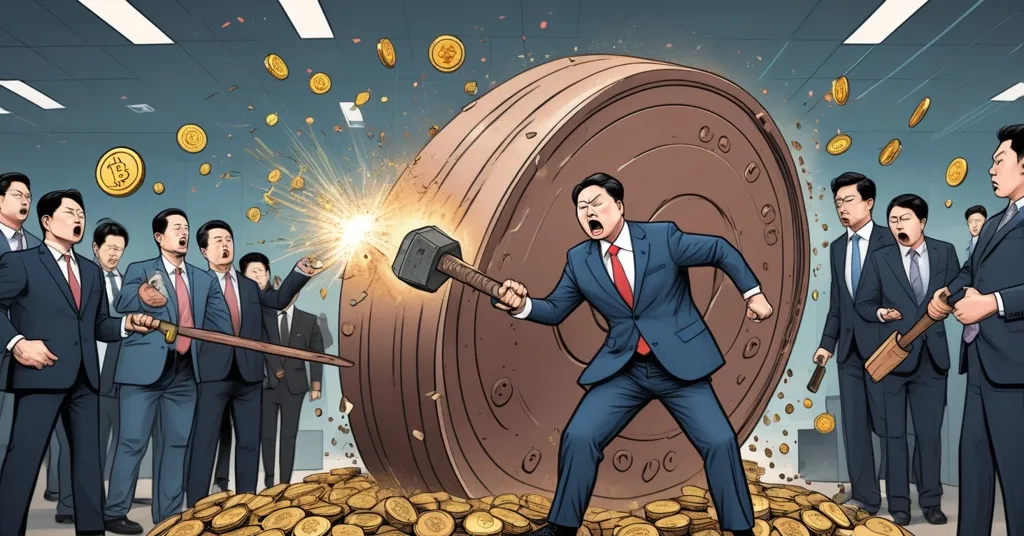
LTB South Korea Crypto Regulations Crack Down on Withdrawals to Fight $127M Fraud Losses
South Korea, a titan in the global cryptocurrency arena, has unleashed a regulatory iron fist to curb rampant fraud after losing a jaw-dropping 170.5 billion won—equivalent to roughly $127 million USD—between June and September 2023. With scammers exploiting glaring loopholes in exchange withdrawal policies, the government is slamming shut the backdoors that allowed this financial carnage, but at what cost to user freedom and market dynamism?
- Staggering Losses: 170.5 billion won ($127M USD) lost to fraud in just months, mostly via withdrawal loopholes.
- Regulatory Hammer: New “enhanced virtual asset withdrawal delay system” to standardize and restrict immediate withdrawals.
- User Fallout: Less than 1% of users qualify for exceptions, facing intense KYC checks and delays.
The Fraud Epidemic: How Scammers Exploited Loopholes
Let’s cut to the chase: South Korea got hit hard. Between June and September 2023, the country recorded total fraud losses of 225.7 billion won ($168M USD), with 75.5% of that—170.5 billion won ($127M USD)—tied directly to withdrawals from accounts that dodged delay rules on crypto exchanges. To put that into perspective, it’s like a mid-sized city losing its annual budget to a swarm of digital con artists in just 90 days. Even more damning, 59% of fraudulent activities—1,490 out of 2,526 cases—happened through these exempt accounts. We’re talking about a bloody scam epidemic, not a minor glitch. For more details on the scale of these losses, check out the report on South Korea’s massive crypto fraud losses.
So, how did the bad guys pull it off? Fraudsters often used sophisticated tactics like voice phishing, where they’d impersonate exchange staff or trusted entities to trick users into handing over credentials or transferring funds. Others leveraged social engineering to manipulate victims into bypassing security protocols, while some exploited hacked accounts to drain wallets before anyone noticed. The root issue? Inconsistent policies across South Korean exchanges like Bithumb and Upbit allowed immediate withdrawals based on laughably weak criteria—sometimes just a brief transaction history was enough to skip the standard 24-72 hour waiting period, known as a withdrawal delay. For the uninitiated, a withdrawal delay is a mandatory hold on funds leaving an exchange, designed to give time for fraud detection and user verification. But when poorly enforced, it’s like leaving your front door wide open with a “take what you want” sign.
New Regulatory Iron Grip: Closing the Escape Hatch
On April 8, 2024, South Korea’s Financial Services Commission (FSC) and Financial Supervisory Service (FSS)—the nation’s financial watchdogs—rolled out what they’re calling an “enhanced virtual asset withdrawal delay system.” This isn’t a gentle nudge; it’s a full-on lockdown. Gone are the days when exchanges could set their own flimsy exception rules for bypassing delays. Under the old system, some platforms let users dodge the wait with minimal oversight, creating a fast lane for criminals to funnel stolen crypto into the abyss. Now, immediate withdrawals are a privilege reserved for the rarest of cases, requiring a brutal evaluation of transaction frequency, duration, and volume. The FSC has hardcoded “non-exception” requirements to ensure no sneaky workarounds slip through the cracks.
Just how tight is this new leash? Simulations by regulators predict that less than 1% of existing customers will qualify for withdrawal delay exceptions. If you’re in that tiny elite, don’t celebrate yet—you’ll face annual Know Your Customer (KYC) checks, a process where exchanges verify user identities and financial backgrounds, including digging into the source of your funds. Add to that a shiny new intensive monitoring system to flag abnormal transactions, and it’s clear the FSC is playing hardball. They’ve even pledged to “regularly reconsider the adequacy of the standards to prevent new bypass methods from occurring,” showing they’re ready for a long game against ever-adapting scammers.
“Minimize consumer inconvenience by allowing withdrawal delay exceptions if immediate withdrawal is required for reasons unrelated to voice phishing, such as liquidation.” – FSC on balancing user needs with fraud prevention.
Impact on Traders and Investors: Security vs. Speed
Let’s not sugarcoat it: this crackdown is a double-edged sword. For the average crypto user in South Korea, these rules mean delays, frustration, and a serious hit to the liquidity that makes trading so appealing. Need to cash out fast to seize a market dip or cover an urgent expense? Good luck unless you’re among the anointed 1% who pass the FSC’s gauntlet of checks. Even then, the KYC scrutiny and constant monitoring might feel like Big Brother is breathing down your neck. For arbitrage traders—those who profit from price differences across platforms—or small businesses relying on crypto for payments, these delays could be a death knell, locking up funds when timing is everything.
South Korea’s tech-savvy culture, with near-universal smartphone penetration and a rabid appetite for digital assets, makes it both a crypto powerhouse and a juicy target for scams. High trading volumes on platforms like Bithumb and Upbit draw in users and fraudsters alike, creating a perfect storm. While the FSC claims they’re minimizing inconvenience with limited exceptions for legit needs like liquidation, the reality is most traders are stuck in bureaucratic limbo. Will these rules kill South Korea’s crypto trading dominance, pushing volume to less regulated markets? It’s a question worth chewing on.
A Bitcoin Maximalist Perspective: Could Self-Custody Be the Answer?
As champions of Bitcoin and decentralization, we can’t help but raise an eyebrow at this heavy-handed centralized oversight. Bitcoin was born to cut out the middleman, to give individuals control over their money without banks or regulators playing gatekeeper. The mantra “not your keys, not your crypto” rings louder than ever here. If users held their assets in personal wallets using private keys—rather than trusting centralized exchanges like Bithumb, which recently botched a Bitcoin overpayment exposing shoddy controls—these fraud risks could shrink dramatically. Self-custody isn’t foolproof; lose your key, and you’re screwed. But it sidesteps the vulnerabilities of exchanges that scammers feast on.
That said, let’s not pretend Bitcoin is the sole savior. Altcoin ecosystems on blockchains like Ethereum face similar centralized exchange risks, and not every user wants the responsibility of managing their own security. Plus, decentralized exchanges (DEXs) as alternatives come with their own pitfalls—less oversight can mean more hacks or rug pulls. South Korea’s crackdown might even drive users to these shadowy corners, undermining the FSC’s goals while creating new headaches. It’s a bitter irony: in trying to protect the ecosystem, regulators could push activity into riskier, unregulated spaces.
Global Ripple Effects: A Blueprint for Crypto Regulation?
Zooming out, South Korea’s aggressive stance isn’t happening in a vacuum. It’s part of a broader regulatory blitz in a country with a tumultuous crypto history—from the 2017 ICO ban to more measured frameworks in recent years. Just last month, the FSC ordered major exchanges to reconcile ledgers and wallet balances every five minutes, a direct jab at internal mismanagement after incidents like Bithumb’s overpayment snafu. This hawkish approach mirrors global trends as governments grapple with money laundering and investor protection. Compare it to the U.S., where the SEC is waging war on unregistered exchanges, or Japan, which tightened licensing after the Mt. Gox collapse. South Korea’s $127 million fraud wake-up call could inspire a domino effect, with other nations adopting similar withdrawal lockdowns or KYC overhauls.
But here’s the flip side: excessive regulation risks stifling the very innovation that makes crypto revolutionary. If every market clamps down like South Korea, will we see capital flight to jurisdictions with looser rules—or worse, a black market boom in peer-to-peer trading? And let’s not ignore the cultural angle: South Korea’s collectivist mindset and trust in government might make such strictures palatable locally, but try this in more libertarian-leaning markets, and you’d have a revolt on your hands. The global crypto community is watching, and this could be a test case for how far regulators can push before breaking the spirit of decentralization.
Critical Questions for the Crypto Community
- Why did South Korea tighten crypto withdrawal rules with such ferocity?
A staggering 170.5 billion won ($127M USD) lost to fraud in mere months of 2023, primarily through exploited withdrawal loopholes, left regulators no choice but to act decisively to safeguard investors. - How will these restrictions impact everyday crypto users?
Most will face significant delays in accessing funds, with less than 1% qualifying for immediate withdrawals, and even those face stringent KYC checks and ongoing monitoring, slowing down trades and liquidity. - Are these measures a silver bullet against crypto fraud, or a Band-Aid?
They address current gaps with standardized rules and enhanced oversight, but scammers evolve fast, and the FSC’s promise to adapt standards will be tested as new bypass tactics emerge. - Could South Korea’s approach set a precedent for global crypto regulation?
Very likely, as other nations facing fraud and money laundering concerns might emulate this aggressive stance, especially in high-volume markets, potentially reshaping how exchanges operate worldwide. - Is this crackdown a betrayal of crypto’s core ethos of freedom?
It’s a tough pill—centralized control clashes with decentralization, but with nine-figure losses, ignoring fraud isn’t an option; the real test is whether innovation can outpace regulatory overreach.
South Korea’s latest regulatory salvo is a gut punch to the crypto world, a stark reminder that freedom comes with vulnerabilities. As advocates of effective accelerationism, we believe blockchain and Bitcoin can—and must—outinnovate solutions like on-chain identity or AI-driven fraud detection faster than regulators can swing their hammers. Fraudsters thought they had a free pass, but the FSC just bolted the exit shut. The challenge now is for the crypto community to build security that doesn’t need a government babysitter, preserving the disruptive spirit that makes this space worth fighting for. South Korea’s experiment is our wake-up call; let’s not hit snooze.