South Korean Retail Traders Dump Bitcoin for AI Chip Stocks as Margin Debt Hits Record High
 LTB
LTB South Korean retail traders are swapping Bitcoin for AI-chip stocks, but they’re not exactly calming down about it. They’re piling into the KOSPI with record leverage, and that’s how a hot trade turns into a potential bloodbath if the market blinks.
- Retail risk appetite has rotated from Bitcoin into South Korean stocks
- Margin credit has hit a record 36.47 trillion won
- Samsung Electronics and SK hynix are doing most of the heavy lifting
- Market breadth is weakening while leverage keeps rising
- Regulators are warning that a crowded trade could unwind fast
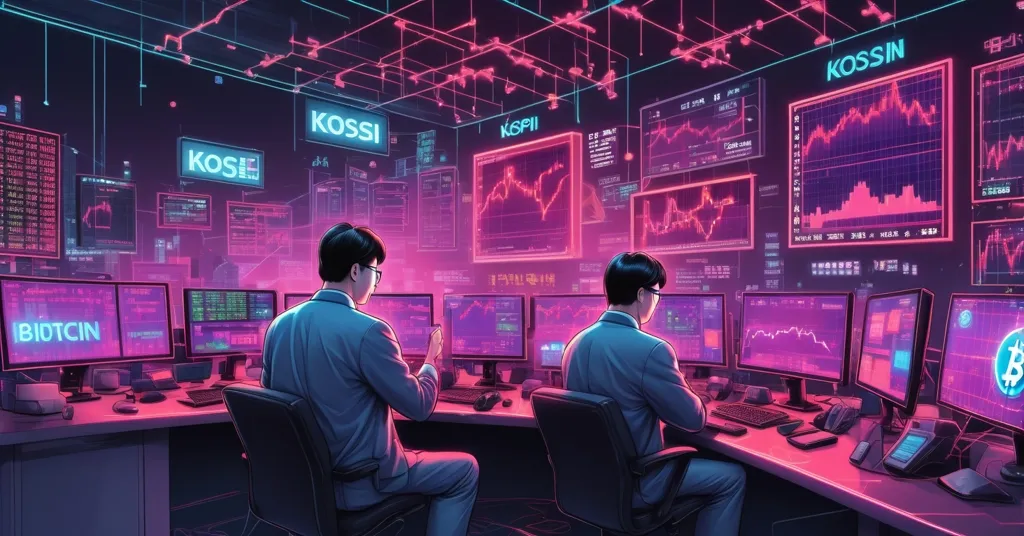
South Korea’s retail investors—long known for their appetite for volatility—are shifting their speculation from Bitcoin (BTC) into domestic equities, especially AI-linked semiconductor names, as highlighted in recent coverage of the rotation. The move is not a retreat from risk. It’s a redeployment of risk, and one with a whole lot more borrowed money behind it.
The center of gravity is the KOSPI, South Korea’s benchmark stock index, where traders are crowding into Samsung Electronics, SK hynix, and other names tied to the memory-chip cycle and the global AI infrastructure boom. In plain English: these traders are betting that demand for chips used in AI data centers keeps ripping higher, and they’re using leverage to juice the upside. Borrowed money makes gains look bigger on the way up. It also makes the floor disappear faster on the way down.
Margin credit in South Korea reached 36.47 trillion won as of last Friday, according to the Korea Financial Investment Association, a record high. That’s not just a big number. It’s a flashing warning sign. During the 2020–2021 “Donghak Ant Movement,” when retail investors flooded into stocks, margin balances sat in the mid-20 trillion won range. This time, the borrowed-money pile is much larger.
For newer readers, margin credit means traders are borrowing from brokerages to buy more stocks than they could afford with cash alone. If the trade works, the gains are amplified. If it fails, losses can snowball and trigger margin calls, which force investors to either add money or sell positions. That’s where the fun dies and the accounting starts.
A viral Blind post captured the mood. One user described a 2.3 billion won SK hynix position, mostly financed with margin loans, with about 1.7 billion won borrowed through brokerage credit. The same user later claimed an unrealized profit of about 267 million won. Another Blind post described a young Seoul Metro employee going full leverage to avoid missing the rally. That’s not disciplined investing. That’s FOMO wearing a hard hat.
Why is this happening? Because South Korean retail investors did not suddenly become less aggressive. They just found a different arena. Bitcoin used to be the obvious high-volatility playground. Now the same speculative energy is flowing into domestic stocks, especially AI semiconductor names, where momentum looks more socially acceptable and, at least for now, more rewarding.
The top 10 Korean securities firms are loving it. They generated about 600 billion won in padding-interest income in the first quarter, up 55.9% year over year. That’s the interest income from margin lending, and it’s a tidy little business as long as clients keep borrowing and the market keeps rising. Brokers get paid. Traders get adrenaline. Everyone feels smart until the tide goes out.
Margin loans in South Korea are typically priced around 7% to 9% annually. That’s not cheap capital. It means traders need their positions to keep climbing just to justify the financing cost, never mind the risk of a sharp drawdown. If the market starts wobbling, that borrowed money becomes a noose.
The rally itself has been narrow, which is the part that should make everyone squint harder. The KOSPI reportedly rose from around 4,000 at the end of last year to above 8,000 in less than half a year, with more than two-thirds of the gains attributed to Samsung Electronics and SK hynix. That’s a powerful headline, but it also means the index is leaning heavily on a couple of giant semiconductors rather than reflecting broad strength across the Korean economy.
William Bratton, BNP Paribas Asia-Pacific cash equities research head, cut straight to the issue:
“Buying the index has effectively become a concentrated wager on the memory cycle rather than broad exposure to the Korean economy.”
That’s the key point. This is not a healthy, broad-based rally where lots of sectors are participating. Market breadth has weakened sharply. Stocks above the 50-day moving average dropped from around 70% to 33%, and only about 2% of names hit 52-week highs. In normal language, most stocks are no longer keeping up with the index’s headline strength. The market is getting thinner while the headline gets louder.
BNP Paribas said non-tech companies contributed only about 4% of total 12-month earnings growth since September. That’s a huge concentration problem. If one theme is carrying the market, and that theme is already stuffed with leverage, the setup becomes fragile fast. POSCO Future M was cited as trading above 300x forward earnings, which is the sort of valuation that makes even the most enthusiastic stock picker pause for a breath. Forward earnings are expected profits over the next 12 months. A 300x multiple means investors are paying an absurdly rich price relative to what the company is projected to make. Sometimes growth justifies a premium. Sometimes it’s just expensive hype with a ticker symbol.
JPMorgan still sees plenty of upside in the Korean market and raised its KOSPI targets to 9,000 in a base case and 10,000 in a bull case. Fair enough. If the AI buildout keeps gobbling up memory chips and global demand stays strong, the trade can keep working. That’s the bullish case, and it shouldn’t be ignored. The problem is not that the thesis is impossible. The problem is that everyone is packed into the same side of the boat, and many of them borrowed money to get there.
Volatility has been climbing alongside prices, which is often what a late-stage melt-up looks like. A melt-up is when prices keep ripping higher because nobody wants to miss out, even as the structure underneath gets shakier. It’s the market equivalent of someone sprinting downhill in fancy shoes: impressive until the first bad step.
The regulatory side of the picture is getting more nervous by the day. South Korea’s Financial Supervisory Service has warned about retail losses and the risks tied to upcoming leveraged and inverse ETFs. Leveraged ETFs aim to magnify the daily move in an asset or index. Inverse ETFs do the opposite—they’re designed to rise when the underlying asset falls. Both can be useful tools for sophisticated traders. Both can also be a complete disaster in the hands of people who think “more leverage” is a personality trait.
Lee Chan-jin, head of the Financial Supervisory Service, has already flagged the danger. The introduction of more leverage vehicles risks turning a crowded position into something more systemic. In a market where a few giant stocks are doing most of the work, that matters a lot. Once leverage becomes the fuel, the unwind can be self-reinforcing: prices fall, margin calls hit, forced selling begins, and then the market starts feeding on itself like a particularly stupid machine.
Foreign investors are not exactly providing a safety net. On Tuesday, the KOSPI fell about 5%, underperforming other Asian markets. Foreign investors were net sellers for nine straight sessions, and Goldman Sachs reportedly said they sold about $3.4 billion of tech stocks that same day. That leaves domestic retail traders absorbing supply with borrowed money, which is fine until it isn’t. If foreigners keep selling and local traders keep leaning harder on margin, the market’s structure starts to look less like confidence and more like a stack of chairs.
There’s a reason this matters beyond South Korea. This is a familiar pattern in markets that run hot: speculative capital leaves one arena and piles into another, usually with more leverage and less patience than before. South Korea’s retail crowd didn’t abandon Bitcoin because they suddenly got conservative. They moved because another trade looked shinier, louder, and more obviously connected to the AI mania. That’s not a moral judgment. It’s just human nature with a brokerage account.
And yes, the memory-chip rally may still have room to run. AI infrastructure spending is real, semiconductor demand is real, and market narratives can stay irrational for a long time. But when a rally becomes narrow, crowded, and financed with borrowed money, it starts to resemble a late-stage speculation bubble more than a durable bull market. Not every bull market is a bubble. But every bubble insists it’s a bull market right up until the air comes out.
Why did South Korean retail investors move from Bitcoin to stocks?
They didn’t suddenly become risk-averse. They rotated into domestic equities, especially AI semiconductor names, because that trade offered bigger momentum, louder headlines, and plenty of FOMO fuel.
How risky is the leverage being used?
Very risky. Margin credit has reached a record 36.47 trillion won, and traders are paying around 7% to 9% annually to borrow. If the market turns, forced selling can hit fast.
Which stocks are driving the KOSPI rally?
Mostly Samsung Electronics and SK hynix, with spillover into other AI and chip-related names. That concentration makes the rally look stronger than the underlying breadth actually is.
What is market breadth, and why does it matter?
Market breadth measures how many stocks are participating in a rally. When breadth weakens, it means fewer names are carrying the market, which makes the move more fragile.
Why are regulators worried about leveraged ETFs?
Because leveraged and inverse ETFs can magnify losses just as easily as gains. In a crowded market already full of margin debt, they can accelerate a nasty unwind.
Could the trade keep working anyway?
Yes. If AI spending stays hot and chip demand keeps rising, the rally can continue. The danger is not that the thesis is dead. The danger is that the positioning is overcrowded and increasingly dependent on borrowed money.
What happens if sentiment flips?
A sharp drop could trigger margin calls, forced selling, and a fast deleveraging event. That’s how a concentrated, leveraged rally turns into a messy cleanup job.