Strait of Hormuz Crisis: Bitcoin Stands Firm as Oil Prices Soar and Markets Panic
 LTB
LTB Strait of Hormuz Crisis Ignites Global Chaos: Bitcoin Holds Firm Amid Crypto Market Jitters
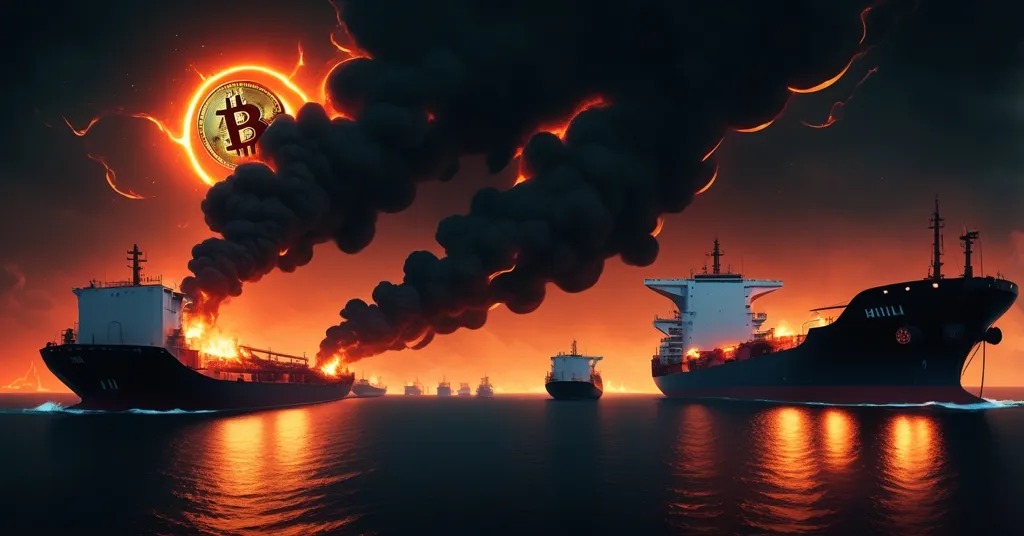
Geopolitical flames are roaring in the Middle East as Iran’s blockade of the Strait of Hormuz sends shockwaves through global energy markets, jacking up oil prices and putting economies on edge. With US President Donald Trump dropping a hardline ultimatum and Bitcoin showing unexpected grit, this crisis is a brutal test of whether decentralized tech can stand tall when the world’s arteries clog up.
- Strait Shutdown: Iran closes key oil route on March 4 after US-Israeli strikes.
- Oil Price Chaos: Brent crude spikes to $126 per barrel, worst since the 1970s.
- Bitcoin’s Backbone: BTC stays steady at $67,000-$71,000 despite market panic.
Strait of Hormuz: The World’s Oil Lifeline Choked
The Strait of Hormuz, a narrow passage between the Persian Gulf and the Gulf of Oman, isn’t just a waterway—it’s the beating heart of global oil transit, handling about 20% of the world’s supply. On March 4, Iran slammed the door shut on this vital corridor, a direct retaliation for US and Israeli airstrikes on Iranian military targets on February 28. Maritime data paints a grim picture: a 90% collapse in tanker transits, with hundreds of ships stranded on either side, unable to move. This isn’t a minor hiccup; it’s a full-blown chokehold on energy flows.
The immediate fallout? Brent crude, the global oil benchmark, smashed through $100 per barrel for the first time since 2022, peaking at a staggering $126. We haven’t seen a supply disruption this severe since the oil crises of the 1970s. Iran’s defiance doesn’t stop at a blockade—its forces have attacked at least 10 ships in the Strait, leaving five crew members dead across two vessels. Their message is clear: mess with us, and we hit back harder. For more on how this escalating tension is affecting markets, check out the detailed coverage on the Strait of Hormuz crisis and its impact on crypto volatility.
Global Markets in Panic Mode: Beyond Just Oil
The domino disaster from this closure ripples far beyond gas pumps. About 85% of Middle East polyethylene exports—think plastics for packaging, auto parts, and everyday goods—pass through the Strait. With shipments stalled, prices for industrial materials like aluminum, fertilizer, and even helium are spiking. The International Energy Agency (IEA) didn’t hold back in its assessment of the carnage.
“The greatest global energy and food security challenge in history.” – International Energy Agency
Financial heavyweights are ringing alarm bells. Andrei Quinn-Barabanov, supply chain lead at Moody’s, pointed out that stockpiles for these commodities are damn near empty, raising the ugly specter of widespread shortages. Goldman Sachs threw out an even grimmer forecast: if this mess drags on, oil could hit $150 per barrel. For perspective, that’s a gut punch to economies already limping from inflation and supply chain knots. Your grocery bill, car parts, hell, even the helium in party balloons—everything’s getting pricier.
Trump’s Ultimatum: A 48-Hour Fuse
Enter US President Donald Trump, who’s not exactly known for diplomatic tiptoeing. Via Truth Social, he issued a blunt 48-hour ultimatum to Iran: reopen the Strait by Monday night, or face the destruction of your power plants. It’s not just talk—US fighter jets have already bombed an Iranian coastal facility storing anti-ship cruise missiles, a strike aimed at crippling Iran’s ability to attack more ships. Admiral Brad Cooper of US Central Command confirmed the move was meant to send a message: the US isn’t playing games.
Iran, however, isn’t backing down. They’ve promised retaliation if hit again, setting the stage for a potential military escalation that could make oil at $150 look like the least of our worries. The world is watching a high-stakes poker game, and the chips are global stability.
Bitcoin’s Surprising Grit: Digital Gold or Mirage?
While traditional markets are sweating bullets, Bitcoin’s playing a different game—or is it? Amidst this geopolitical and economic turmoil, the flagship cryptocurrency has held its ground, trading between $67,000 and $71,000. That’s no small feat when oil’s skyrocketing and expectations for interest rate cuts are getting slashed. Open interest, which tracks the total number of unsettled derivative contracts like futures, has dropped, signaling traders aren’t YOLO-ing into reckless bets. Less speculative gambling often means less wild price swings, and right now, Bitcoin’s looking like a rock in a stormy sea.
For the uninitiated, this stability might raise eyebrows. Is Bitcoin finally living up to its “digital gold” hype—a safe haven when fiat systems tremble? Its decentralized nature, free from government meddling or central bank whims, offers a compelling case. Unlike oil or stocks, no single nation can shut down the Bitcoin network. But let’s not get carried away—Bitcoin’s transactional use is still niche. Most folks aren’t paying for bread with satoshis (the smallest BTC unit). If oil hits $150 and your bills double, cashing out BTC might not be as seamless as HODLers—long-term holders who cling to their coins through thick and thin—might hope.
There’s another angle to chew on: energy costs. Bitcoin mining, the process of validating transactions and securing the network, guzzles electricity. With oil prices through the roof, miners in regions reliant on fossil fuels could get squeezed. Smaller operations might shut down, potentially centralizing hash power (mining control) in the hands of bigger players. Data shows Bitcoin’s network already consumes about 0.1% of global energy. If energy costs keep climbing, will this undermine the decentralization we champion? It’s a nasty counterpoint to the resilience narrative.
Altcoins and DeFi: The Weak Links in Crisis?
Bitcoin might be holding the line, but what about the rest of the crypto zoo? Altcoins—every other cryptocurrency besides BTC—and decentralized finance (DeFi) systems built on blockchains like Ethereum face a rougher road. Ethereum, with its sprawling ecosystem of DeFi apps (think lending, borrowing, and trading without banks), might draw risk-averse investors looking for yield in a crisis. Its market cap, hovering around $400 billion, offers some heft compared to flimsier tokens. But speculative altcoins, especially meme coins like Dogecoin, could get obliterated if a risk-off environment—where investors ditch high-risk assets for safer bets like gold or stablecoins—takes hold.
DeFi’s promise is tantalizing: decentralized stablecoins, pegged to assets outside the USD’s inflation spiral, could gain traction if traditional currencies buckle under oil-driven price hikes. But here’s the rub—smart contract bugs and liquidity crunches in DeFi have burned users before, especially during high volatility. And let’s not ignore privacy coins like Monero or Zcash. In conflict zones or under heightened financial surveillance, their anonymity could be a lifeline for preserving wealth. Yet, with regulators circling and adoption low, they’re a long shot compared to Bitcoin’s battle-tested network.
Decentralization’s Test: Can Crypto Save the Day?
This crisis isn’t just about price charts; it’s a real-world stress test for decentralization’s core promise. Bitcoin’s borderless, censorship-resistant design could be a game-changer for folks in sanctioned regions like Iran, where traditional banking gets choked by geopolitics. Imagine preserving wealth outside a collapsing local currency or dodging asset freezes—that’s the freedom Bitcoin offers. But scalability remains a hurdle. The network processes about 7 transactions per second compared to Visa’s 24,000. If adoption spikes in conflict zones, congestion could cripple its utility.
From an effective accelerationism (e/acc) lens, crises like this could turbocharge decentralized systems if traditional finance stumbles hard. Think about it: if banks or fiat currencies falter under oil shocks, Bitcoin and blockchain tech might rush in to fill the void. But are we ready? The infrastructure—scalability, user-friendliness, even miner energy reliance—still has glaring gaps. As Bitcoin maximalists, we’d argue BTC is the only crypto with proven grit, a 15-year track record of surviving storms. Still, Ethereum’s utility in smart contracts and DeFi fills niches Bitcoin shouldn’t touch. It’s not betrayal to admit altcoins have a role; it’s pragmatic.
Crypto 101: Why This Crisis Matters to Your Wallet
If you’re new to crypto, you might wonder why a Middle East oil spat shakes your digital stash. Here’s the deal: Bitcoin and other cryptocurrencies often react to global uncertainty as either hedges (safe bets) or risk assets (volatile gambles). BTC’s current stability signals it might lean toward the former, a signpost of broader financial disruption. Even if you don’t own a single coin, its price movements reflect how much faith (or fear) investors have in centralized systems. Plus, scammers love chaos—watch out for fake “war-proof” tokens or pump-and-dump schemes promising quick riches. We’ve got zero tolerance for that nonsense.
What’s Next? A Glimpse Into the Abyss
The next few days are a powder keg. If Iran blinks and reopens the Strait, oil prices might cool, giving markets—including crypto—a breather. Bitcoin could solidify its “digital gold” rep, maybe even inch toward $75,000 as a confidence boost. But if tensions flare with more strikes or a prolonged blockade, we’re looking at a full-blown energy crisis. A global recession could tank all risk assets, Bitcoin included, no matter how decentralized it is. Altcoins without fundamentals? Good luck surviving that bloodbath.
On the flip side, a drawn-out conflict might push adoption in sanctioned areas, with folks turning to BTC to dodge financial lockdowns. Hell, even Satoshi might smirk at that, though he’d probably wish he’d coded a “peace protocol” into the blockchain instead of just capping it at 21 million coins. For now, keep one eye on the news and the other on your wallet. This ain’t over.
Key Takeaways and Burning Questions
- What ignited Iran’s closure of the Strait of Hormuz?
Iran blocked this crucial oil route on March 4 as retaliation for US-Israeli airstrikes on its military targets on February 28, ramping up regional tensions. - How are oil price surges slamming global economies?
Brent crude hit $126 per barrel, disrupting supplies of vital commodities like aluminum and helium, posing a historic threat to energy and food security. - What’s the US response to this blockade?
Trump issued a 48-hour ultimatum to destroy Iran’s power plants if the Strait stays closed, while US jets already struck Iranian missile facilities. - Why is Bitcoin showing strength in this mess?
Trading at $67,000-$71,000, Bitcoin’s steadiness reflects reduced speculative bets and a rising view as a hedge against traditional market chaos. - How might altcoins and DeFi react if conflict escalates?
Ethereum’s DeFi platforms could attract cautious investors, but speculative altcoins like meme coins might crash in a risk-off wave from worsening tensions. - Can Bitcoin’s decentralization help in conflict zones?
Its borderless, censorship-resistant nature could aid wealth preservation in sanctioned areas like Iran, though scalability and access issues persist. - Should crypto holders brace for volatility ahead?
Damn right—if military action spikes or the crisis drags, even Bitcoin’s toughness could falter under global economic panic, so stay sharp.