Tennessee Bans Crypto ATMs as Minnesota Pushes Stricter Regulation to Curb Fraud
 LTB
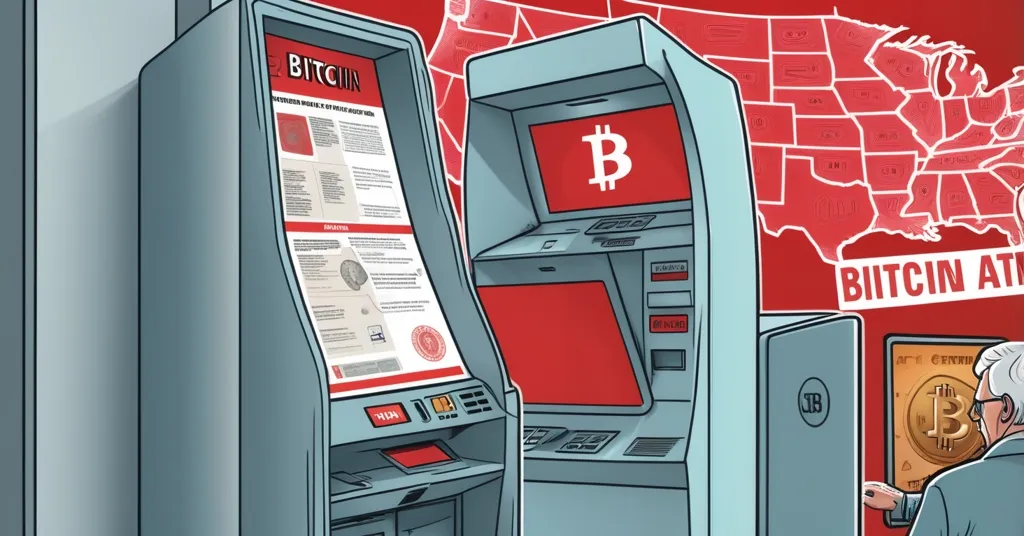
LTB Crypto ATMs are getting squeezed hard in the U.S., and Tennessee just took the most brutal swing yet by effectively banning them statewide, as detailed in this crackdown on crypto ATMs. Minnesota, meanwhile, is trying the “fine, but with a leash” approach.
- Tennessee has made crypto ATM operations illegal statewide.
- Minnesota is pushing stricter regulation instead of a full ban.
- Fraud against older adults is driving the crackdown.
- Critics say bans can cut off access for people without traditional banking.
Crypto ATMs, also called Bitcoin kiosks or virtual currency kiosks, let people buy digital assets with cash. For a while, they were pitched as a simple bridge between the old money system and the new one. Feed in cash, get crypto sent to your wallet, job done. The problem is that these machines also became a scammer’s favorite little cash funnel, because once the money is sent, it is usually gone for good.
Tennessee passed House Bill 2505 on April 24, 2026, and Governor Bill Lee signed it into law on April 13, 2026. The legislation goes beyond regulation and makes it illegal to operate cryptocurrency ATMs statewide. Operators must deactivate kiosks that let customers buy digital assets like Bitcoin with cash by July 1. Violations are treated as a Class A misdemeanor, which is a serious criminal charge under Tennessee law. Lawmakers Jay Reedy and Cameron Sexton backed the push, arguing that scam complaints had become impossible to ignore.
That kind of crackdown is not happening in a vacuum. It is a direct response to a fraud problem that has gotten ugly fast. The FBI said Americans lost $333 million to crypto ATM fraud in the first half of 2025, and $240 million of that came through these machines. That was twice the losses reported in the first half of 2024. When numbers move like that, lawmakers tend to stop politely debating and start reaching for the hammer.
The scam playbook is depressingly familiar. Victims, often older adults, are contacted by criminals pretending to be law enforcement, government agents, or legal officials. They are told they owe money, are under investigation, or need to “protect” their funds immediately. Then comes the pressure: go to a Bitcoin ATM, deposit cash, and send it to a wallet address the scammer controls. The FBI’s 2025 annual report says these false authority tactics are common. It is not innovation; it is extortion with a touchscreen.
“Crypto ATMs continue facing growing legal pressure across the United States.”
There is a reason regulators are angry. The whole appeal of a crypto ATM is also what makes it dangerous. Transactions are fast, usually irreversible, and easy to push through before a victim has time to think. Once the transfer clears, recovery is a nightmare. That is why the phrase “victims rarely get their money back after a transaction is complete” keeps coming up in these debates. It is not hyperbole. It is the ugly mechanics of how bearer-style digital transfers work when scammers are involved.
Tennessee’s move is the blunt-force version of consumer protection: shut the kiosks down and reduce one obvious scam rail. Supporters will say that if a machine is being used mostly as a fraud machine, it deserves to be treated like one. Fair enough. But bans are rarely as clean as the press releases make them sound. Criminals do not vanish because a state legislature gets fed up. They adapt, shift channels, and start leaning on whatever works next: gift cards, wire transfers, fake exchanges, peer-to-peer deals, or some fresh form of financial nonsense waiting in the wings.
That is where the counterargument matters. Crypto ATMs are not just scam tools. They also serve people who do not have easy access to banks, or who simply prefer cash-based access to digital assets. In plain English, these are users who are often called unbanked — people without a bank account or who cannot easily use traditional banking services. For them, a nearby kiosk can be a real on-ramp to Bitcoin and other assets. It is not a fringe use case, and pretending otherwise would be dishonest.
Industry voices cautioned that complete prohibitions may restrict innovation and decrease the number of access points available to regular users. That concern is not nonsense. A cash-to-crypto kiosk can be useful for ordinary people who want a simple, local way to buy Bitcoin without handing their data to a giant exchange or waiting around for bank verification. Bitcoin was supposed to make money more open, not less. The irony, of course, is that open rails are exactly what scammers love to exploit.
Minnesota is taking a different path. Rather than banning virtual currency kiosks outright, lawmakers are advancing Senate File 3868, a proposal that would regulate them more tightly. The bill would require risk disclosures, impose a $2,000 daily transaction limit for new clients, and require full reimbursement for fraud victims within 72 hours. That is the state trying to keep access alive while making abuse more expensive. Whether it works is another matter, but at least it is an attempt at policy instead of a digital guillotine.
The Tennessee-versus-Minnesota split is basically the larger crypto policy war in miniature: do you eliminate a dangerous access point, or do you keep it and wrap it in enough guardrails to stop the worst abuse? There is no perfect answer. A full ban may reduce one fraud channel, but it also cuts off legitimate users. Regulation may preserve access, but only if enforcement is real and the rules are not just decorative wallpaper for a scam problem that keeps growing anyway.
There is also a bigger lesson here for crypto believers. Decentralization is a powerful idea, but it is not magic. Removing gatekeepers does not remove greed, manipulation, or stupidity. It just changes where the trust and risk sit. Crypto ATMs expose that tradeoff in the harshest possible way. They give people direct access to Bitcoin and other assets, but they also let scammers convert lies into irreversible payments at machine speed. That is a nasty combination, and no amount of marketing fluff can paper over it.
For Bitcoin adoption, this is a mixed bag. On one hand, cash-based on-ramps help people who are outside the traditional banking system or who do not want to depend on a bank to buy BTC. On the other hand, if a product becomes a fraud magnet, regulators will eventually treat it like one. Tennessee has chosen to stop pretending the problem can be tuned out with mild oversight. Minnesota is betting that guardrails can preserve the useful parts without feeding the worst actors. Both states are reacting to the same reality: when scammers find a reliable machine, they use it until somebody smashes the machine or locks it down.
What is a crypto ATM?
A crypto ATM, or Bitcoin kiosk, is a machine that lets people buy digital assets with cash, and sometimes cards, by sending the crypto to a wallet address.
Why are states cracking down on crypto ATMs?
Because they have been heavily linked to scams, especially fraud targeting older adults who are pressured into making irreversible payments.
What did Tennessee do?
Tennessee passed House Bill 2505, making crypto ATM operations illegal statewide and requiring kiosks to be shut down by July 1.
What happens if operators ignore Tennessee’s law?
Violations are treated as a Class A misdemeanor, which means operators can face criminal penalties under state law.
How is Minnesota handling the issue?
Minnesota is pursuing Senate File 3868, which would regulate virtual currency kiosks with disclosures, transaction caps, and fraud reimbursement rules instead of banning them outright.
Why do some people oppose a ban?
They argue crypto ATMs help people without bank accounts or easy access to traditional finance and can support broader Bitcoin adoption.
Will banning crypto ATMs stop fraud completely?
No. It may shut down one scam channel, but criminals usually move to other methods if the underlying incentive is still there.
The real fight here is not just about kiosks. It is about whether the U.S. wants to preserve cash-to-Bitcoin access under heavy guardrails, or whether lawmakers will keep shutting off on-ramps whenever scammers poison them. Tennessee chose the hard stop. Minnesota chose the regulatory choke collar. The rest of the country is watching to see whether either approach actually protects people, or just rearranges the mess.