Trump’s $5 Billion Lawsuit Against JPMorgan: A Crypto-Boosting Feud with Wall Street Titans
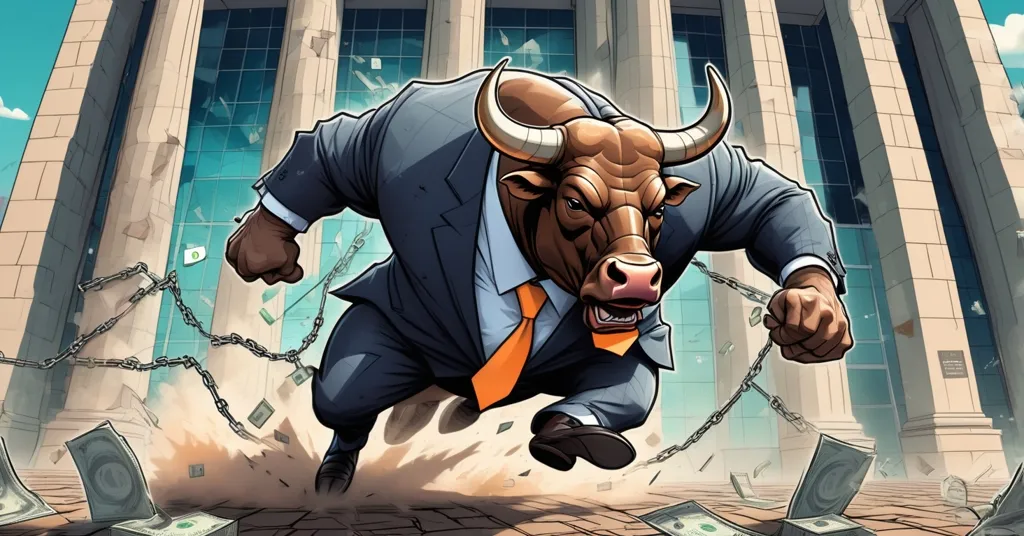
 LTB
LTB Trump Slams Wall Street Titans: $5 Billion Lawsuit Against JPMorgan and Beyond
Donald Trump has stormed back into the White House in 2025, and he’s not wasting time picking fights with Wall Street’s heaviest hitters. Leading with a jaw-dropping $5 billion lawsuit against JPMorgan Chase and its CEO Jamie Dimon, Trump is accusing major banks—including Capital One, Bank of America, and Goldman Sachs—of shutting down or refusing his accounts due to pure political bias. This clash isn’t just courtroom drama; it’s a high-stakes power struggle with ripples that could shake traditional finance and even touch the world of Bitcoin and decentralized tech.
- Blockbuster Lawsuit: Trump targets JPMorgan with a $5 billion claim over alleged political discrimination in account closures.
- Wall Street on Blast: Capital One, Bank of America, and Goldman Sachs face similar accusations of bias and policy clashes.
- Double-Edged Policy: While suing banks, Trump’s team prepares $200 billion in capital relief for the same industry.
A Personal Vendetta or Legitimate Grievance?
Trump’s legal offensive hinges on a raw accusation: these financial giants aren’t playing by financial rules but by political ones. Against JPMorgan, the claim is that they closed his personal and business accounts not for any breach of terms, but because of who he is—a polarizing figure whose views don’t align with Wall Street’s often establishment-leaning ethos. The net widens to Capital One, where Trump’s businesses allegedly faced account terminations for similar reasons, Bank of America, which he claims refused to even open accounts (pointing fingers at CEO Brian Moynihan), and Goldman Sachs, where Trump has publicly slammed CEO David Solomon over the bank’s critical stance on his tariff proposals. This isn’t a quiet grievance filed in the shadows; it’s a loud, public declaration of war on centralized financial power—something that resonates, intentionally or not, with the ethos behind Bitcoin. For more on this escalating battle, check out the detailed coverage on Trump’s clash with major banking giants.
JPMorgan hasn’t taken the punch lying down. Their response is clear and defiant:
“We believe the suit has no merit. We respect the President’s right to sue us and our right to defend ourselves. JPMC does not close accounts for political or religious reasons,”
stated a spokesperson. Yet, the bad blood between Trump and Dimon runs deeper than a mere policy spat. Back in 2018, Dimon threw a verbal jab, claiming he could outrun Trump in an election, only to be met with a brutal online comeback where Trump called him
“a poor public speaker and a nervous mess.”
That feud has simmered into 2025, with Trump taking aim at Dimon’s motives on issues like credit card interest rate caps, quipping,
“Jamie Dimon probably wants higher rates. Maybe he makes more money that way.”
Dimon, meanwhile, hasn’t minced words either, criticizing Trump’s idea of capping rates at 10%—a move that would gut a key revenue stream for banks—and warning against a suggested criminal probe into Federal Reserve Chairman Jerome Powell. This is less a handshake between titans and more a street fight with billions on the line.
Regulatory Relief: A Gift Wrapped in a Fistfight
Here’s where the plot thickens to a near-absurd degree. Even as Trump drags these banks through the legal mud, his administration is rolling out a red carpet for them. Federal regulators are gearing up to release up to $200 billion in capital relief, a deregulatory move that would loosen the reins on how much cash banks must hold in reserve. This essentially frees up massive funds for lending, risky investments, or mergers while scaling back government oversight—think of it as unlocking a vault banks couldn’t touch before, handing them a war chest to play with. White House spokesman Kush Desai touted this as a win for the economy, stating,
“The Trump administration is delivering by shoring up financial markets and cutting unnecessary red tape to accelerate growth.”
But let’s not kid ourselves: is Trump playing both avenger and benefactor, suing banks for bias while gifting them a financial jackpot? The contradiction smells stronger than a bad trade on a leveraged altcoin.
For those new to financial lingo, capital relief means banks can do more with less restriction—like having fewer rules on how much emergency cash they must keep, allowing them to pump billions into loans or speculative bets. Supervisory oversight, on the other hand, is the government’s way of keeping tabs on banks to prevent another 2008-style meltdown. Slashing it might boost profits short-term, but skeptics warn it’s a gamble that could backfire if banks overreach. Could this relief make banks bolder, or just set the stage for the next big crash? Either way, it’s a hell of a carrot to dangle while swinging a $5 billion stick.
Banks Fight Back with Cash, Not Just Words
Wall Street isn’t sitting on its hands waiting for Trump’s next move. In Q4 of 2025, the top eight banks shelled out nearly $12 million on lobbying—a 40% spike from the same period in 2024—to bend policy in their favor. Their targets? Everything from swipe fees (those pesky charges merchants pay for card transactions) to cryptocurrency regulation. That’s right—traditional finance is eyeing Bitcoin and decentralized finance (DeFi) with a mix of fear and loathing, desperate to keep their grip on the money game. They’ve even backed a shiny new advocacy group, the American Growth Alliance, launched in December 2025 under the Financial Services Forum, to push what they call “commonsense” growth policies. Translation: rules that keep their throne intact while innovations like Bitcoin chip away at their foundation. Twelve million bucks to grease the wheels of power—meanwhile, Bitcoin’s code doesn’t need a lobbyist to make its case.
Industry voices aren’t exactly cheering from the sidelines. Todd Baker, a fellow at Columbia University, pointed out the strain of this chaotic environment, noting,
“The industry is losing as many battles as it wins on big issues, and the constant pressure and random nature of developments is taking its toll.”
Nicholas Anthony from the Cato Institute doubled down, suggesting banks might turtle up to dodge both legal blows and regulatory whiplash:
“Banks probably will be more cautious moving forward after seeing this reaction, seeing that they’re no longer just under threat of regulatory retaliation but also lawsuits.”
If banks start playing defense, will they shy away from blockchain partnerships or double down on stifling crypto through policy? That’s a question with stakes as high as a Bitcoin halving rally.
Cryptocurrency in the Crosshairs: Banks vs. Bitcoin
Let’s zoom in on the crypto angle, because this banking-political slugfest isn’t just about Trump’s ego or Wall Street’s bottom line—it’s a skirmish in the broader war over the future of money. Banks ramping up lobbying to shape cryptocurrency regulation isn’t a sidebar; it’s a direct shot at decentralized systems like Bitcoin that threaten their centuries-old monopoly. What might they push for in 2025? Think stricter Know-Your-Customer (KYC) and Anti-Money-Laundering (AML) rules that could force crypto exchanges to delist privacy-focused coins or block self-custody wallets—tools at the heart of Bitcoin’s promise of financial sovereignty. They could also lobby for bans on stablecoins or restrictions on mining operations, citing “energy concerns” while ignoring their own carbon-heavy infrastructures. This isn’t speculation out of thin air; look at past moves like the 2021 OCC guidance on crypto custody, where banks hesitated under regulatory pressure. History shows they’ll fight tooth and nail to keep control.
But here’s the flip side: Trump’s very public brawl with these institutions might be the best ad campaign Bitcoin never paid for. Every time he exposes centralized banking’s flaws—whether it’s alleged bias or sheer arrogance—he’s indirectly making the case for a system that doesn’t bow to CEOs or presidents. Bitcoin doesn’t care about your politics; it’s code, not opinion. Yet, we must temper the optimism. Trump’s history with crypto is a mixed bag—calling it a “scam” one day, hinting at its potential to undermine the dollar the next. His fight is personal, not ideological. Don’t expect him to hoist the orange flag of BTC maximalism anytime soon. Still, if banks grow risk-averse amid lawsuits and political heat, as experts like Anthony predict, could that hesitation create breathing room for blockchain innovation to outpace them? It’s a long shot, but stranger things have happened in this space.
For the uninitiated, decentralized finance (DeFi) refers to financial systems built on blockchain tech—think lending, borrowing, or trading without a bank as middleman. Bitcoin, the OG of crypto, operates on a peer-to-peer network where no single entity calls the shots, unlike traditional banks answerable to shareholders and regulators. When banks lobby against crypto, they’re not just protecting profits; they’re guarding a worldview where they’re indispensable. Trump’s drama, intentionally or not, cracks that facade open for scrutiny—something any decentralization advocate can smirk about, even if the man himself isn’t chanting “HODL.”
Playing Devil’s Advocate: Whose Side Are We On?
Let’s take a hard look at both sides with no rose-tinted glasses. Is Trump’s lawsuit a righteous stand against biased institutions, or just a billionaire’s tantrum to distract from deeper policy missteps? Five billion dollars is a loud number, but personal grudges don’t always equate to systemic reform. If he wins—or even settles—will it change how banks wield power, or just pad his narrative as the underdog? On the other hand, banks claiming “no political bias” sounds noble, but when billions are at stake, neutrality often bends to whoever screams loudest. Their history of bending to political winds—like deplatforming controversial figures under public pressure—doesn’t exactly scream impartiality.
Now, let’s flip the script on the crypto angle. Sure, banks tightening the screws on regulation could choke Bitcoin’s growth, pushing exchanges underground or scaring off mainstream adoption. But couldn’t their caution also be a boon? If they retreat from blockchain experiments out of fear of lawsuits or regulatory unpredictability, smaller, nimbler players—think startups or open-source devs—might fill the gap, accelerating decentralized solutions free from corporate baggage. And let’s not forget: banks might eventually pivot. If Bitcoin’s adoption keeps climbing (Chainalysis pegged global crypto usage at over 300 million users in 2023), Wall Street could shift from foe to reluctant friend, integrating blockchain to stay relevant. Don’t hold your breath, though—their track record on innovation isn’t exactly Satoshi-level.
Key Questions and Takeaways on Trump, Banks, and Bitcoin’s Future
- What fuels Trump’s $5 billion lawsuit against JPMorgan and other banks?
Trump accuses JPMorgan, Capital One, and Bank of America of closing or refusing accounts due to political bias, while targeting Goldman Sachs over policy disagreements like tariffs—a personal and political grudge against centralized financial power. - How does Trump’s administration aid banks amid this legal storm?
Federal regulators are poised to unlock $200 billion in capital relief, easing rules on lending and investments, which could massively boost bank profits despite ongoing lawsuits. - Why are banks lobbying so intensely, especially on cryptocurrency regulation?
With lobbying spend spiking 40% to $12 million in Q4 2025, banks aim to influence rules on swipe fees and crypto regulation, fearing Bitcoin and DeFi could dismantle their dominance over traditional finance. - How could this clash impact Bitcoin and blockchain innovation?
Banks may grow cautious, slowing partnerships with blockchain projects or pushing restrictive policies, but this conflict also exposes flaws in centralized systems, potentially driving interest toward Bitcoin’s decentralized alternative. - Does Trump’s fight indirectly bolster decentralization advocates?
Possibly—his battle highlights vulnerabilities in centralized banking, aligning with Bitcoin’s mission of financial freedom, though his focus remains on personal scores rather than explicit support for crypto.
Trump versus Wall Street is a high-stakes hash race with no clear block winner in sight. On one side, his deregulatory push could empower banks to crush crypto through lobbying muscle, fortifying their grip on finance. On the other, his relentless attacks spotlight the cracks in centralized power that Bitcoin was built to bypass. Between billion-dollar lawsuits, policy chess moves, and the old guard’s scramble to cage decentralized tech, the battle for the future of money—fiat or blockchain—has rarely felt more urgent. If this feud shakes the financial establishment hard enough, 2025 might just be the year Bitcoin proves it doesn’t need permission to rewrite the rules. Stick around—this is one chain of events you won’t want to miss.