Trump’s China Visit Fuels Bitcoin and XRP Volatility, But XRP Power Raises Red Flags
 LTB
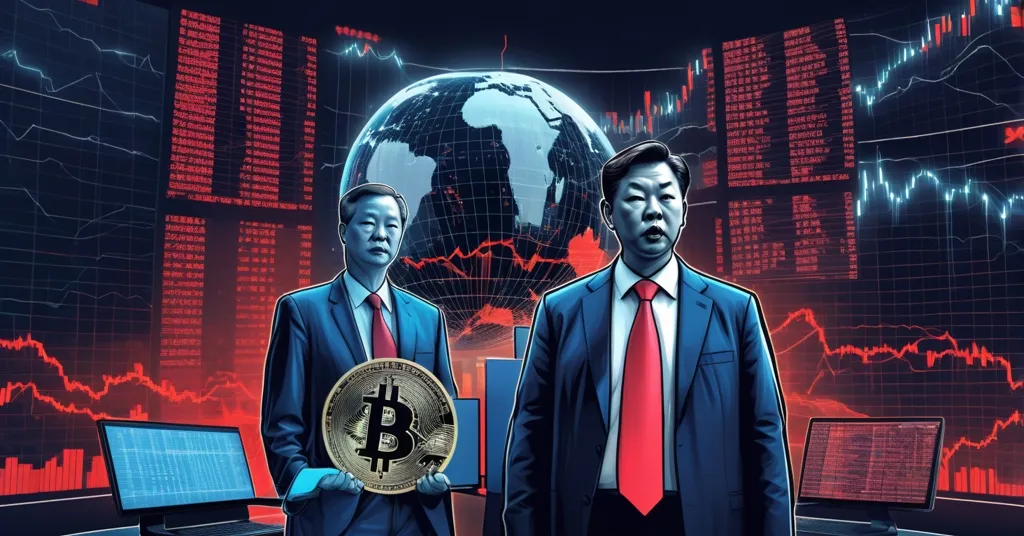
LTB Trump’s visit to China has stirred volatility across global financial markets, and crypto is once again trying to turn macro chaos into a trade. Bitcoin and XRP have both seen renewed attention, but the bigger noise here is a third-party pitch for an AI-driven platform called XRP Power, which is using the market backdrop to sell shiny promises and suspiciously tidy returns.
- Trump’s China visit is being used as a catalyst for market volatility.
- Bitcoin and XRP have seen renewed trading interest as sentiment shifts.
- XRP Power is pitched as an AI-powered digital asset platform.
- Fixed return examples deserve heavy skepticism, not applause.
- Third-party content means this promotion is not endorsed by crypto.news.
Global headlines still move crypto
Trump’s recent visit to China has once again become the focus of global financial markets. That matters because markets hate uncertainty almost as much as traders love pretending they can price it in. When geopolitics gets messy, risk appetite shifts, liquidity moves around, and assets like Bitcoin, XRP, stocks, and gold all start acting like they’ve had too much coffee.
The basic idea is simple: tension between the U.S. and China can make investors nervous, and nervous money tends to chase volatility. Sometimes that pushes capital into Bitcoin as a speculative hedge or macro asset. Sometimes it lifts XRP when traders rotate into assets with strong narrative momentum. Sometimes it just makes everyone stare at charts like they owe them money.
The market framing here links Trump’s China trip and the broader US-China summit narrative to renewed activity in Bitcoin and XRP, with the suggestion that overall crypto trading volume has continued to recover. That part is not far-fetched. Crypto often responds to shifts in global risk sentiment. What matters is separating real market movement from marketing spin, especially when headlines like this one get recycled into product promotion.
What XRP Power is actually selling
That’s where XRP Power enters the picture. The platform is described as an AI-based digital asset system built around automation, real-time data analysis, multi-layer risk control monitoring, global app services, and automated earnings synchronization. In less polished language, it is being sold as a hands-off crypto income machine powered by software that supposedly does the work for users.
For readers not steeped in this kind of jargon, “earning contracts” usually means a product that claims to pay returns over a fixed period after users lock up funds. It is not the same thing as simply trading Bitcoin or holding XRP in a wallet. It is closer to a yield product, and whenever a platform starts promising neat daily payouts with glossy AI branding, the alarm bells should be loud enough to wake the neighbors.
The pitch also says new users can register by email and receive $21 in trial funds. That kind of offer is a classic onboarding hook. Give people a tiny taste, lower the barrier to entry, then try to move them toward deposits. In crypto, free trial funds are often less about generosity and more about funneling users into a sales pipeline dressed up like a fintech app.
The return claims are the problem
Here’s where the pitch really starts to wobble.
The platform advertises “popular AI-powered earning contracts” with highly specific return tables. One example is DOGE [AI Intelligent Quantification], which reportedly takes a $10,000 investment for 20 days, pays $153 per day, totals $3,060 in earnings, and returns the $10,000 principal at maturity. Another is BTC/BCH [AI Global Smart Ecosystem], which supposedly requires $50,000 for 27 days, pays $860 per day, generates $23,220 in total earnings, and also refunds the principal at the end.
That is not conservative yield. That is sales copy in a tuxedo.
Whenever a platform presents fixed or highly specific daily earnings in crypto, a healthy skeptic should ask three basic questions: where is the yield coming from, how is it sustainable, and what happens if the platform stops paying? High returns are usually high risk. If they are not high risk, then the burden is on the platform to prove exactly how the money is being made.
And let’s be blunt: promises like “principal refund at maturity” do not magically make a product safe. If the business model is junk, a refund claim is just a nice sentence wrapped around a bad idea. Plenty of crypto schemes have promised smooth payouts right up until the music stopped and the exit doors got crowded.
AI is not a magic spell
“AI” is doing a lot of heavy lifting in this pitch, as it does in far too many crypto promotions these days. Real AI tools can absolutely help with data analysis, trading automation, monitoring, and operational efficiency. That part is real. But the moment a platform uses AI as a blanket excuse for generous returns, the marketing starts to smell like old gym socks sprayed with perfume.
Claims like “intelligent automation,” “transparent operating models,” and “smart ecosystem” are easy to say and hard to prove. They are also nearly meaningless without verifiable proof of reserves, audited performance, clear counterparty risk disclosure, and a plain-English explanation of how returns are generated. Buzzwords are cheap. Accountability is not.
That does not mean every AI-based crypto product is a scam. It does mean readers should distinguish between useful automation and magical thinking. A bot can execute trades. It cannot repeal market risk. It can optimize processes. It cannot turn nonsense yields into financial science.
Bitcoin and XRP still react to macro shifts
Bitcoin and XRP have different market personalities, even if they often get bundled together in speculative headlines. Bitcoin tends to act as the anchor asset in the crypto market, often attracting flows when traders want the most liquid, recognizable exposure. XRP tends to be more narrative-driven, with traders reacting to payment-sector developments, legal headlines, exchange flows, and relative strength against BTC.
So when the headline says XRP/BTC could continue to rise after the US-China summit, the idea is basically that XRP might outperform Bitcoin for a stretch if traders rotate into higher-beta plays. That can happen. It does happen. But relative strength is not a prophecy, and one geopolitical event does not guarantee a clean trend.
What macro events do create is opportunity and noise. Bitcoin can benefit from both. XRP can, too. But neither asset is immune to the same old market truth: prices move for many reasons, and traders are often the last ones to admit they are mostly guessing with cleaner graphics.
The disclosure matters
There is one detail that should not be buried: this content is third-party provided and not endorsed by crypto.news or the author. That matters because it tells readers exactly what they are looking at — not neutral analysis, but a promotional piece using a real market event as a hook.
That distinction is important. Trump’s China visit may indeed have influenced global financial markets and crypto sentiment. Bitcoin and XRP may well have seen renewed activity. But none of that validates an AI yield platform advertising tidy returns and principal refunds. One is macro context. The other is a sales pitch.
Readers should treat those as separate conversations. Mixing them together is how bad products borrow credibility from real headlines.
Why the warning signs are obvious
Digital assets, stocks, gold, and basically every other market instrument can be volatile. That part of the warning is true, and it should be taken seriously. Anyone participating in crypto should understand contract terms, counterparty risk, lockup periods, and the possibility that “earnings” are only as real as the platform behind them.
Before putting money into any digital asset or smart contract product, a few red flags deserve immediate attention:
- Guaranteed or near-guaranteed daily returns
- Principal refund promises without a strong balance sheet and audited backing
- Heavy AI buzzword usage with little technical transparency
- Trial funds or bonuses used to lower skepticism
- Overly neat payout tables that look more like ad copy than finance
These are not minor concerns. They are the kind of signals that usually show up before something goes sideways. In crypto, you do not need to be paranoid. You do need to be literate in bullshit.
- Why is crypto getting renewed attention?
Because global market volatility tied to Trump’s China visit and broader US-China tensions is affecting risk sentiment across Bitcoin, XRP, and other assets. - What is XRP Power claiming to be?
It is presented as an AI-powered digital asset platform offering automation, risk controls, global app access, and preset earning contracts. - Are the advertised returns believable?
They should be treated with serious skepticism. Fixed daily payouts and principal refund claims are classic red-flag territory in crypto promotions. - Does AI make a crypto product safe?
No. AI can improve automation and analysis, but it cannot eliminate market risk or make unrealistic returns sustainable. - Does macro news prove the platform is legitimate?
Absolutely not. Geopolitical headlines can move Bitcoin and XRP, but they do not validate a third-party yield pitch. - What should users check before participating?
The rules, fee structure, payout source, lockup terms, legal entity, and any independent proof that the product does what it claims.
Trump’s China visit may have added fuel to global financial market volatility, and that can spill into Bitcoin, XRP, and the XRP/BTC pair. But the real story here is how quickly legitimate macro headlines get used as camouflage for aggressive crypto marketing.
Bitcoin and XRP can both benefit from changing sentiment. That part is real. XRP Power’s neat little return tables? Not nearly real enough to trust on sight. In crypto, volatility is normal. Nonsense dressed up as innovation is also normal. The difference is that one can be traded, while the other just empties wallets.