Turkey’s 10% Crypto Tax, Near Protocol’s 38% Surge, and DeepSnitch AI Hype Unpacked
 LTB
LTB Turkey Crypto Tax, Near Protocol Surge, and DeepSnitch AI Hype: Navigating Crypto’s Latest Chaos
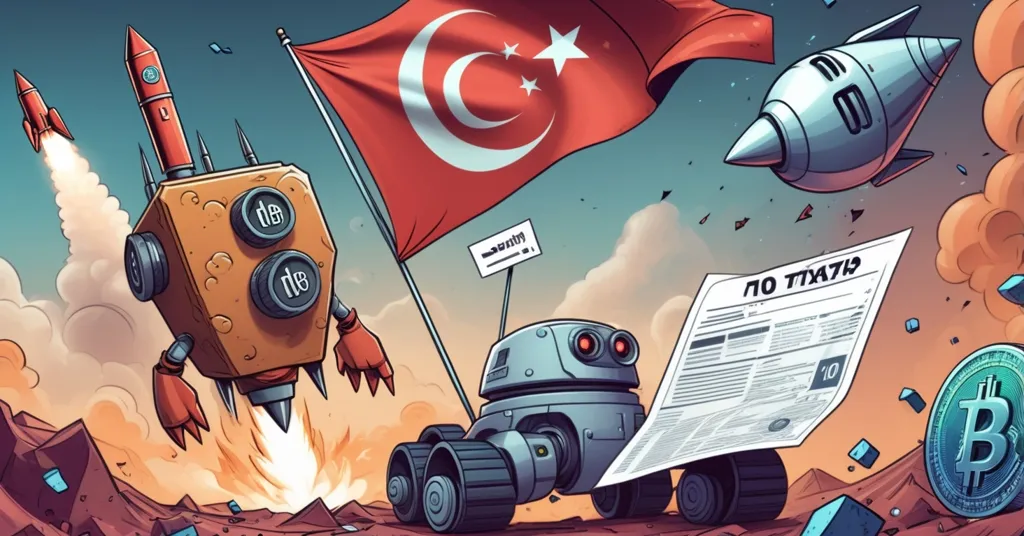
Turkey’s proposed 10% crypto tax, altcoin rallies like Near Protocol’s 38% spike, and the speculative frenzy around DeepSnitch AI’s presale are shaking up the cryptocurrency world. Let’s cut through the noise and dissect what’s driving these developments, their implications, and the risks lurking beneath the surface.
- Turkey’s Tax Push: A 10% tax on crypto income, adjustable from 0-20%, plus a 0.03% transaction levy under consideration.
- Altcoin Momentum: Near Protocol (NEAR) up 38% and Hyperliquid (HYPE) up 21% in a week despite market uncertainty.
- DeepSnitch AI Buzz: Presale raises $1.8M with DSNT token at $0.04228, hyped for potential 300% returns.
Turkey’s Crypto Tax Proposal: Regulation or Overreach?
Turkey’s ruling Justice and Development Party has put forward a draft bill that could slap a 10% tax on cryptocurrency income and trading gains. This isn’t set in stone—the president holds the power to adjust the rate anywhere from 0% to 20%, allowing the government to tighten or relax its grip on crypto traders based on economic or political needs. On top of that, a 0.03% transaction levy might apply to service providers, likely translating to higher fees for users on local platforms. Currently under review by the Turkish Grand National Assembly, this proposal marks a significant shift for a country where crypto adoption has skyrocketed as a hedge against rampant inflation and the lira’s devaluation.
For context, Turkey ranks among the top globally for crypto usage, with estimates suggesting over 40% of the population has engaged with digital assets in some form, driven by economic instability. The lira has lost over 80% of its value against the dollar in the past five years, making Bitcoin and altcoins a lifeline for many. But this tax could throw a wrench into that escape plan. On one hand, formalizing crypto through taxation might attract institutional investors who crave regulatory clarity, lending legitimacy to the space. On the other, it risks alienating a community rooted in decentralization and freedom from government overreach. Will traders comply, or will capital flight to offshore exchanges and black-market trading spike? Look at India’s 30% crypto tax—adoption slowed, and many moved funds to less regulated jurisdictions. Turkey could face a similar exodus.
Globally, this fits a broader pattern of governments trying to cash in on crypto’s growth while wrestling with control. Compare it to Portugal, once a tax haven for crypto with no capital gains tax on personal holdings, now tightening rules under EU pressure, or the US, where the IRS hunts crypto gains with ruthless precision. Turkey’s adjustable rate is a wildcard—potentially a tool to balance innovation with revenue, or a blunt instrument to crush retail enthusiasm while big players dodge through loopholes. As champions of decentralization, we see this as a direct challenge to crypto’s ethos. Sure, taxes fund public goods, but when they’re wielded as a leash, they undermine the very rebellion against centralized finance that Bitcoin birthed.
Altcoin Rally: Near Protocol and Hyperliquid in Focus
While regulatory clouds gather, the altcoin market is flashing green with unexpected vigor. Near Protocol (NEAR), a layer-1 blockchain—think of it as a foundational network running its own independent system, like a primary highway for transactions—surged 38% in a single week, climbing from $0.97 on February 25 to $1.34 by March 3. Designed to rival Ethereum with faster transactions and lower fees, NEAR has gained traction among developers for its user-friendly infrastructure. Recent partnerships, like integrations with DeFi protocols and NFT platforms, plus a growing ecosystem of dApps (decentralized applications), likely fueled this spike, though hard data on transaction volume or active users remains elusive without real-time chain analytics.
Not far behind, Hyperliquid (HYPE) notched a 21% gain, rising from $26.50 to $31.88 over the same period. HYPE focuses on decentralized perpetual futures trading—a type of financial contract in crypto markets where traders bet on price movements without an expiration date, often with high leverage. It’s a niche within DeFi (decentralized finance), catering to risk-hungry speculators. While specific catalysts for HYPE’s rally are unclear, increased trading volume on its platform and broader altcoin recovery sentiment likely played a role. These gains stand out in a market where Bitcoin itself struggles to break key resistance levels, hovering with uncertainty.
For the uninitiated, altcoins—cryptocurrencies other than Bitcoin—often swing wildly based on short-term hype, niche utility, or FOMO (fear of missing out) rather than bedrock fundamentals. Are these surges a sign of lasting value, or just another speculative bubble set to pop? I’m skeptical. NEAR’s tech shows promise for scaling solutions Ethereum can’t match, and HYPE’s DeFi niche taps a real demand for derivative products without centralized exchanges. But without sustained adoption or clear metrics—say, NEAR hitting a million daily transactions or HYPE locking significant liquidity—these could be fleeting pumps. And let’s not forget: while altcoins steal the spotlight for a week, Bitcoin remains the only truly battle-tested store of value in this speculative circus. Altcoins fill gaps BTC doesn’t, sure, but they’re often a distraction from the core mission of unassailable, decentralized money.
DeepSnitch AI: Innovation or Overhyped Gamble?
Enter DeepSnitch AI, the latest project grabbing headlines with promises of revolutionizing crypto through artificial intelligence. Currently in its 6th presale stage, it’s raised over $1.8 million, with its token DSNT priced at $0.04228, a steep climb from its initial $0.01510. For newcomers, a presale is an early fundraising round where investors snag tokens at a discount before they hit public exchanges, banking on huge profits if the project succeeds. DeepSnitch AI markets itself as a game-changer with tools like AuditSnitch, an AI system to analyze token contracts for scams or vulnerabilities, and SnitchGPT, a chatbot offering real-time market insights. A sleek dashboard ties it together, pitched as a one-stop shop for navigating crypto’s chaos, whether you’re a rookie or a veteran.
They’re dangling carrots like the DSNTVIP50 bonus—invest $5,000, and you’ll net 177,000 tokens with extra allocation thrown in. The hype machine is in overdrive, with speculative forecasts of 300% returns once DSNT lists. Sounds juicy, right? Not so fast. Let’s cut the bullshit: these predictions are pure guesswork, fueled by presale momentum and slick marketing, not proven performance. For more on the speculative buzz surrounding this project, check out the detailed analysis on DeepSnitch AI’s price predictions and market trajectory. The presale space is a swamp of broken dreams—think back to the 2017-2018 ICO (Initial Coin Offering) boom, where countless projects hyped big, raised millions, then vanished with investor funds. DeepSnitch AI’s own disclaimers scream caution, and for good reason. Without transparency on the team’s background, token distribution (how much is locked for devs versus public?), or a detailed roadmap, this smells like a gamble dressed in AI buzzwords.
Could their tools have real value? Possibly. AI-driven scam detection and market analysis address genuine pain points in a space plagued by rug pulls (scams where developers abandon a project after raising funds) and misinformation. Tools like Chainalysis already track illicit activity on blockchains, so the concept isn’t new—but a user-friendly, retail-focused version could carve a niche. Yet, without proof of execution or adoption, banking on a 300% ROI is blind optimism that often ends in heavy losses. We’re all for tech that disrupts the status quo, but not when it’s peddled with unproven promises. If DeepSnitch AI delivers, it could be a win for decentralization. If not, it’s just another name on crypto’s long list of flops.
Bitcoin’s Place Amid the Chaos
So where does Bitcoin, the OG of decentralization, fit into this mess of taxes, altcoin pumps, and AI hype? As Turkey’s tax proposal looms, BTC’s borderless nature becomes even more appealing—a middle finger to localized overreach. No government can fully tax or seize what they can’t control, especially with self-custody and privacy tools in play. Altcoin rallies like NEAR and HYPE might grab headlines, but they often distract from Bitcoin’s core strength: an unshakeable, censorship-resistant store of value that’s survived over a decade of attacks, hacks, and FUD (fear, uncertainty, doubt). Even speculative presales like DeepSnitch AI indirectly highlight BTC’s reliability—while altcoins and untested tokens chase moonshot dreams, Bitcoin remains the bedrock of this financial revolution.
That said, we can’t ignore the ecosystem’s diversity. Altcoins and innovative protocols fill niches Bitcoin shouldn’t or can’t serve, like scalable smart contracts or niche DeFi products. Regulatory pressures might even push more capital into BTC as a safe haven, though they also fuel speculative plays in less-regulated corners. Our maximalist lean says Bitcoin is king, but effective accelerationism means cheering any tech that hastens the collapse of centralized systems—provided it’s not snake oil. The trick is separating signal from noise, and right now, the noise is deafening.
Key Questions and Takeaways
- What does Turkey’s proposed 10% crypto tax mean for the market?
It signals a push for formal regulation in a high-adoption nation, potentially curbing retail enthusiasm or driving trading underground. Adjustable rates (0-20%) and transaction levies could set a global precedent, balancing legitimacy with risks of capital flight. - Are Near Protocol and Hyperliquid’s gains sustainable?
Probably not. Their respective 38% and 21% weekly spikes likely stem from short-term hype and market recovery rather than lasting fundamentals. While NEAR’s scalability and HYPE’s DeFi niche show promise, sustained adoption is unproven. - Should investors jump on DeepSnitch AI’s 300% return hype?
Approach with extreme caution. These forecasts are speculative, lacking evidence, and presales are notorious for scams. Despite promising AI tools for scam detection and market insights, unproven execution makes this a high-risk bet. - How does regulatory uncertainty shape crypto trends?
Moves like Turkey’s tax create hesitancy in regulated regions, often pushing capital toward speculative or unregulated projects like presales. This amplifies both opportunity and risk, splitting focus between safe havens like Bitcoin and volatile gambles. - Can AI crypto projects like DeepSnitch AI drive real adoption?
They could, if tools like AuditSnitch and SnitchGPT solve real issues such as scam prevention and data overload. But only transparency and proven utility will distinguish them from empty hype in a crowded, skeptical market.
Navigating crypto today feels like walking a tightrope over a pit of regulatory traps, speculative spikes, and outright scams. Turkey’s tax grab could be a blueprint for global crackdowns, testing the resilience of a borderless ethos. Altcoin rallies remind us that innovation—or at least the illusion of it—can ignite markets, even if briefly. And projects like DeepSnitch AI embody the double-edged sword of potential and peril that defines this space. As advocates for decentralization and rapid progress, we stand firm on Bitcoin’s supremacy while recognizing the chaotic beauty of altcoins and emerging tech filling unique gaps. But let’s not kid ourselves—hype is a drug, and sobriety is survival. Will Turkey’s move kill crypto’s spirit, or is it the wake-up call we need to fight harder for freedom? The game never sleeps.