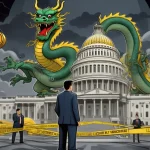
UAE’s $500M Stake in Trump-Linked WLFI Crypto Project Sparks Security Concerns

 LTB
LTB Warren and Kim Demand Answers on UAE’s $500M Stake in Trump-Linked Crypto Project WLFI
A staggering $500 million investment from a UAE government-linked tech giant into World Liberty Financial (WLFI), a cryptocurrency venture tied to the Trump family, has ignited a firestorm in Washington. Senators Elizabeth Warren and Andy Kim, both Democrats on the Senate Banking Committee, are pushing for a national security review, citing risks of foreign influence, data breaches, and geopolitical entanglements that could undermine U.S. interests in a deal dripping with ethical and political controversy.
- Massive Investment: UAE’s G42 secures a 49% stake in WLFI for $500M, with board seats included.
- Security Red Flags: Concerns mount over foreign access to sensitive user data, with China ties in focus.
- Political Quagmire: Trump family entities net $187M, fueling conflict-of-interest accusations.
Unpacking the Deal: UAE’s G42 and Trump Family Ties
The numbers alone are jaw-dropping. G42, a UAE-based technology firm backed by Sheikh Tahnoon bin Zayed Al Nahyan—national security adviser and manager of the country’s largest sovereign wealth fund—has poured $500 million into World Liberty Financial (WLFI), snagging a 49% stake. An upfront payment of $250 million was wired, with roughly $187 million funneled to Trump family entities and at least $31 million directed to firms linked to Steve Witkoff, a WLFI co-founder and President Donald Trump’s special envoy to the Middle East. The deal, signed by Eric Trump via an entity named Aryam Investment 1 just days before his father’s second inauguration in January 2025, also hands two board seats to senior G42 executives, giving the UAE outfit significant influence over this murky crypto project.
Let’s zoom in on G42 for a moment. This isn’t just a run-of-the-mill tech company; it’s a state-backed juggernaut with deep roots in artificial intelligence, surveillance technology, and data analytics—sectors that already raise eyebrows when tied to authoritarian regimes. Sheikh Tahnoon’s involvement amplifies the stakes, as his dual role in national security and wealth management blurs the line between business and statecraft. When a player like this invests half a billion in a U.S.-based crypto venture, it’s not just capital—it’s a potential foothold into American digital infrastructure. The timing, so close to Trump’s return to the White House, only adds fuel to the suspicion that this deal is more than meets the eye. In fact, Senators Warren and Kim have raised serious concerns about this massive UAE investment in WLFI, pushing for thorough scrutiny.
National Security Fears: Crypto Data Risks and China Connections
For those new to the crypto game, here’s why this matters. Cryptocurrency platforms like WLFI often collect a treasure trove of user data—think wallet addresses, transaction histories, and personal details tied to real-world identities through Know Your Customer (KYC) protocols. KYC rules, meant to prevent fraud and money laundering, require users to submit ID documents or other sensitive info to verify who they are. If a foreign entity with questionable loyalties gains control or influence over such a platform, it’s like handing a stranger the keys to your digital safe. The data could be exploited for surveillance, financial manipulation, or worse, especially if it falls into the hands of adversarial governments.
Senators Warren and Kim are zeroing in on exactly this risk. In a pointed letter to Treasury Secretary Scott Bessent, they’ve called for an urgent review by the Committee on Foreign Investment in the United States (CFIUS), a government body tasked with screening foreign investments to ensure they don’t threaten national security. Their worry isn’t just about the UAE; it’s about who might be lurking behind them. U.S. intelligence has flagged G42 for its alleged role in developing technology that aids China’s military, with past connections to Chinese tech giants like Huawei and the Beijing Genomics Institute. Although G42 claims it severed these ties in early 2024, the shadow of those relationships lingers. Could American users’ financial data end up routed through Dubai to Beijing? It’s a chilling thought—and one that CFIUS is uniquely positioned to investigate.
Political Fallout: Trump Family Gains and Policy Suspicions
Beyond the national security angle, the deal screams conflict of interest at a deafening volume. With $187 million flowing to Trump family entities and Eric Trump personally signing off on the agreement, the optics are disastrous. President Trump, when questioned about the investment, dodged with a casual dismissal:
“My sons are handling that, my family is handling it … I have all I can handle right now with Iran and with Russia and Ukraine.”
Apparently, steering the ship of state leaves no time to oversee a half-billion-dollar crypto windfall for the family. Whether you take that at face value or not, the proximity of this deal to Trump’s inauguration and the involvement of his Middle East envoy, Steve Witkoff, raises glaring ethical alarms. It’s not just Warren and Kim sounding off—Rep. Ro Khanna, ranking member of the House Select Committee on Strategic Competition with China, has launched a separate investigation, demanding documents from WLFI co-founder Zach Witkoff by March 1.
Khanna’s probe cuts to an even thornier issue: potential policy-for-profit dynamics. The Trump administration recently approved UAE access to 500,000 advanced AI chips annually, a decision that’s raising eyebrows in light of this investment. Could G42’s cash have influenced U.S. tech export policies? While there’s no hard evidence of a quid pro quo, the timing and scale of both moves suggest a connection that’s hard to ignore. If true, this isn’t just about crypto—it’s about whether foreign money is shaping American strategic decisions at the highest level.
CFIUS Under Pressure: Can It Block This Deal?
So, what’s CFIUS, and why does it hold the cards here? The Committee on Foreign Investment in the United States is an interagency panel overseen by the Treasury Department, designed to vet foreign investments for risks to national security, especially in critical sectors like technology and data. It’s flexed its muscle before—think of the intense scrutiny over Chinese-owned apps like TikTok, where data privacy fears led to threats of bans or forced sales. Now, with Warren and Kim pushing hard, CFIUS is being urged to dig into whether G42’s stake in WLFI could compromise American interests.
The Senators have also pressed Treasury Secretary Bessent to pause any banking charter applications linked to WLFI—a move that could kneecap the project’s legitimacy—and to respond to their concerns by March. But CFIUS reviews aren’t quick or guaranteed to block deals. They can recommend mitigation measures, like restricting foreign board influence, or escalate to a presidential veto in extreme cases. Will WLFI face that level of heat, or will bureaucratic inertia let this slide? The clock is ticking, and the Treasury’s next steps could set a precedent for how crypto investments are policed in an era of geopolitical chess games.
Crypto’s Bigger Dilemma: Decentralization vs. Power Plays
Let’s step back and look at the forest, not just the trees. As Bitcoin maximalists, we can’t help but cringe at this mess. Satoshi Nakamoto didn’t grind out code for a decentralized future just to see crypto projects become piggy banks for political dynasties or pawns for foreign states. Bitcoin’s beauty lies in its simplicity and resistance to centralized control—no board seats, no family payouts, just pure, trustless math. Yet, we’ve got to acknowledge that altcoins and experimental ventures, even sketchy ones like WLFI, often push boundaries in ways Bitcoin doesn’t. DeFi platforms, stablecoins, and niche tokens can fill gaps in the financial revolution, sometimes brilliantly.
But here’s the rub: without transparency, WLFI is a black box. Is it a token, a lending platform, or something else entirely? There’s no public whitepaper, no clear tokenomics—meaning how the digital currency’s supply, value, or usage rules are structured. That opacity is a cardinal sin in a space built on trustless systems. Add in foreign board seats and state-backed investors, and you’ve got a recipe for disaster. Worse, scandals like this could invite regulatory sledgehammers, smothering legitimate blockchain innovation under mountains of red tape. If crypto keeps getting tangled in cronyism, expect Congress to clamp down hard—and not just on the bad actors.
Let’s play devil’s advocate for a second. Foreign investment isn’t inherently evil; UAE cash could bankroll crypto growth in ways skittish U.S. capital won’t touch. Half a billion dollars could fund infrastructure or adoption campaigns that accelerate decentralization. But without ironclad safeguards—think audited smart contracts or data encryption standards—it’s a gamble with American privacy and sovereignty. We’re all for effective accelerationism, pushing tech forward at warp speed, but not if it means selling out user trust to the highest bidder.
Key Questions on UAE-WLFI Crypto Controversy
- What national security risks does the UAE’s investment in WLFI pose?
The primary fear is foreign access to sensitive user data, like financial records or personal IDs collected via KYC, potentially exposing Americans to surveillance by the UAE or even China through G42’s past ties. - Why are Senators Warren and Kim pushing for a CFIUS review?
They’re alarmed that G42’s $500 million stake and board influence could compromise U.S. security, demanding a formal probe into foreign control over a Trump-linked crypto project. - Could this deal be linked to U.S. AI chip export policy?
Suspicion swirls around whether G42’s investment influenced the Trump administration’s approval of 500,000 AI chips annually to the UAE, hinting at a possible policy-for-profit exchange under investigation by Rep. Khanna. - Why do G42’s historical ties to Chinese firms matter?
G42’s past links to China’s military tech and companies like Huawei fuel concerns about data security and the risk of backdoor influence in U.S.-based projects, despite claims of divestment in 2024. - How does the Trump family’s involvement stoke controversy?
With $187 million flowing to Trump entities and Eric Trump signing the deal days before inauguration, ethical red flags wave high over political favoritism, despite the President’s claim of ignorance.
Closing Thoughts: Accountability in Crypto’s Wild West
The WLFI saga lays bare a brutal truth: the crypto frontier, for all its promise of freedom and disruption, remains a Wild West where opportunists and power players roam free. We champion decentralization and the Bitcoin ethos of cutting out middlemen, but stories like this—rife with foreign cash, political payouts, and murky motives—threaten to derail the very ideals blockchain stands for. G42’s half-billion-dollar bet, the Trump family’s windfall, and the specter of policy influence demand scrutiny, not shrugs. Will CFIUS slam the brakes, or is this just the opening act in a wave of crypto-political scandals? We’re watching closely, because the fight for a decentralized future must be matched by a fight for accountability—or we risk losing everything we’ve built.