US Crypto Laws Stalled, Trump PAC Gains $21.5M, Bitcoin Hits $94K Amid Retail Apathy
 LTB
LTB US Crypto Legislation Hits a Wall, MAGA Cashes In, and Trump Tokens Flop Hard
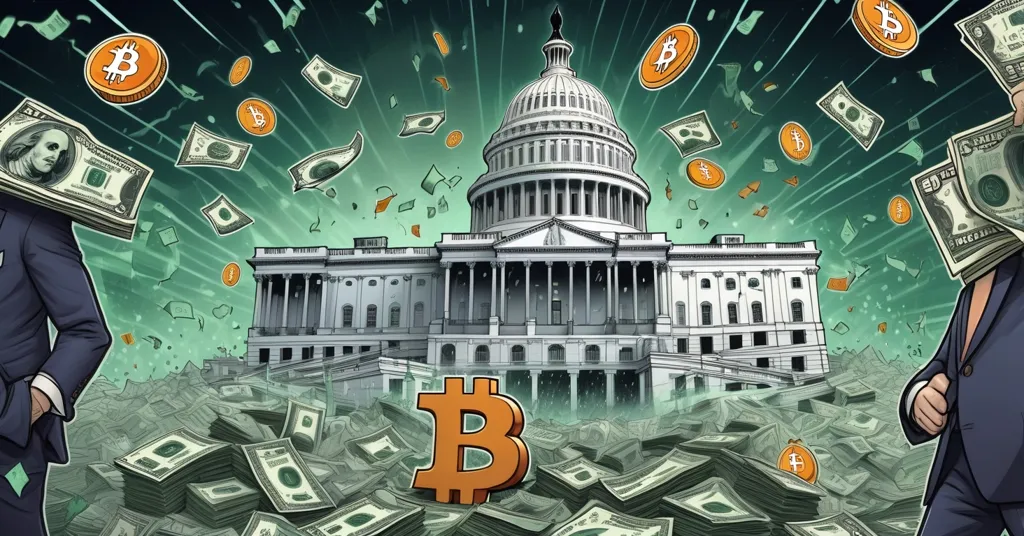
Bitcoin and the wider cryptocurrency ecosystem in the US are caught in a storm of stalled legislation, blatant political cash grabs, and a bizarre market split where prices climb but the average investor couldn’t care less. With the 2026 midterm elections casting a long shadow, a bipartisan push for clarity on digital assets, massive donations to Trump’s PAC, and regulatory overhauls are clashing with tanking Trump-branded tokens and a retail crowd that’s checked out. Is the dream of a decentralized future slipping away under the weight of partisan nonsense and personal agendas, even as Bitcoin pushes past $94,000?
- Legislative Deadlock: Bipartisan efforts on US crypto market structure face delays, possibly to 2027 or beyond.
- Political Muscle: Crypto firms dump $21.5 million into Trump’s MAGA Inc. PAC for influence.
- Market Oddity: Bitcoin surges past $94,000, but retail interest is a ghost town.
Legislative Gridlock: No Crypto Framework Until 2027?
The battle for a sane regulatory framework for digital assets in the US is looking more like a slow-motion trainwreck. Senate Banking Committee Chair Tim Scott (R-SC) has scheduled a bipartisan meeting for January 5 to tackle deep divisions over market structure legislation, followed by a markup session on January 15 (that’s a meeting where lawmakers hammer out final bill details before a vote). The core disagreements are a mess of ideological and ethical thorns. Should crypto exchanges be allowed to offer rewards on stablecoins—digital currencies pegged to stable assets like the US dollar to avoid wild price swings? Should developers behind decentralized finance (DeFi) protocols, which are blockchain-based financial systems that cut out middlemen like banks by running on automated code, be held criminally liable if their tech is exploited for fraud or crime? And here’s the kicker: should Donald Trump and his family profit from crypto ventures while regulatory barriers conveniently crumble under his administration’s influence?
Don’t expect a quick fix. Analysts at TD Cowen are betting on delays that could push the bill’s completion to 2027, with full implementation maybe not until 2029. Why the drag? Midterm elections are looming, and history shows the governing party often takes a beating in these cycles. Political appetite to tackle something as divisive as crypto regulation might just vanish when lawmakers are more focused on saving their seats. This isn’t the first time the US has fumbled crypto policy—past efforts like the FIT21 Act have similarly stalled amid partisan bickering. For an industry built on speed and decentralization, this glacial pace is beyond frustrating. It’s a stark reminder that while blockchain doesn’t wait for permission, innovation might still get choked by red tape. While lawmakers squabble, the crypto world isn’t sitting idle—it’s buying influence at the highest levels.
Crypto’s Political Gambit: $21.5 Million to Trump’s MAGA Inc.
The crypto industry is playing hardball in the political arena, and the numbers are jaw-dropping. Foris Dax, the parent of Crypto.com, and Gemini Trust Company, founded by the Winklevoss twins, have poured $21.5 million into MAGA Inc., Donald Trump’s political action committee. Foris Dax led with a hefty $20 million, while Gemini chipped in $1.5 million in USDC, a widely-used stablecoin. This isn’t a sudden fling—Crypto.com dropped $10 million as recently as February 2025, and the Winklevoss brothers have been consistent Trump backers since June 2024, also funneling cash into pro-crypto PACs like Fairshake. MAGA Inc. now boasts a $300 million war chest, which raises eyebrows since Trump isn’t on the 2026 ballot and can’t run in 2028 due to term limits. So, what’s the game plan? Is this a slush fund to prop up proxy candidates who’ll push deregulatory agendas, or just a long-term bet on keeping crypto-friendly policies alive through MAGA’s influence?
Let’s not sugarcoat it: this reeks of buying influence. Crypto firms see Trump as their ticket to a regulatory free-for-all, and they’re willing to pay top dollar for it. On the flip side, some argue this is just survival—after years of SEC crackdowns labeling tokens as unregistered securities, the industry might feel forced to fight fire with fire. But when millions flow to one political camp, it risks tainting the ethos of decentralization with cronyism. Bitcoin was born to disrupt centralized power, not to cozy up to it. Whether this gamble pays off remains to be seen, but the regulatory landscape is already tilting in their favor.
Regulatory Shakeup: SEC Goes Full GOP, CFTC Embraces Crypto
The regulatory ground is shifting fast under crypto’s feet. The Securities and Exchange Commission (SEC), which oversees securities and has long targeted crypto projects it views as unregistered investments, is now a GOP-only body after Democrat-appointed Commissioner Caroline Crenshaw stepped down on January 2. Crenshaw didn’t go quietly, blasting the current leadership for reckless deregulation.
“The SEC’s current leadership’s appetite to deregulate has been rapacious. The analysis of the costs and benefits of our policies has been nonexistent. And the repercussions, I could argue, could be dire,”
she warned. Her fears seem spot-on as SEC Chair Paul Atkins has already axed major enforcement actions against heavyweights like Coinbase (NASDAQ: COIN), Binance, and entrepreneur Justin Sun. Ranking House Financial Services Committee member Maxine Waters (D-CA) is demanding hearings on these unilateral moves, but with GOP dominance, don’t bet on much resistance. The message is clear: the SEC’s once-iron fist on crypto is loosening, and fast.
Meanwhile, the Commodity Futures Trading Commission (CFTC), which regulates commodities like Bitcoin futures and often takes a softer stance, is doubling down on a pro-crypto vibe. Newly confirmed Chair Michael Selig appointed Amir Zaidi as chief of staff on December 31, touting his role in launching Bitcoin futures during Trump’s first term. Selig expects Zaidi to help craft regulations suited for evolving markets—a polite way of saying “let’s not scare off innovation.” For industry players, this is a dream scenario after years of regulatory whiplash. But critics, including Crenshaw, warn it could open the door to a Wild West of scams and unchecked speculation. Bitcoin maximalists might shrug—BTC doesn’t need permission to thrive—but for altcoins and DeFi projects, this tug-of-war between freedom and oversight could make or break their future.
Market Paradox: Bitcoin Surges to $94,000, Retail Stays Away
On the market front, Bitcoin has fought its way above $94,000 as of January 5, up from sub-$90,000 levels in December. That’s a win on paper, but dig deeper, and the picture gets bleak. Retail interest—the everyday investors who fueled crypto’s early mania—is practically nonexistent. Google Trends shows cratering search volumes for crypto terms, and Glassnode data reveals trading volumes thinner than ever, with year-over-year drops in spot market activity nearing 30%. Crypto influencer Mario Nawfal nailed it with brutal honesty:
“There is close to no retail interest in crypto right now… none of my normie friends or family ask me anything about crypto anymore.”
What’s behind this ghosting? Trust might be shattered after high-profile flops, including Trump-linked tokens we’ll get to in a moment. Add in macro pressures like inflation and lingering scars from the FTX collapse, and it’s no wonder the average Joe isn’t rushing to buy BTC. Compare this to the 2017 or 2021 bull runs, where retail FOMO drove prices to dizzying heights—today, the hype machine is out of gas.
Yet, institutions aren’t sleeping. PricewaterhouseCoopers (PwC), one of the ‘Big Four’ accounting firms, is jumping into crypto auditing, spurred by Trump’s policies. PwC’s U.S. CEO Paul Griggs credits the GENIUS Act, signed last summer, and pro-crypto regulatory appointments for their pivot.
“The GENIUS Act that Trump signed into law last summer will create more conviction around leaning into that product and that asset class. The tokenization of things will certainly continue to evolve as well. PwC has to be in that ecosystem,”
Griggs explained. Their work with MARA Holdings (NASDAQ: MARA), a Bitcoin mining firm, shows big finance smelling opportunity, even if retail investors remain skeptical. Is this the future—a market driven by suits rather than Reddit armies? It’s a maturity Bitcoiners might welcome, but it’s far from the grassroots rebellion Satoshi envisioned.
Trump-Branded Tokens Crash: Hype Over Substance
If you thought Trump’s influence in crypto was all rosy, think again. His branded tokens and ventures are a dumpster fire, proving that slapping a famous name on a project isn’t a golden ticket—it’s often a fast track to ruin. The $TRUMP token has nosedived from a peak of $73.43 to a measly $5.60. The $MELANIA token? Down a staggering 98% to $0.13. World Liberty Financial (WLFI), a DeFi project tied to Trump, is limping along at $0.17 after hitting $0.40 early on. Trump Media & Technology Group (TMTG), listed as NASDAQ: DJT, rolled out a new token on the Cronos network and five Truth Social ETFs, but their Bitcoin treasury, bought at $118,529 per BTC, is underwater by 20%. These aren’t just failures—they’re textbook cases of hype-driven garbage, exploiting name recognition while delivering zero value to holders.
Bitcoin maximalists will say “told you so”—this is why decentralization, not celebrity endorsements, should drive the space. But even beyond that, these flops tarnish DeFi’s reputation at a time when it’s already under scrutiny. Counterargument? Some claim these tokens bring mainstream attention to crypto, even if they crash. I’m not buying it—attention at the cost of credibility is a devil’s bargain. “Make Crypto Great Again” clearly doesn’t apply to token prices, and for an industry fighting for legitimacy, these stunts are a gut punch.
Bitfinex Hack Release: Crypto Crime Meets Political Leniency
Adding a darker layer to this saga is the early release of Ilya Lichtenstein, the mastermind behind the 2016 Bitfinex hack that stole 119,754 BTC—worth billions today. Alongside his wife, Heather ‘Razzlekhan’ Morgan, Lichtenstein walked free thanks to Trump’s First Step Act, a law aimed at reducing sentences for certain offenders. The Bitfinex hack wasn’t just a heist; it shook Bitcoin’s early reputation and fueled skepticism about crypto’s security. It’s also tied to Tether (USDT), the stablecoin issuer with over $187 billion in circulation, which has long faced criticism for murky audits and reserves. Their release raises hard questions: is this justice adapting to tech’s nuances, or a dangerous precedent for bad actors with powerful allies?
For an industry still haunted by scams and hacks, this feels like a slap in the face. Yes, rehabilitation matters, but when political strings seem pulled, it undermines trust. Bitcoin’s ethos is accountability through code, not leniency through connections. How do we square this with a future where decentralization promises fairness over favoritism?
Key Takeaways and Burning Questions on the US Crypto Scene
- What’s stalling US crypto legislation?
Partisan battles over stablecoin rewards, DeFi developer liability, and Trump family profits are clogging the pipeline, with delays likely until 2027 due to midterm election politics. - How deep does Trump’s influence run in crypto?
It’s everywhere—from $21.5 million in donations to MAGA Inc., to SEC and CFTC appointments, to personal ventures like WLFI. It’s a mixed bag of opportunity and ethical quicksand. - Why are retail investors ignoring Bitcoin’s $94,000 surge?
Trust is likely eroded after flops like Trump tokens, compounded by low trading volumes and broader economic pressures—retail FOMO is dead for now. - What does a GOP-only SEC mean for crypto?
It signals potential deregulatory overreach, as Crenshaw warned, with major enforcement cases against Coinbase and Binance already dropped under Atkins’ leadership. - Are institutions like PwC the future of crypto legitimacy?
Their pivot, fueled by Trump’s GENIUS Act, suggests big finance sees staying power in blockchain, even if retail remains wary of the space. - What risks do Trump token failures pose to DeFi’s reputation?
They paint DeFi as a playground for hype and scams, not serious innovation, undermining trust at a critical time when regulatory eyes are watching closely.
What’s Next for Crypto Amid Chaos?
The US crypto landscape is a chaotic stew of promise and peril. Bitcoin’s resilience at $94,000 and institutional moves by firms like PwC hint at a maturing market, yet legislative gridlock, retail apathy, and the stench of politically charged flops like Trump tokens show how far we’ve got to go. The industry’s fate rests on whether lawmakers can prioritize decentralized innovation over personal gain, and whether regulators can balance freedom with accountability. Post-2026 midterms, expect either a breakthrough or a breakdown—neither side has the patience for more delays. Meanwhile, millions will likely keep flowing into political coffers, and the space won’t wait for the slow to catch up. Stay sharp, because in crypto, chaos is just another day at the office.