US Waiver for Indian Oil Amid Iran Crisis: Bitcoin and DeFi as Decentralized Solutions
 LTB
LTB US Grants India Waiver for Russian Oil Amid Iran Conflict: A Wake-Up Call for Decentralization
The United States has made a surprising move, granting India a temporary 30-day waiver to purchase Russian oil as tensions in the Middle East spiral out of control. With a U.S.-Israeli military campaign targeting Iran disrupting global energy supplies—especially through the vital Strait of Hormuz—Brent crude prices have shot past $80 per barrel. This waiver is a desperate bid to stabilize markets, but it also begs the question: in a world so easily rattled by centralized chokepoints, isn’t it time for Bitcoin and decentralized systems to take center stage?
- US Waiver Details: India gets 30 days to buy Russian oil, but only for cargoes loaded on or before March 5.
- Iran Conflict Impact: U.S.-Israeli strikes on Iran choke off 20% of global oil via the Strait of Hormuz.
- Oil Price Fallout: Brent crude surges past $80 per barrel amid geopolitical chaos.
- Crypto Connection: Could this crisis fuel Bitcoin as an inflation hedge and spotlight DeFi’s potential?
The Waiver: A Band-Aid on a Bleeding Market
Let’s break this down. The U.S. Treasury Department, via the Office of Foreign Assets Control (OFAC), issued a tightly controlled 30-day license allowing India to import Russian oil amidst the Iran conflict—but there’s a catch. It only applies to shipments already at sea before or on March 5, ensuring Russia doesn’t cash in too heavily while addressing an urgent energy gap. Treasury Secretary Scott Bessent didn’t mince words on the intent behind this move:
“A stop-gap measure meant to alleviate pressure caused by Iran’s attempt to take global energy hostage.”
Bessent also called India “an essential partner,” hinting at hopes for future U.S. oil sales to the subcontinent. But let’s not sugarcoat it—this isn’t charity. It’s a calculated play to stop global energy markets from collapsing while Iran plays hardball in one of the world’s most critical shipping lanes. India, a longtime buyer of discounted Russian crude, had scaled back imports under U.S. pressure, particularly after sanctions tied to Russia’s invasion of Ukraine. Before this waiver, diplomatic arm-twisting and tariffs curbed deals, but with supply chains now in chaos, the U.S. had little choice but to loosen the reins. Energy experts like Maxim Malkov from Kept predict Russian oil flows to India could hit 1.5 million barrels per day, matching peak levels from 2024-2025. Russian Deputy Prime Minister Alexander Novak has already noted a surge in Indian demand, while analyst Sergey Kaufman from Finam suggests a prolonged Iran conflict might force the U.S. to ease up even more on Russian oil restrictions globally. It’s a bitter twist—sanctions meant to kneecap Moscow are taking a backseat because another foe, Iran, is the bigger thorn in everyone’s side right now.
Iran’s Stranglehold: Why the Strait of Hormuz Matters
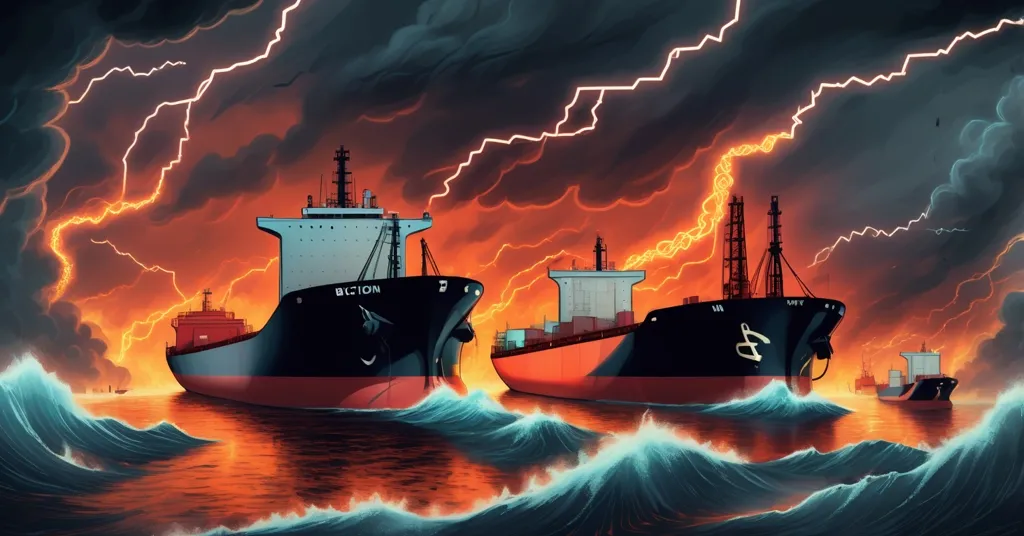
So, what’s driving this mess? Since late February, the U.S. and Israel have been pounding Iran with strikes aimed at halting nuclear weapon development and pushing for regime change. Targets include military sites and leadership strongholds, but Iran isn’t backing down. The Islamic Revolutionary Guard Corps (IRGC), Iran’s elite military force often at the forefront of regional conflicts, has retaliated with missile and drone attacks on U.S. and Israeli interests. Worse, they’ve clamped down on traffic through the Strait of Hormuz—a narrow, 21-mile-wide waterway between the Persian Gulf and the Gulf of Oman that’s the lifeline for 20% of the world’s oil supply. Think of it as the global economy’s main artery; when it’s blocked, the whole system seizes up. The IRGC has restricted passage to ships tied to the U.S., Israel, Europe, and their allies, claiming to have struck over 10 vessels since hostilities began. The fallout? Brent crude, a global benchmark for oil prices used to gauge market trends, has soared past $80 per barrel, and the pain is rippling from gas pumps to boardrooms worldwide.
For those new to this geopolitical quagmire, the Strait of Hormuz isn’t just a random strip of water. It’s the gateway for oil from heavyweights like Saudi Arabia, Iraq, and Kuwait to reach international markets. When Iran—or its proxies—flexes muscle here, it’s not a local skirmish; it’s a sucker punch to global trade. Tankers dodging drones and missiles mean delays, higher insurance costs, and, ultimately, pricier fuel for everyone. This isn’t just about geopolitics; it’s about the fragility of centralized systems—whether we’re talking oil pipelines or financial networks. And that’s where our world of crypto and blockchain starts to look mighty relevant.
US Response: Trump’s High-Stakes Gamble
President Donald Trump isn’t sitting on the sidelines. He’s promised swift action to rein in oil price spikes, including political risk insurance for tankers braving the Gulf’s warzone waters and even floating the idea of U.S. naval escorts to secure transit routes. Trump sounded almost casual when addressing the crisis:
“Further action to reduce pressure on oil is imminent, and the oil seems to have pretty much stabilized.”
Stabilized? That’s a damn stretch when prices are climbing faster than a Bitcoin bull run in 2021, and tanker captains are playing dodgeball with Iranian drones. Make no mistake—deploying warships into a powder keg like the Gulf is a roll of the dice. One misstep, one stray missile, and we’re looking at a full-blown escalation that could send oil to $100 a barrel overnight. Sure, naval protection might keep some routes open, but it’s also painting a bigger target on U.S. forces. For now, the world watches as Trump’s gamble unfolds, but the underlying truth remains: centralized systems—be they shipping lanes or fiat currencies—are terrifyingly vulnerable to single points of failure.
Bitcoin as a Safe Haven Amid Oil Chaos?
Let’s pivot to why this matters to our crowd. When oil markets implode and fiat currencies wobble under inflation fears, investors often scramble for alternatives. Enter Bitcoin, frequently touted as a hedge against economic uncertainty and devaluing fiat. With Brent crude over $80 per barrel, the specter of inflation looms large—pumping gas or heating homes costs more, eroding purchasing power. Historically, Bitcoin has seen price surges during major fiat crises; think back to the 2020 COVID crash when BTC rallied as governments printed trillions. Could this Iran-driven oil shock spark a similar flight to digital gold? Some Bitcoin maximalists are already shouting “I told you so,” arguing that a borderless, censorship-resistant asset is exactly what you need when a single strait can tank the global economy.
But let’s not get carried away with hopium. Bitcoin isn’t a guaranteed safe harbor. Market volatility can be a gut punch—BTC has dropped 20% in a week before, often on nothing more than a regulatory rumor. Speaking of which, governments spooked by geopolitical chaos might double down on crypto crackdowns, fearing capital flight. And don’t forget energy costs—Bitcoin mining rigs guzzle power, and with oil prices spiking, electricity bills for miners could skyrocket, squeezing margins or even halting operations for smaller players. So, while I’m rooting for BTC to shine as a middle finger to broken systems, we’ve got to keep our eyes open. This crisis could just as easily spook risk-averse investors away from anything smelling of “speculation”—crypto included.
DeFi and Blockchain: Solutions for a Broken System?
Beyond Bitcoin, there’s a broader case for decentralized finance (DeFi) and blockchain tech amid this chaos. For the uninitiated, DeFi refers to financial applications built on blockchains like Ethereum, allowing users to trade, lend, or borrow without middlemen like banks. When global trade routes are disrupted—say, by Iranian missiles in the Strait of Hormuz—DeFi could offer a lifeline. Imagine cross-border payments or trade financing happening peer-to-peer, bypassing sanctioned banks or choked-off shipping lanes. No need to wait for a tanker to dodge a drone; transactions settle on-chain in minutes. It’s the kind of freedom and resilience we champion, especially when centralized systems are buckling.
Then there’s blockchain for supply chains. Oil disruptions are a logistical nightmare, but platforms like VeChain or IBM’s TradeLens use blockchain to track goods transparently from source to destination. If a tanker’s delayed, companies can pivot faster with real-time data, minimizing losses. A crisis like this could accelerate adoption as energy firms scramble for efficiency—though high setup costs and tech illiteracy remain hurdles. Still, every centralized failure is a neon sign screaming “decentralize now.” We’re not just hodling for lambos; we’re pushing for systems no government or rogue regime can strangle. That’s effective accelerationism (e/acc) in action—crises expose legacy flaws, forcing faster tech integration. But let’s be real: scams in DeFi are rampant, and blockchain isn’t plug-and-play. We’ve got work to do before this vision scales.
Devil’s Advocate: Crypto Isn’t Ready for Prime Time
Playing devil’s advocate, let’s not pretend crypto is a silver bullet. Sure, Bitcoin might hedge inflation, but what happens when mining costs spike with oil prices? Many mining operations rely on cheap energy—bump that up 30% with $80 crude, and suddenly your ASIC rigs look like money pits. DeFi sounds slick, but most platforms can’t handle mainstream volume without gas fees exploding or networks grinding to a halt—Ethereum’s seen this movie before. And don’t get me started on user education; half the world still thinks “blockchain” is a buzzword for scams. Speaking of which, beware the hucksters exploiting this oil crisis with dodgy “energy tokens” or fake investment schemes promising riches. Stick to fundamentals, folks—don’t fall for the hype.
Then there’s the sanctions angle. This waiver shows the U.S. can bend on Russian oil when push comes to shove, but don’t expect a free-for-all on crypto-related sanctions. Governments love control, and a geopolitical mess like this often means tighter grips, not looser ones. Crypto’s promise of freedom is real, but the infrastructure and adoption gaps are glaring. We’re champions of disruption, but we’ve got to call out the BS and acknowledge the grind ahead if we’re serious about decentralizing the future.
Key Questions and Takeaways on Oil, Crypto, and Decentralization
- How do rising oil prices from the Iran conflict affect Bitcoin’s value?
With Brent crude over $80 per barrel, inflation fears could push investors to Bitcoin as a store of value, though its volatility and regulatory risks might deter some. - Can geopolitical instability boost decentralized finance (DeFi) adoption?
Yes, disruptions like the Strait of Hormuz crisis highlight DeFi’s potential for cross-border transactions without reliance on sanctioned or disrupted traditional systems. - What impact could oil price spikes have on Bitcoin mining costs?
Higher oil prices often mean pricier electricity, which could squeeze Bitcoin miners’ margins or force smaller operations to shut down temporarily. - Could blockchain tech help with energy supply chain chaos?
Blockchain offers transparent tracking for logistics, which could mitigate oil supply disruptions, though high costs and tech barriers slow widespread adoption. - Does the U.S. waiver signal weaker sanctions, and what’s the crypto implication?
It shows pragmatic flexibility in crisis, which might hint at softer crypto sanction enforcement, but governments will still cling to control during instability. - Why is this crisis a case for decentralization over centralized systems?
A single chokepoint like the Strait of Hormuz can cripple global economies, proving the fragility of centralized systems and the urgent need for decentralized alternatives like Bitcoin.
Zooming out, this U.S. waiver for India is a fleeting fix for a festering wound. The Iran conflict and Strait of Hormuz disruptions aren’t vanishing soon, and oil prices will keep jittering as long as superpowers play chess with warships and drones. India gets a breather to fuel its economy, but the bigger picture is stark: centralized systems—energy, finance, you name it—are cracking under pressure. For us in the crypto space, this is both a warning and a rallying cry. Bitcoin, DeFi, and blockchain aren’t just toys for speculators; they’re tools to upend a status quo that’s failing hard. Yet, we can’t ignore the gaps—adoption lags, scams thrive, and infrastructure creaks. If a single strait can tank the world, shouldn’t we double down on systems no one can choke? That’s the future we’re fighting for, and crises like this only crank up the urgency.