Dollar’s 2025 Slump: Bitcoin’s Big Break or Another False Dawn?
 LTB
LTB Dollar’s Dive Sparks Bitcoin Buzz: Is This the Moment for Crypto to Shine?
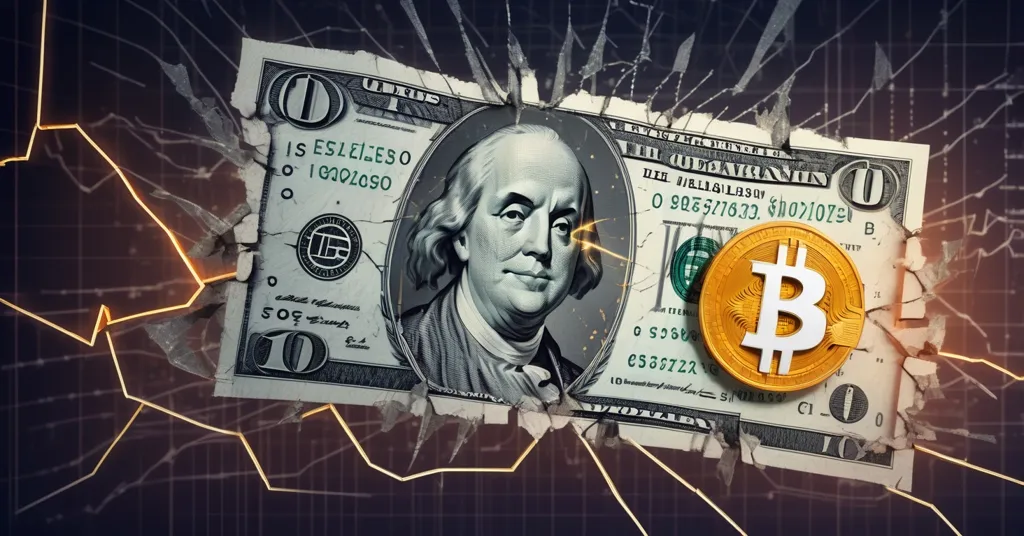
The U.S. dollar is staggering into the end of 2025, posting its worst weekly loss since June with the DXY Index down 0.8%, and an 8% annual drop—the steepest since 2017. With traders betting on Federal Reserve rate cuts and U.S. stock markets like the S&P 500 hitting record highs, a burning question emerges for the crypto community: could this fiat fragility be the catalyst Bitcoin needs to solidify its role as the future of money?
- Dollar Decline: DXY Index down 0.8% weekly, 8% yearly, lowest since September.
- Fed Outlook: Markets expect two rate cuts by 2026, key U.S. data looms in January.
- Crypto Potential: Weak dollar may push investors toward Bitcoin as a hedge.
Dollar’s Downfall: The Hard Numbers
The dollar’s slump is more than just a headline—it’s a stark reminder of fiat’s vulnerability. The DXY Index, which measures the U.S. dollar’s strength against a basket of major global currencies, has tanked to its lowest level since September. That 8% yearly decline is a flashing red light, signaling eroding trust in traditional currency, especially as the Federal Reserve has already cut interest rates three times in 2025. Traders are now pricing in a 90% chance that the Fed won’t raise rates at the next meeting, and they’re anticipating at least two more small cuts by the end of 2026. Meanwhile, currencies tied to higher risk appetite, like the Australian dollar and Norwegian krone—often stronger when investors feel bold during economic optimism—are outperforming the greenback. For more on the dollar’s decline, check out this detailed report on its worst weekly loss since June.
On the flip side, U.S. stock markets are riding high. The S&P 500 hit an all-time peak during the holiday-thinned Santa Claus rally, a seasonal uptick that’s averaged 1.3% gains since 1950 according to Stock Trader’s Almanac. The Dow and Nasdaq are also up over 1% for the week. But don’t let the equity euphoria fool you. As Tom Hainlin, national investment strategist at U.S. Bank Asset Management, pointed out, much of this movement is driven by technical trading and positioning rather than hard data.
“People are taking profits here and there, or buying on lows, but there’s not a lot of information. You’re not getting corporate profit results. You’re not getting a lot of economic data, so it’s probably just more technicals and positioning heading into here,” Hainlin noted.
He also highlighted broader market confidence, with financials and industrials—not just tech—pushing gains, thanks to tax legislation signed in July and the Fed’s rate cuts.
“That just gives more confidence heading into 2026 that it’s not just tech here and everybody behind them. It’s the market benefiting from the tax bill that was signed in July, the rate cuts that came in the fourth quarter of this year. Heading into 2026, those are some tailwinds,” he added.
Bottom line? The dollar’s looking shaky, and markets are betting on risk. But what does this mean for Bitcoin and the crypto space?
Bitcoin’s Big Chance—or Bust?
For those new to the game, Bitcoin (BTC) was forged in the fires of the 2008 financial crisis as a direct challenge to centralized banking and fiat systems prone to devaluation. Think of it as digital gold—a decentralized, peer-to-peer currency secured by blockchain, an unalterable ledger no government or bank can manipulate. When traditional currencies like the U.S. dollar falter, as we’re seeing now, Bitcoin often gets pitched as a safe haven, immune to inflation and policy meddling. Could Bitcoin act as an inflation hedge in 2025 amidst this U.S. dollar decline? Historically, periods of fiat weakness and low interest rates have driven capital into risk assets, including cryptocurrencies. Investors ditching a weakening greenback might just stack sats (a slang term for Bitcoin’s smallest unit, satoshis) instead.
Looking back, Bitcoin has thrived during past dollar slumps. Post-2008, as trust in fiat waned, BTC’s value proposition as hard money gained traction, with early adopters seeing massive gains by 2011. Fast forward to 2020, when unprecedented stimulus weakened the dollar, Bitcoin surged from under $10,000 to nearly $69,000 by late 2021. While past performance isn’t a promise, the current 8% annual drop in the dollar echoes those moments of opportunity. If Hainlin’s note on market “technicals” holds, Bitcoin might be riding a speculative wave right now—but without January’s economic data, including the December jobs report and inflation figures, it’s hard to say if this momentum will stick.
Let’s not get carried away with blind optimism, though. Playing devil’s advocate, a crumbling dollar doesn’t guarantee a Bitcoin boom. BTC’s price volatility can still rattle even the steeliest investors—swings of 20% in a week aren’t uncommon. Regulatory threats are another beast entirely. Governments aren’t exactly cheering for crypto; they’re more likely to lock the door and push their own Central Bank Digital Currencies (CBDCs) as controlled alternatives. Remember the 2021 China mining ban? It tanked Bitcoin’s price by nearly 50% in months as miners scrambled. Similar crackdowns could hit again, especially if the U.S. or EU ramps up tax policies or oversight in 2026. And here’s a kicker: Bitcoin’s correlation with traditional markets like the S&P 500 has tightened. If this Santa Claus rally fizzles, BTC could catch the fallout.
Decentralization’s Defining Moment
Zooming out, the dollar’s woes underscore why we champion decentralization, freedom, and privacy. The Fed’s rate cuts and fiat’s fragility are neon signs pointing to the flaws of centralized systems—endless cycles of debt and devaluation. Bitcoin isn’t just a speculative play; it’s a rebellion against a rigged game. This moment could accelerate the shift to trustless, sovereign financial systems, aligning with effective accelerationism (e/acc)—the idea of speeding up tech-driven progress to reshape society. Bitcoin’s rise could be the rocket fuel for reinventing money, cutting out middlemen and empowering individuals.
But the road isn’t paved with roses. The dark side of crypto—scams, hacks, and market manipulation—remains a gut punch. Exchanges get breached, rug pulls drain wallets, and regulatory overreach looms large. This isn’t a utopia; it’s a battlefield. Adoption is growing, sure, but it’s a slow grind. While institutional interest in Bitcoin has spiked during past dollar dips, retail investors often hesitate, burned by volatility or FUD (fear, uncertainty, doubt) from mainstream media. If 2025’s dollar decline is to be a turning point, the community must push education and usability to onboard the masses.
Altcoins: Allies or Distractions?
If the dollar’s slide nudges investors toward Bitcoin, altcoins like Ethereum (ETH) might also ride the wave, offering features BTC doesn’t touch. As a Bitcoin maximalist at heart—BTC is the king, the original hard money—I still recognize that Ethereum and others fill critical niches. ETH’s smart contracts power decentralized finance (DeFi), letting users lend, borrow, or trade without banks through platforms like Aave or Uniswap. These tools are real-world alternatives to traditional finance, especially appealing when low rates squeeze legacy systems. If capital flees fiat, Ethereum DeFi opportunities could explode.
Other blockchains like Solana, with lightning-fast transactions, or Polkadot, focusing on cross-chain connectivity, also have their place in this financial revolution. But let’s cut the crap—many altcoins are a cesspool of hype and fraud. For every solid project, there are countless scams waiting to fleece the gullible. Stats from Chainalysis suggest over $1 billion was lost to rug pulls and exit scams in 2021 alone, and 2025 likely isn’t much cleaner. We’re not here to peddle pipe dreams. Dig into any project before throwing your hard-earned cash at it.
Even privacy coins like Monero, which prioritize anonymity over Bitcoin’s transparent ledger, could see a bump if distrust in fiat grows. They cater to those of us who value privacy as a cornerstone of freedom, though they often draw regulatory heat for their untraceable nature. It’s a niche, but an important one in the decentralized ethos.
What’s Next for Crypto Amidst Fiat Fragility?
As we await January’s U.S. economic data, the crypto space needs to stay on edge. If inflation spikes, the Fed might pause rate cuts, propping up the dollar and potentially curbing risk appetite for Bitcoin. Conversely, weak jobs numbers could cement expectations of looser policy, fueling further dollar decline and crypto interest. Either way, no one’s got a magic wand to predict BTC at $1 million or ETH at $10k. Those wild price forecasts flooding social media are mostly shameless shilling, and we’ve got zero tolerance for that nonsense. Our goal is to inform, not inflate hype.
So, is this dollar dive Bitcoin’s defining moment? It’s a crack in the fiat fortress, but cracks don’t always lead to collapse. We’re bullish on crypto’s potential to disrupt and rebuild finance from the ground up, yet grounded about the hurdles—volatility, regulation, and scams aren’t going away overnight. Keep your wits sharp, consider stacking sats if you buy into the vision, and brace for the economic data drop. As the U.S. greenback wobbles, are you betting on decentralized money or watching from the sidelines? The next few weeks might just tell us more.
Key Questions and Takeaways on Dollar Weakness and Crypto Implications
- Why is the U.S. dollar declining so sharply in 2025?
The dollar’s fall, with an 8% annual drop and a 0.8% weekly loss in the DXY Index, is fueled by three Federal Reserve rate cuts in 2025 and a risk-on market mood boosting currencies like the Australian dollar. - How does dollar weakness affect Bitcoin price potential?
A weakening dollar often drives investors to alternative stores of value like Bitcoin, seen as digital gold and resistant to fiat inflation or central bank interference. - What risks does crypto face despite a faltering dollar?
Bitcoin’s wild price swings, looming regulatory crackdowns, the push for CBDCs, and ties to traditional market movements pose significant barriers to lasting growth. - Can altcoins like Ethereum capitalize on this scenario?
Yes, Ethereum’s DeFi platforms and smart contracts offer unique utility, potentially drawing capital escaping fiat, though many altcoins carry heavy scam risks. - What’s the bigger picture for decentralization?
The dollar’s struggles expose fiat’s flaws, strengthening the case for decentralized systems like Bitcoin that prioritize financial sovereignty and cut out centralized control. - What should crypto investors watch for in January 2026?
Key U.S. data releases, including the December jobs report and inflation figures, will shape Fed policy and could either bolster or dampen the dollar’s decline and crypto’s momentum.