Bitcoin’s Unshakable Dominance: Why Capital Always Returns to the King
 LTB
LTB All Roads Lead Back to Bitcoin: Why the King Remains the Crypto Anchor
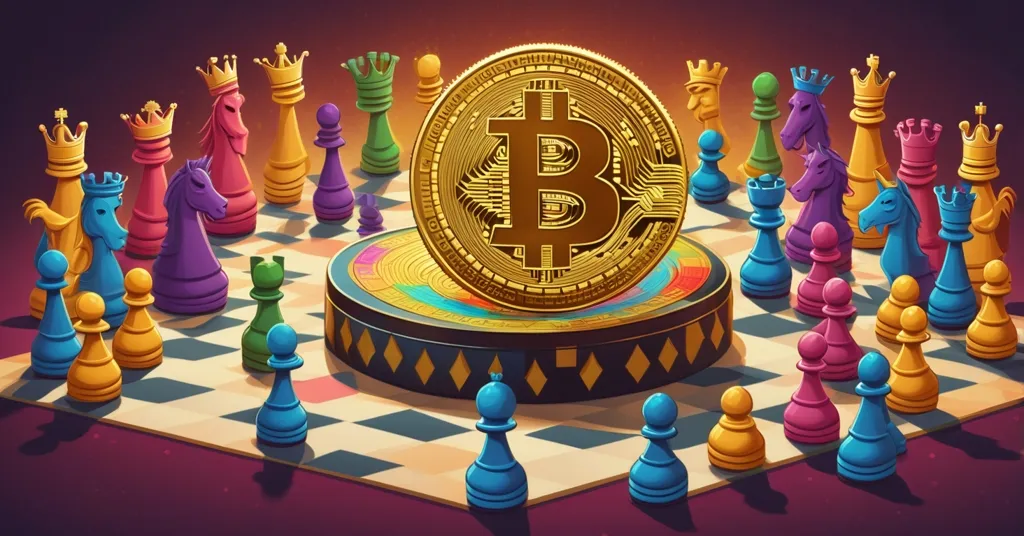
Bitcoin stands as the unyielding cornerstone of the cryptocurrency market, a truth hammered home by veteran analyst Benjamin Cowen of Into the Cryptoverse. Despite the seductive pull of altcoins and the chaotic hype of meme tokens, capital in this space has a nasty habit of circling back to Bitcoin, reinforcing its role as the ultimate benchmark and the safest bet in a sea of volatility.
- Bitcoin’s Grip: Commands 58.3% of total crypto market cap as of March 2026, over half of all invested money.
- Cyclical Nature: Capital shifts to altcoins during “altcoin seasons” but inevitably returns to Bitcoin across market cycles.
- Analyst Perspective: Benjamin Cowen emphasizes Bitcoin’s first-mover edge and institutional allure as key to its dominance.
Bitcoin’s Unshakable Foundation
Let’s strip away the hype and look at the raw numbers. As of March 2026, Bitcoin holds a staggering 58.3% of the total cryptocurrency market capitalization. If the entire crypto space is valued at, say, $2 trillion, over $1.16 trillion of that is parked in Bitcoin alone. That’s not just dominance—it’s a chokehold. Even with its price sitting 44% below the all-time high of $126,000 set in October 2025, Bitcoin’s position remains rock-solid. This isn’t a fluke; it’s the result of a first-mover advantage that’s been compounding since 2009. Bitcoin was the first cryptocurrency, and that head start created a network effect—a self-reinforcing cycle where its value grows as more people use and trust it, making it the go-to for everyone from retail noobs to Wall Street titans.
Security is another pillar. Bitcoin’s blockchain, powered by a decentralized network of miners, is the most battle-tested in the game. It’s slow and clunky compared to newer chains—transactions can take minutes and fees spike during congestion—but that’s a deliberate trade-off for unmatched security. No other cryptocurrency has withstood the same level of scrutiny, hacks, or regulatory pressure. And let’s not forget its role as the gateway for institutional capital, which refers to the massive pools of money from banks, hedge funds, and corporations that prioritize stability over speculative moonshots. When these big players dip their toes into crypto, they start with Bitcoin, not some obscure token with a cute mascot. For deeper insights on this trend, check out this analysis on why all roads inevitably lead back to Bitcoin.
The proof is in the price action. In late 2024, Bitcoin rocketed from $70,000 to $100,000, fueled by a surge of institutional demand through Spot Bitcoin ETFs—exchange-traded funds that let investors track Bitcoin’s price without owning it directly. These ETFs opened the floodgates for mainstream money, and by October 2025, Bitcoin hit that record $126,000. Sure, it’s pulled back since, but its dominance hasn’t budged. Historically, Bitcoin’s market share has fluctuated—dipping below 40% during the 2017 ICO craze, for instance—but it always claws back. Why? Because when the market gets shaky, investors flock back to Bitcoin as the safer bet.
The Altcoin Temptation: Boom and Bust
Now, let’s talk about the shiny distractions. During what’s known as “altcoin season,” a phase in bull markets where alternative cryptocurrencies outperform Bitcoin in percentage gains, capital rotates out of the king into riskier plays. It’s greed over grit—investors chase 10x or 100x returns, often driven by retail FOMO rather than fundamentals. The 2024-2025 cycle was a textbook case: Solana peaked at $295 in January 2025, XRP soared to $3.65 in July 2025, and Ethereum climbed to $4,946 in August 2025. These aren’t small numbers; they represent billions in capital temporarily fleeing Bitcoin for greener pastures.
But here’s the brutal truth: most of these pumps are a carnival of gains where everyone’s a winner… until the music stops. Altcoins often bleed out faster than you can say “bear market.” Take meme coins, the wildest of the bunch. The TRUMP token exploded to a multi-billion-dollar market cap shortly after launch, only to crater by over 95% from its peak. And it’s not an isolated case—think of other scams like the infamous Squid Game token from a few years back, where developers hyped a project tied to a Netflix show, then vanished with investor funds in a classic rug pull. These aren’t investments; they’re digital slot machines with abysmal odds.
For the uninitiated, let’s clarify a couple of things. Market capitalization, or market cap, is the total value of a cryptocurrency—price per coin multiplied by the number of coins in circulation. A high market cap doesn’t always mean longevity, as meme coins prove. Altcoin season, meanwhile, is fueled by speculative hype, often amplified on social media platforms where influencers shill tokens for quick profits. It’s a mirage of wealth that evaporates when sentiment flips.
Institutional Muscle Behind Bitcoin
One reason Bitcoin keeps its crown is the sheer weight of institutional backing. When hedge funds, pension funds, or corporate treasuries like MicroStrategy or Tesla want crypto exposure, they don’t gamble on a random altcoin—they buy Bitcoin. Why? Brand recognition, regulatory clarity (or at least less uncertainty), and liquidity. Bitcoin’s market is deep enough to handle billion-dollar trades without massive price swings, unlike most altcoins where a single whale can tank the chart.
The impact of this big money is undeniable. Spot Bitcoin ETFs, launched in earnest in 2024, were a game-changer. They allowed traditional investors to gain exposure without the hassle of wallets or private keys, driving Bitcoin’s price from $70,000 to $100,000 in mere months. By the time it peaked at $126,000 in October 2025, institutional inflows were a key driver. Even now, with Bitcoin trading well off that high, firms like BlackRock and Fidelity continue to hold and accumulate through these vehicles. This isn’t just a trend; it’s a structural shift that cements Bitcoin as the North Star of crypto.
Contrast that with altcoins. Sure, Ethereum has some institutional interest thanks to its role in decentralized finance (DeFi), but it’s a distant second. Smaller projects like Solana or XRP? Barely a blip on the radar for most big players. When the market cools, as it always does, institutional money doesn’t stick around to prop up speculative assets—it consolidates back to Bitcoin.
Altcoins’ Role: Innovation Over Stability
Let’s be fair—altcoins aren’t just hype machines. Many fill niches Bitcoin was never meant to serve, and their innovations are crucial to the blockchain ecosystem’s growth. Ethereum, for instance, pioneered smart contracts—self-executing agreements coded on the blockchain—that power DeFi protocols like Uniswap, where users swap tokens or lend assets without banks. Ethereum also offers a staking mechanism, where users lock up coins to support the network and earn rewards, akin to interest on a savings account. Bitcoin doesn’t have this; it’s a store of value, not a yield generator.
Solana, meanwhile, boasts lightning-fast transactions and dirt-cheap fees, making it a hub for non-fungible tokens (NFTs) and decentralized apps. At its peak of $295 in 2025, it showed real demand for scalable tech. XRP, backed by Ripple, focuses on cross-border payments, partnering with banks through RippleNet to settle transactions in seconds—a use case Bitcoin’s slow network can’t match. These projects push boundaries, driving adoption in ways Bitcoin alone can’t.
But there’s a catch. When the market turns, these altcoins often lack the staying power of Bitcoin. Their prices crash harder, their communities scatter, and their utility gets drowned out by panic selling. Innovation is great, but it doesn’t pay the bills when liquidity dries up. Capital, as Cowen notes, bleeds back to the king.
“Everything in the cryptoverse eventually just bleeds back to Bitcoin. People have engineered all sorts of different things, but after a cycle or two, it all just bleeds back to the king.” – Benjamin Cowen
Could the King Be Dethroned?
Let’s play devil’s advocate and ask the uncomfortable question: Is Bitcoin’s dominance guaranteed forever? Some argue it’s not. Scalability remains a glaring weakness—Bitcoin processes about 7 transactions per second compared to Solana’s thousands. Fees can skyrocket during peak demand, making it impractical for everyday use. Then there’s the energy debate. Critics slam Bitcoin mining for its carbon footprint, with some estimates suggesting it consumes as much power as small countries. Governments could crack down harder on this front, especially as ESG (environmental, social, governance) concerns grow.
Other threats loom on the horizon. Quantum computing, though still years away, could theoretically crack Bitcoin’s cryptography, undermining its security. Altcoins, meanwhile, keep innovating—Ethereum’s staking and Solana’s speed offer tangible benefits Bitcoin lacks. Regulatory headwinds could also hit Bitcoin hardest simply because it’s the most visible target. Smaller projects might slip under the radar while Bitcoin takes the heat.
Yet, let’s be real. Bitcoin’s network effect and cultural entrenchment are damn near unbreakable. It’s not just a coin; it’s a symbol of financial rebellion. Its security track record—over a decade without a major breach—dwarfs newer chains. Institutional money isn’t betting on tech specs; it’s betting on staying power, and Bitcoin has that in spades. Even if quantum risks emerge, developers are already exploring countermeasures. And energy criticism? Miners are shifting to renewables at a rapid clip. The king’s throne might wobble, but it’s not falling anytime soon.
Bitcoin’s Broader Revolution
Zoom out beyond market caps and price charts, and you see Bitcoin’s true value: it’s a middle finger to centralized finance. In places like Venezuela or Zimbabwe, where hyperinflation turns savings to dust, Bitcoin offers a lifeline—a borderless, uncensorable store of value. It’s not perfect; price volatility can screw over the desperate. But it’s a start toward financial sovereignty, a core tenet of decentralization that aligns with the push for privacy and freedom.
This ties into the idea of effective accelerationism—accelerating tech adoption to solve systemic issues faster than traditional systems can adapt. Bitcoin’s resilience builds trust in non-fiat alternatives, even if altcoins innovate quicker in specific niches. Every cycle, every institutional buy-in, chips away at the old guard. It’s messy, riddled with scams and wild swings, but Bitcoin remains the battering ram for this financial revolution. Ignore the noise of 100x altcoin promises; the real story is how Bitcoin keeps proving itself as the bedrock.
Key Takeaways and Questions
- What drives Bitcoin’s persistent dominance in the crypto market?
Its first-mover advantage, unmatched security, and status as the primary entry for institutional capital through Spot Bitcoin ETFs keep it at 58.3% of market cap as of March 2026. - Why do altcoins see short-term surges during market cycles?
In “altcoin seasons,” investors chase higher gains in coins like Solana ($295 peak in 2025), XRP ($3.65), and Ethereum ($4,946), though these surges often fade when sentiment shifts. - Are speculative assets like meme coins a sustainable investment?
Hardly—the TRUMP meme coin’s 95% crash from a multi-billion-dollar peak shows their volatility, unlike Bitcoin’s enduring value as a market anchor. - How do institutional investors shape Bitcoin’s price trends?
Their demand, especially via Spot Bitcoin ETFs in 2024, propelled Bitcoin from $70,000 to $100,000, highlighting their massive influence on market momentum. - What role do altcoins play compared to Bitcoin?
Altcoins like Ethereum (DeFi), Solana (speed), and XRP (payments) drive innovation in niches Bitcoin doesn’t serve, but lack its stability during downturns. - Could Bitcoin’s dominance face real threats in the future?
Scalability limits, energy criticism, and emerging tech like quantum computing pose risks, though Bitcoin’s network effect and cultural weight remain formidable barriers. - Why does Bitcoin matter beyond just markets?
It champions decentralization and financial freedom, offering a hedge against fiat failures in unstable economies, accelerating trust in blockchain as a revolutionary force.