Bitcoin Miners Crushed by Hashprice Collapse, AI Pivot Risks Loom: CoinShares Report
 LTB
LTB Bitcoin Miners Face Crushing Profit Squeeze as Hashprice Hits Rock Bottom, CoinShares Reports
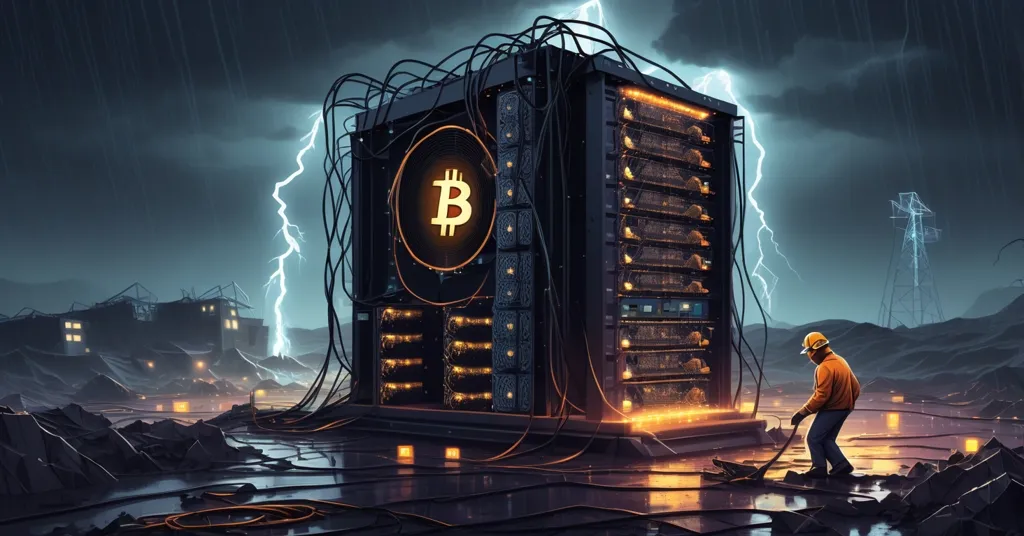
Bitcoin miners are in a fight for survival. The latest Q1 2026 mining report from CoinShares lays bare an industry battered by plummeting Bitcoin prices, a hashprice collapse to historic lows, and relentless network competition that’s driving many operators into the red. It’s a stark wake-up call for anyone betting on mining as a surefire path to riches.
- Profitability Meltdown: Bitcoin’s price crashed 31% from $124,500 to $86,000 in Q4 2025, with hashprice sinking to $29 per PH/s/day in early 2026.
- Miner Shutdowns: Three straight negative difficulty adjustments in Q1 2026 signal widespread capitulation among struggling operators.
- Industry Shift: Public miners eye AI and high-performance computing (HPC) for salvation, with projections of 70% revenue from these sectors by late 2026, but debt risks loom large.
Hashprice Collapse: The Numbers Behind the Pain
Let’s break this down hard and fast. Since the April 2024 Bitcoin halving cut block rewards in half, miners have been clinging to the hope of a price rally to offset the slashed income. For those new to the space, the halving happens roughly every four years, reducing the number of new Bitcoin awarded to miners for validating transactions on the network. It’s meant to control supply and often sparks bullish price action—except this time, the market had other plans. Bitcoin took a savage 31% dive in Q4 2025, sliding from a peak of $124,500 in early October to $86,000 by late December. As of press time, it trades at a sobering $67,850.
The bigger blow is the hashprice implosion. Hashprice measures the daily revenue a miner earns per petahash per second (PH/s) of computing power—a critical gauge of profitability. It tanked to $36–38 per PH/s/day in Q4 2025, then nosedived to $29 in Q1 2026, scraping a brutal low of $28 in late February before a slight bump to $30–35. CoinShares didn’t hold back in their assessment, as detailed in a recent report on Bitcoin miners facing intense profit challenges:
“The hash price environment has deteriorated beyond our prior expectations, briefly touching ~$28/PH/s/day in late February before recovering to ~$30-35 at the time of writing.”
At $30 per PH/s/day, miners running hardware less efficient than the S19 XP—think outdated rigs like the S9 series still grinding away in some setups—and paying electricity costs at or above 6 cents per kilowatt-hour (kWh) are straight-up losing cash. CoinShares pegs this as affecting 15–20% of the global mining fleet. The weighted average cash cost to mine one Bitcoin among public miners hit $79,995 in Q4 2025. With Bitcoin’s current price at $67,850, it’s like running a bakery where each loaf costs $80 to bake but sells for $67—you’re bleeding on every deal. No wonder we’ve seen three consecutive negative difficulty adjustments in Q1 2026, a grim streak not witnessed since July 2022. For the uninitiated, difficulty adjusts based on network participation; negative shifts mean miners are shutting off rigs, easing competition, and signaling surrender.
Desperate Measures: Selling Bitcoin Treasuries
CoinShares dubbed Q4 2025 “the most challenging quarter for Bitcoin miners since the April 2024 halving,” and the data backs that up. Public miners—those listed on stock exchanges and under pressure to deliver results—are getting hit hardest. To keep the lights on, they’ve slashed Bitcoin treasuries, dumping over 15,000 BTC from peak holdings. Core Scientific offloaded 1,900 BTC in January 2026, netting about $175 million, and plans to liquidate most of its remaining stack this quarter. Riot unloaded 1,818 BTC in December 2025 for roughly $162 million, while Bitdeer went all-in, reducing its treasury to zero by February 2026. Is this a short-term lifeline or a death knell for their Bitcoin-first identity?
These aren’t just precautionary sales; they’re survival tactics. Mining at a loss forces tough calls, and for many, cashing out hard-earned Bitcoin is the only way to cover operational costs. It’s a bitter pill for an industry built on the ethos of holding the world’s hardest money.
AI Pivot: Salvation or a Risky Gamble?
With traditional mining revenue drying up, many operators are looking beyond Bitcoin’s blockchain for a lifeline—enter artificial intelligence (AI) and high-performance computing (HPC). For clarity, HPC involves using massive computing power for tasks like scientific simulations, while AI workloads often include training machine learning models for things like chatbots or autonomous vehicles. Public miners have inked over $70 billion in AI and HPC contracts, repurposing idle rigs for these lucrative markets. CoinShares projects a seismic shift:
“Listed miners could derive as much as 70% of revenue from AI by the end of 2026, up from roughly 30% today.”
Firms like TeraWulf, Hut 8, Cipher Mining, and Iren are spearheading this transformation, alongside Core Scientific, moving from pure Bitcoin mining to diversified tech operations. Why let expensive hardware gather dust when Bitcoin mining doesn’t pay? It’s a logical pivot, and as champions of effective accelerationism, there’s an argument to be made that repurposing mining rigs for AI accelerates broader tech progress, even if it sidesteps Bitcoin’s core mission temporarily.
But let’s play devil’s advocate with a sharper edge: are these miners betraying Bitcoin’s soul by chasing AI dollars, or are they just playing the hand they’ve been dealt in a rigged economic game? The dark side of this shift is the staggering debt piling up to fund these new ventures. Iren carries $3.7 billion in convertible notes—loans that can convert to company stock, often at a discount—while TeraWulf shoulders $5.7 billion in total debt, and Cipher Mining holds $1.7 billion in senior secured notes, debts backed by specific assets and prioritized in bankruptcy. That’s a hell of a lot of leverage for an industry already on thin ice. If interest rates climb or the AI hype bubble pops, these miners-turned-tech-firms could collapse under their own weight.
Small Miners Caught in the Crossfire
While public miners grab headlines with billion-dollar deals, spare a thought for the small-scale operators—often the ideological heart of Bitcoin’s decentralized ethos. These are the folks running a handful of rigs in garages or small warehouses, driven by a belief in censorship-resistant money rather than pure profit. They’re getting priced out fast. With hashprice at rock bottom and electricity costs unrelenting, anyone without access to dirt-cheap power—think hydropower in Quebec or stranded energy in remote Texas—is toast. CoinShares estimates 15–20% of the global fleet, largely smaller players with older hardware, is unprofitable.
This culling risks more than just individual livelihoods; it threatens the diversity of Bitcoin’s mining ecosystem. When small miners shut down, hash rate—the total computational power securing the network—concentrates among larger, often corporate, players. Historically, we’ve seen this trend after events like China’s 2021 mining ban, where hash rate temporarily centralized in regions with cheap energy or government-friendly policies. Could we be sleepwalking into a future where a handful of giants dominate mining, undermining the very decentralization we fight for? Initiatives like mining pools, where smaller players band together to share rewards, or subsidized energy programs could help, but they’re Band-Aids on a gaping wound. The community buzz on forums like Reddit’s Bitcoin mining subs echoes this pain—stories of miners selling rigs at a loss or switching to altcoin mining just to break even are all too common.
Historical Context: A Cyclical Storm or Unique Crisis?
Zooming out, this isn’t the first time miners have faced a relentless squeeze. Post-2018 bear market saw Bitcoin drop below $4,000, forcing mass shutdowns as mining costs outpaced rewards. China’s 2021 crackdown on mining displaced huge chunks of hash rate, creating temporary chaos before relocation to places like Kazakhstan and the U.S. stabilized the network. Each crisis felt existential, yet Bitcoin—and its miners—adapted. Is this 2026 downturn just another cycle, a natural Darwinian purge of inefficient players, or something uglier?
There’s a case for uniqueness. The 2024 halving collided with a bearish macro environment, unlike the post-2020 halving bull run fueled by pandemic stimulus and institutional adoption. Add in record-high network difficulty and rising global energy costs, and you’ve got a perfect storm. CoinShares warns of more pain ahead:
“We expect further capitulation among higher-cost operators in H1 2026 unless BTC price recovers materially.”
Yet, not all analysts are this bleak. Some mining experts, like those at BitInfoCharts, suggest low hashprice periods often precede consolidation and innovation—think better hardware or energy-efficient setups. Whether this optimism holds water remains to be seen.
Decentralization at Risk: The Bigger Picture
As a Bitcoin maximalist with a soft spot for decentralization, I’m wrestling with mixed feelings. Mining secures the network, ensuring no central authority can meddle with transactions. Every miner that shuts down or pivots to AI chips away at that distributed power, even if just for now. If hash rate centralizes with a few big players—especially those cozy with cheap energy or lenient governments—Bitcoin’s resilience takes a hit. We’ve dodged bullets before, like when over 50% of hash rate was in China pre-2021, but complacency isn’t an option.
On the flip side, economic reality doesn’t bow to ideology. Miners adapting via HPC or other means might preserve their operations long enough for Bitcoin’s price to rebound, ultimately strengthening the network. It’s a brutal trade-off, but Bitcoin wasn’t built to coddle the inefficient. This is survival of the fittest, and smaller miners getting squeezed out is a harsh reminder that freedom comes at a cost.
Looking Ahead: Any Light on the Horizon?
So, what could turn this ship around? A Bitcoin price recovery is the obvious savior, but that hinges on broader market dynamics. Macro shifts like potential interest rate cuts in 2026 could spur risk-on assets like crypto, though geopolitical tensions or inflation spikes might counter that. Institutional flows via Bitcoin ETFs, which saw record inflows in 2025 before stalling, could also reignite retail interest if sentiment flips. On the mining front, innovation in energy efficiency—think next-gen ASIC rigs or renewable integrations—might lower breakeven costs for survivors.
Still, don’t hold your breath. The hashprice ticker is a grim reaper right now, and only the most adaptable—or dangerously leveraged—will make it through. For the OGs chuckling at the irony, remember when mining was a dorm room hobby? Now it’s a high-stakes chess match with debt as the queen and ideals as pawns. Stay sharp, stack those sats, support the network—because in Bitcoin, resilience is the only currency that never devalues.
Key Takeaways and Questions for Reflection
- Why are Bitcoin miners facing such a severe profitability crisis?
Bitcoin mining profitability is at record lows due to a price drop from $124,500 to $67,850, hashprice collapsing to $29 per PH/s/day, and mining costs averaging $79,995 per BTC—meaning many operate at a loss. - How are miners responding to this financial pressure?
Public miners have sold over 15,000 BTC from treasuries to cover costs, while others shift to AI and HPC contracts for alternative income streams amid the crypto mining crisis. - Is the pivot to AI and HPC a sustainable solution for miners?
It’s uncertain; while it could drive 70% of revenue by late 2026, massive debts—like TeraWulf’s $5.7 billion—pose huge risks if the AI market falters or interest rates rise. - What does this crisis mean for small-scale Bitcoin miners?
Small miners, often running older hardware, are being crushed by low hashprice and high energy costs, risking exclusion and further centralization of hash rate among big players. - Could this downturn threaten Bitcoin’s decentralization?
Yes, miner shutdowns and pivots to AI reduce network security and risk hash rate concentration, though it’s also a natural thinning of inefficient operators in a competitive, decentralized system. - Are there any catalysts that could ease the Bitcoin mining crisis in 2026?
A Bitcoin price recovery, spurred by macro shifts like rate cuts or ETF inflows, plus innovations in energy-efficient mining tech, could offer relief, though timing and impact remain uncertain.