Trump China Trip Puts Bitcoin Miners and ASIC Supply Chains Back in Focus
 LTB
LTB Donald Trump’s China trip has put Bitcoin miners back under the microscope, because when U.S.-China tensions heat up, the mining business feels the heat fast.
- Trump’s China trip is dragging Bitcoin miners back into market focus
- China Bitcoin mining still matters through hardware, chips, and supply chains
- Bitcoin mining hardware prices can move on trade policy, not just hash rate
- Bitcoin is resilient; the mining industry’s supply chain is still messy as hell
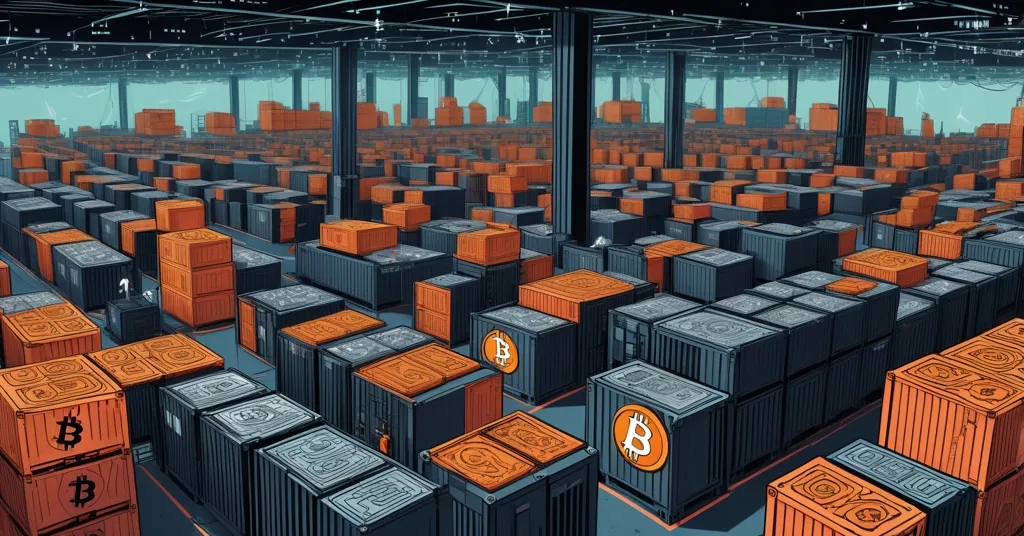
Bitcoin mining is often described like it’s some neat digital process happening in the cloud. Cute idea. In reality, it’s warehouses full of loud machines, giant power contracts, shipping delays, customs paperwork, chip shortages, and the sort of geopolitical nonsense that can turn a business model into a migraine.
That’s why any high-profile U.S.-China move tends to put Bitcoin miners back in the spotlight. The connection is bigger than where the machines are physically located. China still influences the sector through hardware manufacturing, component supply, logistics, and the policy shocks that ripple across the global mining market. Even after Beijing’s crackdown pushed a huge chunk of mining activity offshore, China never stopped mattering.
The key point is simple: Bitcoin mining is borderless in theory, but not in the boring real-world parts that actually keep the operation alive. Miners depend on ASICs, the specialized machines built to mine Bitcoin, and those machines do not magically appear out of thin air. They rely on semiconductor supply chains, factory output, transport routes, and access to affordable power. When trade relations between the U.S. and China get noisier, the mining industry has to price in uncertainty.
ASICs — short for application-specific integrated circuits — are the purpose-built machines that do the heavy lifting in Bitcoin mining. Unlike a regular computer or even a GPU setup, ASICs are designed for one job: crunching SHA-256 calculations as efficiently as possible. If their production costs rise, or shipping gets tangled up, miners feel it immediately. No amount of “line go up” chart worship changes that.
Why China Still Matters to Bitcoin Miners
China’s role in Bitcoin mining used to be obvious: it was home to massive mining farms before the crackdown forced operators to flee. But even after that exodus, China remained structurally important to the business.
First, it has been central to Bitcoin mining hardware production and the broader electronics ecosystem. A lot of the equipment, components, and manufacturing capacity tied to mining has long depended on Chinese industry or Chinese-linked supply chains. Second, shipping and logistics matter. If trade friction slows container movement, raises freight costs, or creates customs headaches, that cost gets baked into rig prices. Third, policy changes in China still affect market expectations. Miners, investors, and manufacturers all pay attention when Beijing makes a move, because yesterday’s crackdown can become today’s supply squeeze.
That’s the overlooked part of the story: the mining industry may have decentralized geographically, but it has not become immune to centralized industrial bottlenecks. Bitcoin’s network is spread across the planet. The hardware pipeline? Not nearly as clean.
How U.S.-China Tensions Hit Mining Hardware
When people hear “geopolitics,” they often picture diplomats, speeches, and a lot of useless chest-thumping. Miners picture something more practical: costs. The business lives and dies on margins, and trade policy can squeeze those margins hard.
Here’s how a Trump China trip — or any broader U.S.-China tension — can affect Bitcoin mining hardware:
- Tariffs: Higher import duties can push up rig prices for U.S.-based miners.
- Export controls: Restrictions on components, chips, or industrial equipment can slow deliveries.
- Shipping delays: Customs friction can leave miners waiting while the clock keeps running on market conditions.
- Supply shortages: Even small bottlenecks can tighten availability and make hardware more expensive.
- Uncertainty: Investors hate it, manufacturers hate it, and miners absolutely hate it because planning becomes a guessing game.
This matters because Bitcoin mining is not a hobbyist’s side project at this scale. It is industrial infrastructure. The firms doing it at scale make capital allocation decisions months or years ahead. If they think the next batch of ASICs will cost more, arrive late, or get stuck in trade drama, they may delay expansion or move capital elsewhere.
That’s the real-world meaning behind a geopolitical headline. It’s not just about who said what to whom over dinner in Beijing. It’s about whether miners can still source machines at a price that makes sense.
Bitcoin Network Security Is Strong, Mining Businesses Are Not Bulletproof
There’s a critical distinction here that gets blurred all the time: Bitcoin network security is not the same thing as the health of mining companies.
The Bitcoin protocol is designed to adapt. If miners leave one region and relocate to another, the network adjusts through mining difficulty. That’s one of Bitcoin’s best features. It is remarkably good at surviving political stupidity. A mining farm can disappear from one country and reappear in another, and the network keeps humming.
But mining companies are still businesses. They can get hit by bad financing, expensive energy, tighter hardware supply, and trade policy. So while Bitcoin itself is built to survive geographic shifts, miners can still get their faces shoved into the economic pavement by the very same changes.
That’s why decentralization is both a success and an unfinished project. The network is harder to kill than ever. The supply chain behind it? Still has weak points. A lot of people confuse those two things because “decentralized” sounds like a magic spell that makes every problem vanish. It doesn’t. It just makes the system more resilient.
Who Benefits, Who Gets Burned
There is a bull case buried in all this noise. If trade friction pushes mining hardware manufacturing and deployment to diversify further, that could help create a healthier, less China-dependent mining ecosystem over time. More supply chain redundancy is good. More geographic spread is good. Bitcoin benefits when mining isn’t overconcentrated in any one country or industrial corridor.
But there’s also the ugly side. If tariffs, export controls, or broader U.S.-China friction raise costs too quickly, smaller miners can get crushed. Big operators with better financing and more negotiating power may survive. Smaller players may get squeezed out. That can lead to a more centralized industry, even if the network itself stays distributed.
That’s the uncomfortable truth: policy shocks can strengthen the long-term case for decentralization while still kicking miners in the teeth in the short term. Markets love to pretend those two things cannot happen at the same time. They absolutely can.
The other risk is that people start treating every China-related headline like an instant signal for Bitcoin price action. That’s usually nonsense. Yes, miners matter. Yes, hardware supply chains matter. No, every diplomatic photo op does not mean some grand crypto revelation has arrived from the heavens. Sometimes it just means politicians are doing politician things while industrial operators count costs and hope customs doesn’t ruin their week.
Why This Keeps Coming Back
Bitcoin mining keeps re-entering the conversation because it sits at the intersection of money, energy, manufacturing, and state power. That makes it one of the most politically exposed corners of crypto. The irony is delicious: the asset itself is designed to escape borders, but the machines that secure it still depend on them.
That tension is exactly why a Trump China trip can send the industry back into focus. The question is not whether Bitcoin survives. It will. The question is how much pain miners absorb while the world’s biggest economies posture, negotiate, and occasionally try to kneecap each other with trade policy dressed up as strategy.
Bitcoin miners have always lived close to the edge. Cheap power, efficient hardware, and disciplined execution separate the survivors from the dead weight. Add geopolitics to that mix and the margin for error gets even thinner. In other words: Bitcoin may be borderless, but mining is still stuck in the mud with the rest of the physical world.
Key questions and takeaways
-
Why does Trump’s China trip matter for Bitcoin mining?
Because U.S.-China relations can affect tariffs, hardware imports, component access, logistics, and the cost of running a mining business. -
Why is China still important to Bitcoin miners?
China still matters through manufacturing, supply chains, shipping routes, and the lingering influence of its past dominance in mining infrastructure. -
What is Bitcoin mining hardware?
It refers mainly to ASIC miners, specialized machines built to perform Bitcoin’s proof-of-work calculations as efficiently as possible. -
Can U.S.-China tensions hurt miners?
Yes. Tariffs, export controls, freight issues, and supply shortages can raise costs and squeeze mining margins fast. -
Does this threaten Bitcoin itself?
Not directly. The network is resilient and adjusts over time, but mining companies and hardware supply chains are far more exposed. -
What’s the real takeaway for Bitcoin?
Bitcoin can outlast political theater, but the mining industry still depends on fragile global supply chains that deserve scrutiny.