IREN Ditches Bitcoin Mining Losses for $9.3B AI Cloud Gamble
 LTB
LTB IREN Abandons Bitcoin Mining Losses for Risky AI Cloud Bet
Australia-based IREN, once known as Iris Energy, is pulling a hard U-turn, ditching the bleeding wound of Bitcoin mining for the high-stakes arena of AI cloud services. With losses stacking up to $19,000 per Bitcoin mined against a brutal production cost of $80,000 per coin, the company is staking its future on GPU-powered tech contracts, aiming to flip a volatile crypto revenue model into something steadier and more lucrative.
- Mining Disaster: IREN loses $19,000 per Bitcoin, with costs at $80,000 per coin against lower market prices.
- AI Goals: Plans to grow AI revenue from 9% to 70% by 2026, targeting $3.7 billion in earnings.
- High-Stakes Move: A $9.3 billion-funded pivot carries execution risks, customer concentration pitfalls, and fierce AI market competition.
Bitcoin Mining’s Brutal Math: Why IREN Had to Pivot
Bitcoin mining has turned into a financial meat grinder for many operators, and IREN is no exception. For those just getting into crypto, here’s the deal: Bitcoin operates on a system where miners use powerful computers to validate transactions and secure the network, earning newly minted Bitcoin as a reward. Every four years or so, an event called the halving cuts that reward in half to control the supply of new coins and prevent inflation. Sounds neat, until you’re a miner watching your revenue get chopped while costs stay sky-high. For IREN, the numbers are a horror show—producing a single Bitcoin costs them an estimated $80,000, while the market price often sits well below that, resulting in a gut-wrenching loss of about $19,000 per coin. That’s not a business; that’s a slow-motion car crash. For more details on their shift, check out IREN’s pivot to AI cloud services amid mining losses.
The latest Bitcoin halving has only tightened the screws. Miners now face what’s known as margin compression—think of it as being squeezed between rising operational expenses and shrinking income. Profitability depends on three things: hyper-efficient hardware, rock-bottom electricity prices, and a Bitcoin price that doesn’t tank. IREN, like many publicly traded mining firms, has been caught flat-footed. Power costs are a silent killer in this game; without access to cheap hydropower or renewable energy deals, mining becomes a money pit. Continuing down this path for IREN is like trying to fix a broken leg with a Band-Aid—pointless and painful. So, they’re bailing on mining’s sinking ship and steering toward a lifeline in AI cloud services.
Why AI? The Mining-to-Tech Connection
If you’re wondering how a Bitcoin miner jumps to AI, the link isn’t as far-fetched as it seems. Both industries crave the same thing: raw computational power and the infrastructure to handle it. Miners already know how to build data centers packed with high-performance gear, often in regions with access to affordable energy. IREN is capitalizing on this overlap, pivoting to offer cloud computing for AI tasks like machine learning or data crunching, which demand what’s called GPU-intensive workloads. GPUs, or graphics processing units, are specialized chips that handle complex calculations at lightning speed—think of them as the muscle cars of computing, far outpacing regular processors for AI jobs.
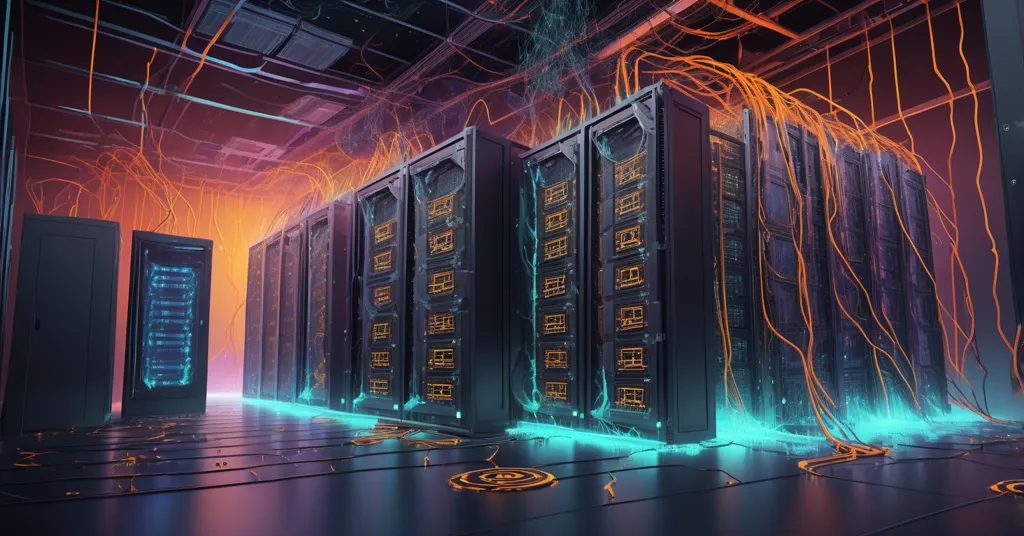
IREN’s plan is ambitious, bordering on audacious. They’re aiming to construct up to 200 MW of liquid-cooled GPU capacity. For the uninitiated, liquid cooling is a fancy way to keep hardware from overheating under extreme stress, much like a radiator keeps a car engine from melting down during a race. It’s essential for AI data centers running non-stop. The hardware fueling this shift? Nvidia B300 GPUs, cutting-edge tech at the heart of the AI boom. IREN intends to acquire over 50,000 of these units, scaling their total GPU arsenal to a massive level. Right now, AI makes up just 9% of their revenue, but they’re gunning for 70% by 2026, projecting $3.7 billion in AI cloud earnings and $3.4 billion in total annual revenue. If they nail this, they’re not just pivoting—they’re reinventing themselves from a crypto casualty into a tech contender.
A $9.3 Billion Gamble: Risks of IREN’s AI Bet
Before we start cheering, let’s pour some cold water on this hot idea. IREN has secured a staggering $9.3 billion to bankroll this transition, including $3.5 billion in capital expenditures and $3.7 billion through convertible bonds. If that last term sounds like gibberish, picture it as a loan that can later turn into a slice of the company, like lending money to a startup with the option to become a partner down the line. It’s a way to raise cash without immediately giving away ownership, but it’s still a hefty debt load. The upfront costs are eyewatering, and the risks are glaring enough to keep any investor up at night.
First up is execution risk. Building 200 MW of AI-ready infrastructure isn’t like slapping together a IKEA shelf—it’s a complex, multi-year endeavor. Delays, technical screw-ups, or supply chain bottlenecks (like the ongoing global chip shortages) could throw a wrench in the timeline. Then there’s customer concentration risk—if IREN scores a handful of big AI clients but doesn’t spread out their base, losing just one contract could gut their revenue. Imagine a miner banking on a single whale client, only to watch them jump ship and take 40% of the income with them. Add to that the cutthroat competition in the AI data-center market, where giants with fatter wallets and bigger reputations are already throwing punches. IREN’s stepping into a cage fight with some serious heavyweights.
Geographic expansion adds another layer of complexity. IREN is eyeing growth in British Columbia, a region known for abundant hydropower that could keep energy costs down. But scaling operations across borders means wrestling with new regulations, power agreements, and logistical nightmares. British Columbia isn’t just a pretty postcard—it’s a bureaucratic and operational puzzle. IREN’s revenue dreams hinge on turning these massive infrastructure bets into long-term, durable contracts with AI firms desperate for compute power. If demand dips or they can’t deliver on specs, this bold move could turn into a billion-dollar faceplant.
A Miner’s Identity Crisis: Industry Trends and Bitcoin’s Future
Stepping back, IREN’s shift isn’t happening in a vacuum. It’s part of a larger wave among Bitcoin miners grappling with halving cycles that force adaptation every few years. Historically, miners have doubled down on efficiency—upgrading rigs, chasing cheaper power, or merging to cut costs. But diversification into AI cloud services or high-performance computing (HPC) is a newer play. Companies like Hut 8 have also dipped toes into similar waters, signaling a potential redefinition of what a “miner” even is. IREN’s gamble suggests the future might not be pure blockchain for some players; it could be a hybrid where crypto takes a backseat to tech’s bigger paycheck.
For Bitcoin maximalists—those who eat, sleep, and breathe BTC as the ultimate decentralized currency—this pivot might sting. Mining isn’t just a business; it’s the backbone of Bitcoin’s security. Every miner who jumps ship to AI potentially weakens the network’s hash rate, the collective computing power that keeps Bitcoin untouchable by attackers. If too many follow IREN’s lead, could we see a brain drain that risks decentralization itself? On the flip side, survival demands pragmatism. If mining can’t keep the lights on, clinging to ideology is a fast track to bankruptcy. IREN’s move embodies the kind of disruptive, full-throttle innovation we root for—effective accelerationism in action, pushing tech adoption forward even if it veers from the crypto purist path. Still, the dark side looms: a flop here could make IREN a poster child for overreaching in a hyper-competitive tech space.
Another angle worth chewing on is Bitcoin’s price volatility. Should BTC spike to, say, $100,000 or beyond, could IREN pivot back to mining with their existing infrastructure? Or are they burning bridges for good? And if AI demand softens—hardly unthinkable given tech’s boom-bust cycles—what’s the fallback? These unknowns add spice to an already wild story, reminding us that in the race to disrupt the status quo, there’s no safety net.
Key Takeaways and Burning Questions on IREN’s Pivot
- Why is IREN walking away from Bitcoin mining for AI cloud services?
IREN is bleeding $19,000 per Bitcoin due to production costs of $80,000 per coin, a crisis deepened by the Bitcoin halving that slashes rewards and punishes inefficiency. - What’s the potential win for IREN in shifting to AI infrastructure?
A successful pivot could remake IREN’s finances, with AI projected to drive 70% of revenue by 2026, raking in $3.7 billion in earnings and trading crypto volatility for tech stability. - What are the biggest threats to IREN’s $9.3 billion AI transition?
IREN risks execution failures in scaling 200 MW of GPU capacity, crippling upfront costs of $9.3 billion, over-reliance on a few AI clients, and brutal competition in the AI data-center market. - How does the Bitcoin halving crush miners like IREN?
The halving cuts block rewards every four years, slashing income unless costs drop or Bitcoin’s price surges, leaving miners like IREN drowning in losses when the math doesn’t add up. - Why are Nvidia GPUs the linchpin of IREN’s AI strategy?
Nvidia B300 GPUs power the heavy-duty computing needed for AI tasks, and IREN’s massive investment in them aims to capture the skyrocketing demand for AI cloud services—if they can pull it off.
IREN’s high-wire act encapsulates the raw, messy evolution of the crypto space. Bitcoin remains the ultimate symbol of decentralization, a defiant middle finger to centralized finance, and a torch for freedom and privacy. Yet the cold, hard economics of mining slam home a brutal truth: ideals don’t pay the bills—innovation and guts do. IREN’s leap into AI could be a stroke of genius, marrying crypto’s infrastructure with tomorrow’s tech demands. Or it could be a spectacular wipeout. Either way, it’s a front-row seat to disruption in motion, underscoring a core belief we hold tight: in the push for effective accelerationism, standing still is death. Pedal to the metal, risks and all—let’s see where this ride takes us.