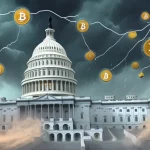
SEC Shifts Crypto Regulation Stance Amid Iran Tensions and DeFi Exploits

 LTB
LTB SEC Signals Regulatory Rethink for Crypto as Markets Face Geopolitical and Security Headwinds
The U.S. Securities and Exchange Commission (SEC) has hinted at a seismic shift in how it handles cryptocurrency regulation, with Chair Paul Atkins declaring an end to the controversial “regulation by enforcement” approach. This potential pivot toward structured rulemaking brings a flicker of hope for clarity in the crypto space, but it’s far from smooth sailing as markets grapple with geopolitical storms, DeFi vulnerabilities, and legislative gridlock.
- SEC’s New Direction: Moving away from enforcement-heavy tactics toward formal rules could ease uncertainty for crypto projects.
- Global Tensions: Iran policy and the Strait of Hormuz standoff threaten to rattle risk assets like Bitcoin.
- Security and Sentiment: DeFi exploits and massive whale transfers underscore ongoing risks and volatility.
SEC’s Regulatory Shift: A Step Toward Clarity or Another False Dawn?
For too long, the SEC has played a game of regulatory whack-a-mole with the crypto industry, slapping projects with lawsuits after the fact instead of setting clear boundaries upfront. This “regulation by enforcement” strategy has left businesses guessing whether their tokens count as securities—essentially investment contracts under strict federal oversight—often learning the hard way through crippling fines or legal battles. Remember the 2017 ICO frenzy? Countless token sales got burned when the SEC retroactively deemed them unregistered securities offerings, crushing innovation under legal uncertainty. Now, SEC Chair Paul Atkins has signaled a break from this approach, announcing the end of such tactics for digital assets. This could mean formal rulemaking—think explicit guidelines on what makes a crypto asset a security or how to register with the agency—finally giving the industry a roadmap instead of a minefield. For more on this pivotal change, check out the latest insights on the SEC’s shift away from enforcement-driven regulation.
“The agency has ended ‘regulation by enforcement’ for the digital asset industry,” said SEC Chair Paul Atkins during a recent statement, hinting at a long-overdue move to structured guidelines.
As a Bitcoin maximalist, I see this as a cautious victory. Bitcoin itself, with its decentralized, no-frills design as peer-to-peer money, might skirt the worst of regulatory overreach. But for altcoins like Ethereum, which power complex ecosystems of smart contracts and decentralized apps, clearer rules could be a game-changer—or a straitjacket if they’re too rigid. Let’s not kid ourselves: the SEC isn’t exactly known for lightning-fast execution. Past attempts at crypto frameworks have crawled along, and there’s a risk that new rules could stifle smaller projects unable to afford compliance costs. Compared to the EU’s Markets in Crypto-Assets (MiCA) regulation, which offers a more unified standard, the U.S. might still lag in fostering innovation. Still, any step away from arbitrary crackdowns aligns with the ethos of freedom and decentralization we champion—provided they don’t botch the follow-through.
Geopolitical Risks: Iran’s Shadow Looms Over Crypto Markets
While regulatory hope glimmers on the horizon, a much darker cloud hangs over crypto markets from halfway across the globe. President Trump’s recent hardline stance on Iran has spiked tensions, with a stark warning that the likelihood of extending a ceasefire is “very low” and that the Strait of Hormuz—a narrow waterway in the Persian Gulf handling about 20% of global oil shipments—won’t reopen without a signed agreement. For those new to geopolitics, this strait is a critical chokepoint; any blockade or conflict there can send oil prices soaring, stoke inflation, and trigger a “risk-off” mood where investors dump speculative assets for safer bets like gold or cash. Bitcoin and altcoins, often classified as high-beta assets (meaning they amplify broader market swings), tend to take a beating in such scenarios, much like stocks.
“The likelihood of extending the ceasefire with Iran is very low, and the Strait of Hormuz would not be reopened until an agreement is signed,” President Trump declared during a tense press briefing, amplifying fears of economic ripple effects.
Confusing the picture further, White House Press Secretary Janet Leavitt offered a contradictory note of optimism, suggesting the U.S. and Iran are “very close” to a deal. Details? Nonexistent. This back-and-forth headline chaos only fuels uncertainty, leaving traders to bet on whether we’re headed for conflict or compromise. History offers a sobering lesson: during the 2020 U.S.-Iran flare-up after the Soleimani strike, Bitcoin initially dipped as risk assets sold off, though it later rallied as a potential “safe haven” during prolonged uncertainty. Could we see a repeat? Possibly, but short-term pain often hits first, and crypto’s sensitivity to macro shocks remains a harsh reality.
“The U.S. and Iran are ‘very close’ to reaching a deal,” said Janet Leavitt, though the vagueness of the statement leaves plenty of room for doubt.
DeFi Under Siege: KelpDAO Exploit Exposes Persistent Flaws
While global tensions shake markets from the outside, crypto’s internal vulnerabilities add another brutal layer of turbulence. Decentralized Finance (DeFi)—blockchain protocols aiming to replace banks and middlemen with code—suffered a gut check with the recent KelpDAO exploit. On April 20 at 11:26 p.m. ET, Arbitrum, a layer-2 solution that speeds up and slashes costs for Ethereum transactions, froze 30,766 ETH tied to the hack, diverting funds to a secure intermediary wallet. Meanwhile, the attacker moved a staggering 50,700 ETH, valued at $117.72 million, to a fresh address. On-chain sleuth ZachXBT tracked the laundering trail, revealing $1.5 million bridged from Ethereum to Bitcoin via THORChain, a cross-chain liquidity protocol, and $78,000 routed through Umbra, a privacy tool for obscuring transactions. The kicker? The exploiter’s initial funding traces back to Tornado Cash, a crypto mixer infamous for anonymizing funds, often linked to illicit activity.
This isn’t a one-off glitch; it’s a glaring neon sign that DeFi security risks remain a massive hurdle. Over $2 billion has been lost to hacks in recent years, eroding trust in these systems. Decentralization is the dream, but right now, it’s like handing a toddler the keys to a Ferrari—brilliant until it inevitably crashes. Bitcoin sidesteps these pitfalls with its simpler, battle-tested design, another reason it reigns as the king of decentralization. Yet, Ethereum and DeFi have their place, driving innovation in financial access and automation. The flip side? There’s hope in community-driven fixes—think multi-signature wallets requiring multiple approvals for transactions, formal code audits, or insurance protocols like Nexus Mutual to cover losses. Until these become the norm, though, every exploit is a reminder that cutting-edge tech comes with bleeding-edge risks.
Whale Movements: Market Sentiment on a Knife’s Edge
Adding to the jittery vibe in crypto markets are mysterious whale transfers—those massive movements of Bitcoin and Ethereum by big players that keep traders guessing. Recently, over $150 million in BTC shifted in two transactions: 2,123 BTC to Coinbase Institutional, possibly hinting at a sell-off or custody move, and 1,999 BTC from Coinbase to an unknown wallet. Meanwhile, 80,000 ETH, worth roughly $184.67 million, was withdrawn from Binance to a new address, which could signal long-term holding (or “HODLing,” as crypto OGs call it). Without clear context, these moves are a psychological game for investors: bullish accumulation or bearish dumping? They ripple through sentiment, amplifying volatility already stoked by macro risks.
Let’s cut through the noise—ignore the Twitter prophets screaming “BTC to $100K on whale news.” Most of it’s baseless shilling meant to pump their own bags. Truth is, these transfers often reflect mundane institutional housekeeping rather than market-moving intent. Still, for retail traders, every blockbuster transaction feels like a storm warning, keeping Ethereum whale movements and Bitcoin price volatility as hot topics in 2023. It’s just another layer of uncertainty in a space that thrives on speculation but desperately needs stability.
Stablecoin Legislation: Banks vs. Crypto in a Regulatory Tug-of-War
On the legislative front, stablecoins—digital currencies pegged to assets like the U.S. dollar to maintain price stability—remain a battleground between traditional finance and crypto’s disruptive ideals. A Senate Banking Committee review of a stablecoin bill, initially set for April 27, may slip into May due to fierce lobbying by banking groups like the North Carolina Bankers Association. The sticking points? Restrictions on yield (the returns stablecoin issuers can offer users), ethics rules for issuers, and oversight of DeFi platforms that often rely on stablecoins for liquidity. Patrick Witt, Executive Director of the White House Crypto Council, didn’t hold back, slamming the delays as rooted in “profit-seeking or ignorance” from banks desperate to protect their turf.
“Banking-industry lobbying is difficult to explain except by ‘profit-seeking or ignorance,’” said Patrick Witt, slicing through the diplomatic fog with a blunt critique.
Stablecoins are the unsung heroes of crypto, acting as a bridge between fiat and digital economies. They power everything from cross-border payments (faster and cheaper than bank wires) to DeFi protocols, where they provide stable liquidity for lending and trading. Their market cap sits north of $150 billion, with players like Tether (USDT) and USD Coin (USDC) dominating. Yet, banks see them as a threat to their deposit and interest models, pushing for rules that could kneecap issuers’ ability to compete. Crypto advocates, on the other hand, argue for lighter-touch regulation to let innovation flourish—especially in DeFi, where stablecoins are often the lifeblood. If these stablecoin legislation delays drag on, expect slower mainstream adoption and persistent friction between centralized power and decentralized vision. The outcome of this fight could shape whether crypto truly disrupts finance or gets boxed in by legacy gatekeepers.
Key Takeaways and Questions for Crypto Enthusiasts
- What could the SEC’s shift away from ‘regulation by enforcement’ mean for crypto growth?
It promises less uncertainty with formal rules, potentially boosting innovation by clarifying securities definitions and compliance paths—though slow implementation or overly strict guidelines could still hinder smaller projects. - How do Iran tensions contribute to Bitcoin price volatility in 2023?
Threats to the Strait of Hormuz risk spiking oil prices and inflation, often dragging high-risk assets like Bitcoin and altcoins down as investors flee to safer havens during global uncertainty. - Do DeFi security risks like the KelpDAO exploit threaten the sector’s future?
They’re a serious setback, exposing flaws that erode trust, but solutions like audits and insurance protocols show the space can evolve—adoption depends on fixing these cracks fast. - Why do Bitcoin and Ethereum whale movements stir market anxiety?
Massive transfers can signal selling or holding strategies, fueling price swings, though they’re often just routine institutional moves rather than actionable market signals. - What’s driving delays in U.S. stablecoin legislation, and why does it matter?
Banking lobbyists are stalling over yield limits and DeFi oversight to protect traditional finance, while stablecoins are vital for crypto’s role in payments and liquidity—delays slow broader adoption.
Steering through today’s crypto landscape feels like building a skyscraper in an earthquake zone: ambitious, risky, and prone to collapse if the foundation isn’t solid. The SEC’s hinted overhaul offers a blueprint for legitimacy, but immediate threats—geopolitical flare-ups with Iran, DeFi’s security potholes, and legislative arm-wrestling over stablecoins—keep the ground shaking. Bitcoin stands as the bedrock of decentralization in my view, immune to many of altcoins’ smart contract woes, yet Ethereum and other protocols carve out vital niches in this financial uprising. As champions of effective accelerationism, we must push disruptive tech forward, potholes be damned, but let’s not swallow every hyped narrative or price prediction—most of it’s pure garbage. Crypto’s potential to redefine money and freedom burns bright, but the path is littered with landmines. We tread boldly, eyes wide open.