Powell Out, Warsh In: Fed Shift Could Hit Bitcoin Short Term, Boost It Long Term
 LTB
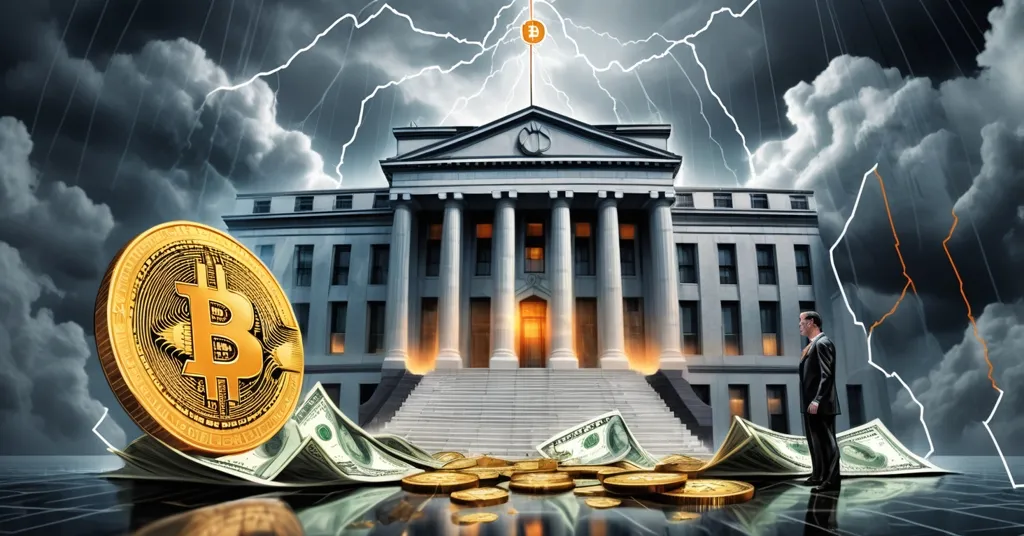
LTB Jerome Powell’s Fed tenure is ending with markets still glued to the central bank’s every move, and Bitcoin traders pretending macro doesn’t matter while absolutely trading like it does. After eight years of crisis management, inflation whiplash, and a balance sheet that swelled to absurd size, Powell is handing the Federal Reserve torch to Kevin Warsh, a more inflation-hawkish successor who is also surprisingly respectful toward Bitcoin, according to Jerome Powell’s Fed Legacy and Kevin Warsh’s Policy Shift: What It Means for Markets and Bitcoin.
- Powell’s legacy: emergency stimulus, late inflation response, and a painful tightening cycle
- Bitcoin’s reaction: liquidity helped fuel the crypto boom, then tighter policy cooled risk appetite
- Warsh’s direction: tougher on inflation, serious about shrinking the Fed’s $6.7 trillion balance sheet
- Crypto takeaway: short-term headwinds for speculative assets, long-term support for Bitcoin’s scarcity thesis
Jerome Powell is set to deliver what is described as his final Federal Reserve press conference, closing an eight-year run that will be remembered less for smooth stewardship and more for nonstop crisis triage. He inherited a relatively stable economy from Janet Yellen, then got hit with the COVID-19 pandemic, historic inflation spikes, and regional banking failures. That is a brutal hand for any Fed chair, but the policy choices that followed made the ride even messier.
When the pandemic hit in 2020, the Fed cut interest rates to zero and rolled out emergency lending programs. For readers who don’t live and breathe central banking jargon: lower rates make borrowing cheaper, and emergency lending programs are basically the Fed stepping in as a backstop when financial markets start freezing up. In plain English, the Fed turned the money taps wide open to keep the system from seizing.
That move helped stabilize financial markets. It also lit a fire under risk assets, including Bitcoin and the wider cryptocurrency market. When cash is cheap and dollars are flooding the system, investors tend to get adventurous. Suddenly, assets with a fixed supply start looking a lot more attractive than assets that can be printed, diluted, or “managed” into the ground by bureaucrats with a printer and a policy memo.
“His rapid response in 2020, which included slashing interest rates to zero and launching emergency lending programs, helped stabilize financial markets and indirectly fueled the cryptocurrency boom.”
Bitcoin surged dramatically during that period, and the reason is not mysterious. Bitcoin is highly sensitive to liquidity, meaning the amount of money flowing through the financial system. When liquidity is abundant, speculative assets usually rally. When liquidity tightens, they usually get slapped. Bitcoin may be a decentralized asset, but it is not floating in a macro vacuum.
That pandemic response also reinforced the core Bitcoin thesis for a lot of investors: when central banks go full “don’t worry, we’ve got this,” the long-term costs usually arrive later in the form of inflation, asset bubbles, and distorted incentives. The Fed may have prevented a deeper collapse in 2020, but it also showed the same old central banking habit — fix the immediate fire, then act surprised when the smoke detector goes off again two years later.
Powell is now being criticized for responding too slowly to rising inflation in 2021. That delay mattered. Inflation was not caused by one man alone — supply chain disruptions, massive fiscal stimulus, and global energy shocks all played a role — but the Fed’s hesitation made the problem worse. Once inflation got out of hand, the central bank had to slam the brakes.
That led to an aggressive tightening cycle, with rapid rate hikes designed to drag inflation back down. Current Fed policy rates are stated at 3.50% to 3.75%, while inflation is described as stabilizing at 3.3%. That’s a big improvement from the worst of the post-pandemic price surge, but it’s not exactly a victory lap.
“His delayed response to rising inflation in 2021 forced the Fed into an aggressive tightening cycle”
For those less familiar with Fed mechanics, tightening means making money more expensive and credit harder to access. Higher rates cool borrowing, slow speculation, and usually pressure stocks, crypto, and other risk assets. That was the point — but the Fed’s whiplash approach created new stress elsewhere in the system.
The result was banking sector strain and several regional bank collapses in 2023. That is the dirty little truth of aggressive rate hikes after years of ultra-loose policy: institutions that loaded up on low-yield assets suddenly find themselves underwater when rates rise fast. Unrealized losses become very real problems very quickly. The same central bank that flooded the system with money ended up creating the conditions for stress when it yanked liquidity back out.
Fed communication during this period has also been criticized as inconsistent, which is not ideal when markets are trying to price everything from mortgage rates to Bitcoin spot flows. Confidence matters. When the central bank sounds like it is making it up as it goes, traders start assuming it probably is.
Now Kevin Warsh is expected to take over, and he arrives with a more hawkish stance on inflation. “Hawkish” simply means more aggressive about fighting inflation, even if that slows growth and dampens market enthusiasm. Warsh also wants to reduce the Fed’s roughly $6.7 trillion balance sheet. That balance sheet is the Fed’s giant pile of assets built up through years of bond buying and crisis intervention. Shrinking it means pulling money back out of the financial system instead of leaving it sloshing around to fuel speculation.
“Kevin Warsh now steps into this challenging environment with a more hawkish stance on inflation”
For markets, that likely means a tougher environment for leverage-heavy trades, meme assets, and the kind of speculative froth that thrives when money is cheap. Tighter liquidity conditions may pressure risk assets like Bitcoin in the short term. That is not bullish for traders hoping for an easy rally off the back of central bank easing, and it is even less friendly to altcoins that depend on frothy sentiment and endless liquidity to stay airborne.
Still, Warsh’s arrival comes with an interesting twist: he has spoken positively about Bitcoin. He has described it as a sustainable store of value and acknowledged its role in the financial system. That is not exactly a full-blown conversion to orange-pilled maximalism, but it is a meaningful shift from the usual reflexive anti-crypto nonsense that pours out of Washington like stale coffee from a broken machine.
“describing Bitcoin as a sustainable store of value and acknowledging its role in the financial system.”
That matters because it signals something bigger than one man’s opinion. Even inside traditional policy circles, Bitcoin is no longer being dismissed as a punchline. It is increasingly recognized as an asset shaped by scarcity, distrust in monetary debasement, and the need for an alternative to centrally managed money. Bitcoin does not need the Fed’s blessing. If anything, it has grown stronger by surviving the Fed’s repeated mistakes.
There is also a useful devil’s-advocate angle here. A hawkish Fed is not automatically “good” for Bitcoin. In the short term, it can absolutely hurt BTC price action because less liquidity means less fuel for speculative flows. If investors are forced to park money in safer, higher-yielding assets, the appetite for risk usually shrinks. That is just how markets work, whether the maxis like it or not.
But the longer-term picture is different. If Warsh really does push for stricter monetary discipline and a smaller Fed footprint, it strengthens the argument for Bitcoin as a non-sovereign store of value. The more central banks make money harder to trust, the better Bitcoin’s hard-capped supply narrative looks. Scarcity is not a marketing slogan. It is the whole point.
Powell’s exit therefore marks more than a personnel change. It closes one chapter of emergency-era central banking and opens another that may be less forgiving for speculative assets. For Bitcoin, that means the near-term backdrop could be choppy, especially if the Fed keeps reducing liquidity and stays serious about inflation. But it also means the macro case for decentralized money remains intact — maybe even stronger.
Bitcoin has always been a bet against monetary excess, policy confusion, and the idea that a small group of central planners can steer the economy without creating fresh distortions. Powell’s Fed gave that thesis plenty of ammunition. Warsh may tighten the screws further, which could bruise markets now and strengthen the case for Bitcoin later. That is the uncomfortable reality: the same policy discipline that slows the party often makes the hardest money look the smartest.
Key takeaways and questions
-
What is Powell leaving behind?
An economy shaped by pandemic stimulus, inflation shocks, aggressive rate hikes, and banking instability. His tenure helped prevent a collapse in 2020, but it also set up the inflation and market stress that followed. -
Why did Bitcoin benefit during Powell’s tenure?
Zero interest rates, emergency lending, and abundant liquidity boosted risk assets across the board. Bitcoin tends to rise when money is cheap and confidence in fiat policy gets shaky. -
What is Powell criticized for?
He moved too slowly on inflation in 2021, then had to tighten aggressively afterward. That whiplash contributed to banking stress and several regional bank collapses in 2023. -
Who is Kevin Warsh and why does he matter?
He is the expected successor to Powell and is seen as more hawkish on inflation. He also wants to shrink the Fed’s $6.7 trillion balance sheet, which could mean less liquidity for markets. -
Is Warsh hostile to Bitcoin?
No. He has described Bitcoin as a sustainable store of value and acknowledged its place in the financial system, which is a notable departure from the usual knee-jerk anti-crypto stance. -
What does a hawkish Fed mean for Bitcoin?
Short term, it can pressure Bitcoin because tighter liquidity usually hurts risk assets. Long term, it can strengthen Bitcoin’s appeal as a scarce, decentralized alternative to fiat mismanagement. -
What should Bitcoin holders watch next?
Interest rate policy, balance sheet reduction, and how aggressively the next Fed chair fights inflation. Those signals will shape liquidity conditions, and liquidity still matters a lot for BTC price action.