CLARITY Act Markup Looms as Senate Crypto Bill Faces 60-Vote Hurdle
 LTB
LTB The CLARITY Act Thursday markup explained is heading into a Senate Banking Committee markup on Thursday, but that is not the same thing as crypto getting regulatory clarity. It is only the first ugly grind through a legislative process that still has several ways to go sideways.
- Markup is not passage
- 60 Senate votes are the real hurdle
- Over 100 amendments could reshape the bill
- Bipartisan support may decide whether it survives
For anyone who has been watching Washington treat crypto like a mix of policy problem, political bargaining chip, and fundraising hobby, the key point is simple: a committee vote is not a victory lap. A successful markup on Thursday does not mean the CLARITY Act becomes law. It does not even mean the bill automatically reaches the Senate floor. It only means the Senate Banking Committee has debated, amended, and voted on a draft well enough to send it to the next stage.
The CLARITY Act itself is meant to create a framework for deciding which digital assets are treated like securities and which fall under commodities rules. That matters because the current U.S. setup is a jurisdictional mess, with agencies like the SEC and CFTC often leaving builders, exchanges, and investors guessing which rulebook applies. In plain English: the bill is trying to decide who gets to police crypto, and under what standards. That is not some minor paperwork exercise. It is the legal plumbing beneath the entire market.
Tim Scott, chairman of the Senate Banking Committee, will present the base draft. Then comes the part where Capitol Hill does what it does best: turn a supposedly focused bill into a political hay baler full of amendments, side-deals, and “must-have” provisions that were somehow never mentioned until the moment votes became necessary.
More than 100 amendments have reportedly been filed. That is not what consensus looks like. That is what happens when lawmakers, staffers, lobbyists, and assorted Washington organisms all see one of the rare major Senate Banking Committee bills and rush to stuff their favorite priorities into the vehicle before it leaves the station.
“A successful markup on Thursday does not mean the bill becomes law.”
“It does not even mean the bill goes to the Senate floor for a vote.”
Ron Hammond, head of policy and advocacy at Wintermute, laid out why this moment matters. Major Senate Banking Committee bills are rare. He said the committee has passed roughly three major bills in the past decade: Dodd-Frank, a fix to Dodd-Frank, and the GENIUS Act. That is a tiny list for one of the most powerful committees in Congress, and it shows why this markup is being treated like a serious event rather than another ceremonial snooze-fest.
Hammond also described the usual Senate habit of loading up legislation with unrelated goodies to win support.
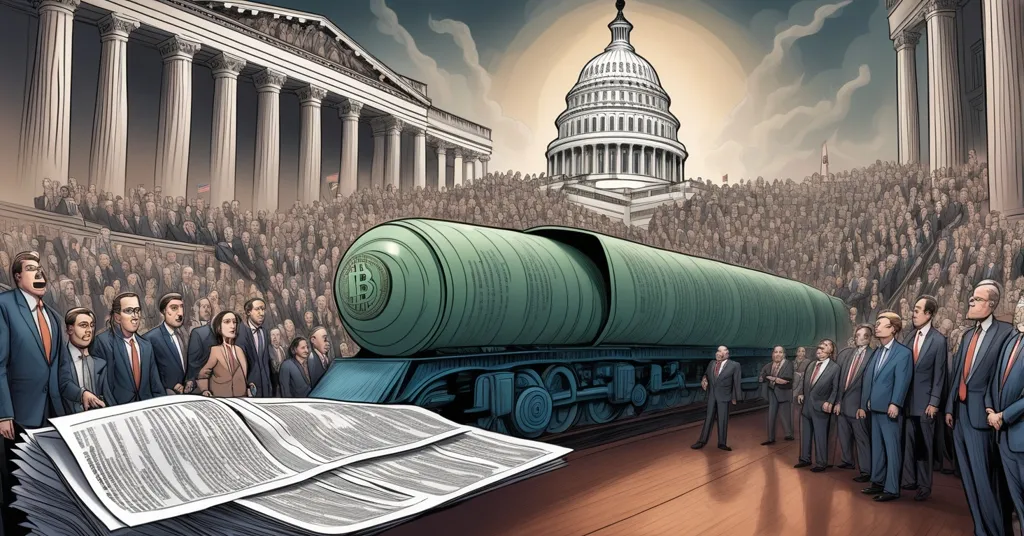
“The Senate, Hammond explained, loves to see what it can attach. These trains do not leave the station often.”
That pretty much sums up Washington’s legislative art form: build a train, then let every lobbyist in the building try to bolt on an extra carriage. In this case, a housing provision is reportedly included, a prediction market provision was rejected, and a credit card competition measure that had been attached to the GENIUS Act was later removed. It is classic Senate sausage-making, except the sausage is expensive, slow, and mostly served cold.
For readers less steeped in Capitol Hill procedure, a markup is the committee stage where lawmakers debate a bill line by line, propose amendments, and vote on whether the draft should advance. Think of it as the part where the bill gets stress-tested before it is allowed to face the bigger political brawl. It is still early. It is still messy. And it is still very capable of blowing up.
Even if the Banking Committee version passes, the job is not even close to done. The bill must then be harmonised with the Agriculture Committee version, since the two committees have handled separate pieces of the broader package. That reconciliation could take two to three weeks, assuming nobody decides to turn a technical drafting exercise into a turf war. Washington loves a turf war almost as much as it loves pretending one round of committee politics means the mission is accomplished.
“The other half passed through the Agriculture Committee separately.”
That split matters because crypto legislation in the Senate often gets divided along financial and commodities lines. Banking handles one slice of the problem; Agriculture handles another. The result is a legislative jigsaw puzzle where two committees have to build compatible versions before the Senate can even think about floor action. If the pieces do not fit cleanly, the whole thing stalls. Simple as that.
And then comes the actual wall: 60 votes in the full Senate. The bill needs 60 votes to pass, which means Republicans plus about 9 to 10 Democrats would have to support it. That is not a small ask in a chamber where bipartisan cooperation often feels like a rare bird sighting. Senate leaders will not bring the bill to the floor unless they believe that threshold is realistic, because nobody wants to waste time on a doomed vote that dies in public and poisons the next round of negotiations.
“The bill needs 60 votes to pass the full Senate floor.”
This is where the math gets less theoretical and more brutal. One last-minute defection can kill a supposedly safe push, which is why the McCain healthcare vote is always lurking in the background as a cautionary tale. Legislative momentum can look strong right up until it craters under the weight of one senator deciding to torch the whole thing. That is not drama; that is just Senate reality.
The immediate question, then, is whether any Democrats on the Banking Committee vote yes on Thursday. If the committee vote is bipartisan, the CLARITY Act gains real credibility and a better shot at surviving the floor fight. A bipartisan committee result signals that the bill can attract support beyond the Republican conference, which matters when the endgame requires 60 votes and not just partisan chest-thumping.
If the vote breaks along party lines, the bill is not dead, but the path gets nastier. A party-line markup can make floor negotiations harder by shrinking goodwill and making Democratic support more expensive. That is the kind of procedural bruise that can haunt a bill later, especially when senators start asking whether they want to spend political capital on something that already looked partisan at committee stage.
For crypto, the stakes are bigger than Washington theater. The CLARITY Act could help define the rules around digital asset markets in a way that reduces the current regulatory fog. Supporters want clearer lines for token classification, more predictable compliance for exchanges and custody providers, and fewer “regulate by enforcement” surprises that leave builders dodging legal landmines. That upside is real. The industry has spent years living in a swamp of uncertainty, and that helps nobody except lawyers and opportunists.
But there is a darker side too. Bad legislation can lock in sloppy definitions, create loopholes, or hand bureaucrats a fresh toolset for confusion. “Clarity” in Washington has a funny way of becoming “we made it worse, but with cleaner formatting.” That is why the actual text matters more than the marketing. A bill can sound pro-innovation and still be a mess once the amendments finish chewing through it.
There is also a broader policy fight underneath the headlines: SEC versus CFTC jurisdiction, securities versus commodities treatment, and whether the U.S. can finally stop pretending that regulatory ambiguity is a strategy. For builders, this is not abstract. It affects how tokens are issued, where they trade, how they are custodied, and what kind of compliance burden lands on startups versus established exchanges. For investors, clearer rules can mean fewer nasty surprises. For scammers, tighter definitions can be a problem. Good.
The upside is obvious if lawmakers get this right. The downside is equally obvious if they do not. Crypto does not need another grand legislative gesture that ends up as a zombie bill with pretty branding and terrible mechanics. It needs rules that are usable, enforceable, and not written by people who still think “blockchain” is just a synonym for internet magic beans.
Here is the basic path from here:
- Senate Banking Committee markup on Thursday
- Committee vote on the amended draft
- Harmonisation with the Agriculture Committee version
- Final Senate floor scheduling, if leadership thinks 60 votes are reachable
- Potential House consideration or conference process after that
That road is long, and it can get uglier at each stop. A successful markup is progress, yes. But it is also just the opening move in a very expensive game of political chess where half the pieces are technically extra provisions nobody asked for.
- What is a markup?
It is the committee stage where senators debate, amend, and vote on a bill before it can move forward. It is progress, not passage. - Does a successful markup make the CLARITY Act law?
No. The bill still has to survive more committee work, Senate leadership decisions, and a floor vote. - Why do so many amendments matter?
More than 100 amendments suggest the bill is still being fought over, shaped, and bargained around rather than broadly settled. - Why is bipartisan support so important?
Because the Senate needs 60 votes, and Republicans alone cannot get there. - What happens after the Banking Committee vote?
The Banking Committee version still has to be harmonised with the Agriculture Committee version before the Senate can seriously move it forward. - Why does Thursday matter at all?
Because a bipartisan committee result would improve the bill’s chances, while a party-line vote could make the next phase harder. - What does the CLARITY Act mean for crypto?
It could finally set clearer rules for digital assets, including how tokens are classified and which regulators oversee them.
Thursday matters. But it is the beginning of the hard part, not the end. If the CLARITY Act is going to become real law rather than another Washington acronym with a hype problem, it still has to survive amendments, reconciliation, 60-vote arithmetic, and a Senate that can turn on a dime. No champagne yet. The knives are still out.