Kalshi Backs Lobbying Push as Prediction Markets Face Legal Crackdown
 LTB
LTB Kalshi is turning up the pressure in Washington, backing a new lobbying group as prediction markets face a growing pile-up of legal, political, and regulatory threats.
- Kalshi backs Americans for Fair Markets
- Taylor Budowich joins as strategic advisor
- CFTC oversight is the main goal
- Congress is probing Kalshi and Polymarket
- State gambling fights are heating up fast
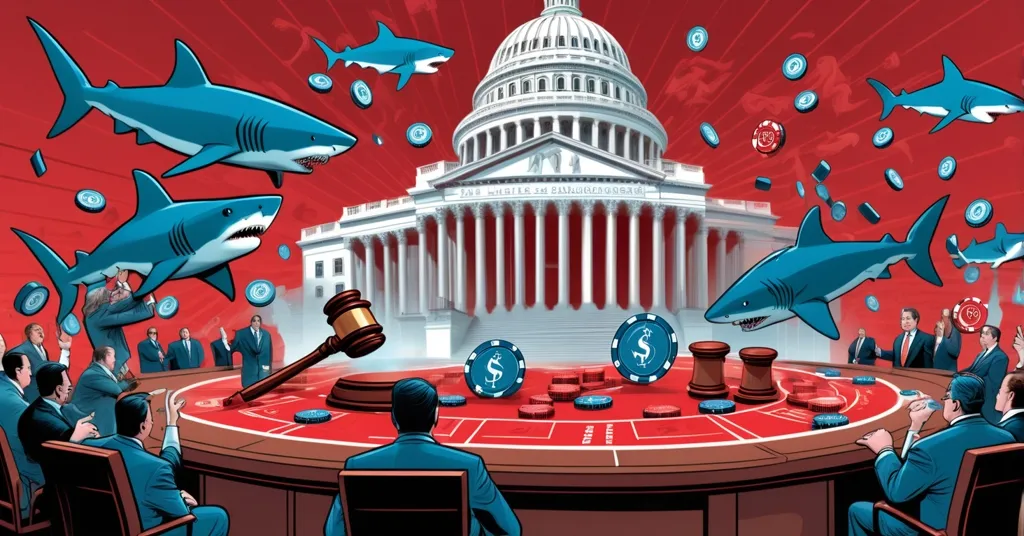
Kalshi has helped launch Americans for Fair Markets (AFM), a new advocacy group built to defend prediction markets as casinos, sportsbooks, state regulators, and lawmakers all start circling like sharks that just smelled blood in the water.
For anyone new to the concept, prediction markets let people trade contracts tied to real-world outcomes. That can mean elections, inflation data, court rulings, sports events, or other yes-or-no events. If the event happens, the contract pays out; if not, it doesn’t. Supporters say these markets are useful because they can aggregate information faster than polls or punditry. Critics say they are just gambling with better branding. Both camps have a point, which is usually how these fights end up getting ugly.
AFM’s mission is simple enough: push for federal oversight under the Commodity Futures Trading Commission (CFTC), defend prediction markets from state-by-state crackdowns, and clean up the public narrative around event contracts before incumbent betting interests lock the door.
The group is not shy about its target. Kalshi says AFM will fight what it calls “false narratives” spread by sportsbook and casino interests. That’s hardly a shock. When a new market threatens old cash cows, the “consumer protection” crowd often arrives wearing a lobbyist badge and a bucket of crocodile tears.
Helping steer the effort is Taylor Budowich, former Trump White House deputy chief of staff under Susie Wiles, who has joined as a strategic advisor. That’s a serious political signal. Prediction markets are no longer just a quirky fintech product or a crypto-adjacent curiosity. They are becoming a real lobbying battleground with the kind of connections that can shape how regulators, lawmakers, and agencies treat them.
AFM says its priorities include know-your-customer (KYC) checks, bans on insider trading, full CFTC funding, and limits on contracts tied to war, death, terrorism, and assassination. KYC means identity checks so platforms know who their users are. Insider-trading safeguards are supposed to stop traders from using non-public information to game the system. On paper, these are basic guardrails. In the real world, they’re only as good as the people enforcing them, and compliance theater is a thriving industry all by itself.
Why prediction markets are under fire
The pressure is coming from multiple directions at once.
On one side, prediction markets are increasingly being viewed as a threat by sportsbooks and casinos, which see a new kind of competition that doesn’t play by the old casino playbook. On the other side, state regulators are arguing that some event contracts — especially sports-related ones — are basically gambling and should fall under state gambling laws, not federal derivatives rules.
That legal distinction is the whole game. Kalshi wants these products treated as federally regulated financial instruments under the CFTC. States want to keep control over anything that smells like betting. And because prediction markets sit in that gray zone between finance, information, and gambling, everyone gets to claim the law is on their side.
The ambiguity is part of the appeal and part of the headache. Prediction markets can be useful tools for pricing uncertainty, but if the market is weak on controls, then the whole thing starts looking like a rigged betting shop with a shinier interface. That’s the problem Kalshi has to solve if it wants mainstream legitimacy.
Congress is now watching closely
The U.S. House Committee on Oversight and Government Reform has opened an investigation into both Kalshi and Polymarket. Lawmakers are asking for records related to user checks, geographic restrictions, and suspicious-trading controls. The concern is obvious: if people can trade on event contracts using non-public government information, then the market stops looking like a crowd-sourced forecasting tool and starts looking like a fraud machine with better PR.
That worry is not theoretical. Reports have cited an Army master sergeant accused of using classified information to make more than $409,000. If that kind of behavior is real and not just isolated noise, it’s exactly the sort of scandal that can poison trust in prediction markets fast.
And trust is the whole product. Prediction markets only work if users believe the prices reflect real information and not insider tricks, jurisdictional arbitrage, or a half-baked compliance setup. Once that credibility gets burned, good luck rebuilding it.
The state-level fight is getting messier
Kalshi and Polymarket have already lost emergency legal bids in Nevada and Washington. A Ninth Circuit panel also ruled that a federal derivatives defense does not automatically move state gambling cases into federal court.
That matters because it knocks down the idea that simply labeling a product a derivative magically shields it from state enforcement. It doesn’t. States still have teeth, and they are not thrilled about being told to sit quietly while federally regulated prediction markets eat into their turf.
For state regulators, the argument is straightforward: if a contract functions like gambling, then it should be regulated like gambling. For Kalshi, that is exactly the wrong framing. The company wants prediction markets recognized as a legitimate, federally supervised market structure, not shoved into the same legal bucket as your average sportsbook parlay.
And let’s be honest: the states are not just making a philosophical argument. Gambling regulation means control, enforcement power, and tax revenue. Nobody in a statehouse wants to hand that over to Washington if they can help it.
Kalshi is also chasing the institutional crowd
While the legal fight plays out, Kalshi is pushing toward more serious use cases. That includes bespoke block trades and regulated access through Clear Street. Bernstein has described that move as a step toward institutional event-risk trading.
In plain English, that means larger and more professional traders may start using prediction markets to hedge or express views on real-world outcomes in a regulated setting. That’s not just retail punters guessing on election odds. That’s a market trying to become infrastructure.
That shift matters. If prediction markets can attract institutions, they gain liquidity, depth, and credibility. They also become more valuable as tools for pricing uncertainty around politics, economics, regulation, and other messy real-world events. That could be a genuine breakthrough for market-based forecasting.
But there’s a flip side. The more institutional these markets become, the more regulators will care, the more lawyers will hover, and the more every compliance failure will get dragged into daylight. Bigger markets don’t just bring legitimacy. They also bring heavier scrutiny and bigger consequences when things go wrong.
Media exposure is accelerating too
The visibility push is expanding beyond finance and Washington. Fox is set to stream Kalshi probabilities across its networks, following similar integrations with CNN and CNBC.
That kind of media integration is a big deal. It normalizes prediction markets by making them part of the broader news cycle. It also turns them into a public-facing signal that viewers can see alongside polls, price charts, and political coverage. If those odds are accurate and responsibly presented, that can be useful. If not, it becomes just another layer of speculative noise dressed up as insight.
Kalshi head of government relations John Bivona, who also sits on the AFM board, put the company’s view bluntly:
“We’re not going to be outspent or out-organized by entrenched interests protecting their monopolies.”
That’s the core of the fight. This is not just a debate over legal definitions. It’s a battle over who gets to shape the future of prediction markets: the incumbents defending their monopoly-like control, or the new entrants pushing for a federally recognized framework that lets markets price uncertainty more openly.
For Bitcoin and crypto people, the whole mess should sound familiar. Anything that challenges centralized gatekeepers tends to get hit with the same old playbook: scare stories, jurisdiction games, and sudden concern for the little guy from organizations that usually couldn’t care less about him. That doesn’t mean the challengers are pure saints. Far from it. But it does mean the backlash often has less to do with principle than with money and control.
Prediction markets are still vulnerable to abuse. They can be manipulated. They can be gamed. They can be used by people with non-public information. That’s why the pro-innovation crowd has to do more than just wave the flag and yell “disruption.” It has to prove these systems can be fair, enforce rules properly, and survive political crossfire without turning into a scam circus.
Questions and key takeaways
What is Americans for Fair Markets?
It is a new advocacy group backed by Kalshi that will lobby for federal prediction market rules, consumer protections, and CFTC oversight.
Why is Kalshi backing this group now?
Because prediction markets are under pressure from Congress, regulators, casinos, and sportsbooks, and Kalshi wants to shape the policy fight before opponents define the rules for everyone else.
Who is Taylor Budowich and why does he matter?
He is a former Trump White House deputy chief of staff now serving as a strategic advisor to AFM, giving the group political reach and added credibility in Washington.
Why are Congress and regulators looking at Kalshi and Polymarket?
They are concerned about insider trading, weak user checks, geographic restrictions, and the possibility that traders could profit from non-public government information.
Are prediction markets gambling?
That is the central fight. Kalshi says they are federally regulated derivatives, while state regulators argue some contracts, especially sports-linked ones, are gambling by another name.
What is the core regulatory battle?
Whether prediction markets should be governed mainly by the CFTC at the federal level or by state gambling laws.
Why do casinos and sportsbooks care?
Because prediction markets could compete with their business and threaten their control over betting markets. They are not exactly rooting for a new competitor.
What risks do prediction markets face?
Legal uncertainty, state enforcement, congressional scrutiny, insider-trading scandals, and reputational damage if the platforms can’t prove they are fair and well controlled.
What does the institutional push mean?
It suggests prediction markets may be moving beyond retail speculation into professional event-risk trading, which could make them more useful but also more heavily scrutinized.
What big question remains unresolved?
Whether prediction markets become a legitimate, federally recognized financial product or get boxed in as gambling with a nicer suit on.
The real test is not whether prediction markets can attract attention. They already have that. The test is whether they can survive the legal beating, clean up the obvious risks, and prove they are more than just another shiny market structure waiting to be swallowed by bureaucracy or bled dry by incumbent pressure. If they fail, the whole sector gets shoved back into the junk drawer. If they succeed, they could become one of the more interesting financial innovations to emerge in years.