Bitcoin ETFs Surge as Institutions Dive In Amid Global Economic Turmoil
 LTB
LTB Institutional Bitcoin Push Accelerates as ETFs Boom Amid Global Chaos
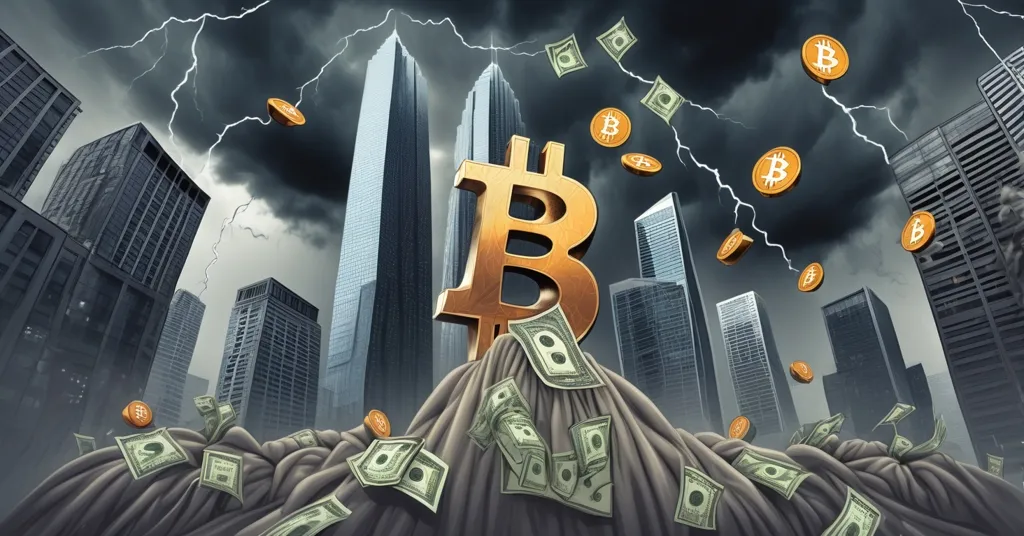
Bitcoin and cryptocurrencies are no longer fringe experiments—they’re storming the gates of traditional finance with institutional muscle behind them. Heavyweights like Osprey Funds and BlackRock are fueling adoption through exchange-traded funds (ETFs), but the crypto market faces a gauntlet of macro-economic turmoil, geopolitical flare-ups, and relentless security threats that could make or break this momentum.
- Institutional Wave: Osprey Funds pitches Bitcoin as a must-have asset on CNBC, while BlackRock’s Ethereum staking ETF surges past $254 million.
- Macro Minefield: Fed rate hike fears and Middle East conflicts hammer risk assets like Bitcoin and stocks.
- Digital Dangers: iOS malware ‘GhostBlade’ exposes ongoing vulnerabilities for crypto holders.
Institutional Momentum: Bitcoin and Ethereum Go Mainstream
The push for Bitcoin (BTC) to become a staple in traditional portfolios is hitting a fever pitch, driven by a growing institutional interest in Bitcoin ETFs amid economic uncertainty. Osprey Funds, overseeing $500 million in assets, made a gutsy appearance on CNBC, arguing that Bitcoin isn’t just a speculative gamble—it’s a new asset class that deserves a permanent spot in every investor’s toolkit. Their message to financial advisers was blunt: stop treating BTC as a quirky side bet and start recommending it as a core holding. They framed Bitcoin as a hedge against inflation and a digital gold for the modern era, a narrative that resonates deeply with those of us who see BTC as the ultimate middle finger to fiat decay. But the reality on the ground is messier—many advisers and mainstream platforms remain skittish, slowed by regulatory red tape and the whiplash of crypto’s notorious volatility. This distribution bottleneck is the real hurdle, even as the logic for Bitcoin’s inclusion grows undeniable.
Meanwhile, Ethereum (ETH) is carving its own path into institutional hearts with BlackRock’s iShares Staked Ethereum Trust (ETHB). This ETF, focused on staking yield, racked up over $254 million in assets under management (AUM) in just a week after launch. For the unversed, staking means locking up your ETH to help secure the Ethereum network, earning rewards in return—think of it as a crypto savings account with a decent interest rate. BlackRock’s rapid success with this product screams one thing: institutional investors are hungry for yield in a world where traditional bonds and savings accounts are yielding peanuts. This isn’t just a win for Ethereum; it’s a signal that TradFi is ready to embrace more complex crypto mechanisms beyond simply holding coins. But let’s pump the brakes—could this influx of Wall Street cash start to centralize what was meant to be a decentralized revolution? It’s a nagging thought worth chewing on.
Macro-Economic Storm Clouds: A Threat to Risk Assets
Before we get too cozy with this institutional love fest, let’s face the harsh winds blowing against crypto. The broader economic landscape is a mess, and cryptocurrencies, as risk assets, are caught in the crossfire. Bank of America dropped a sobering warning, as reported by Odaily:
“The possibility of a Fed rate hike this year cannot be fully ruled out should inflation re-accelerate.”
What does this mean for Bitcoin and its peers? Higher interest rates are like turning off the money faucet—liquidity dries up, and speculative investments like crypto and stocks get hammered as investors flock to safer bets like bonds. With inflation already twitchy due to spiking energy prices tied to Middle East tensions involving the U.S., Israel, and Iran, the Federal Reserve might have no choice but to tighten the screws. We’ve seen this movie before: during past rate hike cycles like in 2018, Bitcoin took a nosedive alongside equities as cheap money vanished. History doesn’t always repeat, but it sure as hell rhymes.
Geopolitical chaos adds another layer of pain. The ongoing conflicts in the Middle East aren’t just news headlines—they’re dragging down risk assets in sync. Bitcoin and stock indexes have shown an unsettling correlation lately, tumbling together when global uncertainty spikes. Then there’s the U.S. government’s recent move to issue licenses for limited sales of Iranian oil. On paper, this could ease crude prices temporarily, but the domino effect on inflation and Fed policy is a wildcard. If energy costs keep climbing, inflation could force tighter monetary policy, sucking the air out of crypto markets. Decentralization be damned—Bitcoin might be borderless, but it’s still tangled in the web of centralized power plays and government meddling.
Security Vulnerabilities: GhostBlade and the Ever-Present Threat
Even as institutional dollars pour in, the crypto space remains a digital Wild West plagued by bandits. Google Threat Intelligence recently uncovered a nasty piece of malware called ‘GhostBlade,’ targeting iOS devices to swipe private keys and messaging app data. For newcomers, private keys are the secret codes that unlock your crypto wallet—lose them to a hacker, and your funds are gone for good. GhostBlade often spreads through phishing scams, like fake apps or malicious links that trick users into handing over access. While exact loss figures are murky, the rise of such malware is a stark reminder that security risks aren’t diminishing—they’re evolving. If you’re not using a hardware wallet (a physical device that stores keys offline) or layering up with two-factor authentication on exchanges, you’re basically leaving your front door wide open. Institutional adoption means squat if investors—retail or otherwise—can’t safeguard their stacks from these digital vultures.
On-Chain Whispers: Massive Stablecoin Moves Raise Eyebrows
While external threats loom, the blockchain itself is buzzing with activity that keeps traders on edge. Whale Alert flagged a jaw-dropping transfer of 406,945,202 USDC—a stablecoin pegged to the U.S. dollar—valued at roughly $406.9 million, between unidentified wallets. Stablecoins like USDC are often used by big players for treasury shifts or positioning on exchanges, and a move this size could hint at a major trade or market maneuver. It’s not a direct signal of a price swing, but in thin liquidity conditions, such transactions can ripple through the market, nudging volatility. Is this a whale gearing up for a dump, a buy, or just reshuffling assets? We don’t know, but it’s the kind of activity that makes you sit up and watch the charts a little closer.
Future Horizons: Innovation Amidst the Noise
Beyond the immediate turbulence, there are sparks of progress worth noting. Social media platform X has rolled out a feature to detect AI-generated content, aiming to curb the flood of fake news and bot-driven narratives that often whip crypto markets into a frenzy. Pump-and-dump schemes and shoddy token hype thrive on misinformation, so this could be a step toward sanity—if enforcement holds up. Imagine fewer Twitter randos shilling shitcoins with doctored memes; it might just build trust among institutional players who’ve long viewed crypto as a cesspool of scams. But let’s not kid ourselves—tech alone won’t fix human greed or gullibility.
Another frontier with legs is tokenized real-world assets (RWAs), though it’s still in its infancy. Electric Capital notes that only 34 yield-bearing RWAs currently exceed $50 million in on-chain size. These are assets like real estate, commodities, or even AI infrastructure, digitized and traded on blockchain networks like Ethereum or Polygon. The potential here is massive—think trillions in traditional capital flowing onto decentralized rails, offering investors fractional ownership in skyscrapers or data centers. BlackRock and other TradFi giants could salivate over this, but regulatory roadblocks loom large. The SEC has already cracked down on similar innovations, and without clarity, RWAs risk stalling out before they even start. It’s a long game, but one worth watching.
What’s Next for Crypto?
The institutional push for Bitcoin and Ethereum is a game-changer, with ETFs acting as a bridge for TradFi to wade into crypto waters. Osprey Funds and BlackRock are leading the charge, proving there’s real appetite for digital assets among the suits. Yet, the path is littered with landmines—macro-economic pressures, geopolitical shocks, and security gaps like GhostBlade could derail even the most bullish momentum. Bitcoin maximalists like myself see BTC as the bedrock of this revolution, a censorship-resistant fortress that no altcoin can match for sheer resilience. Still, I’ll tip my hat to Ethereum’s staking niche and even some altcoin experiments like Solana’s speed or Polkadot’s interoperability—they fill gaps Bitcoin was never meant to address.
Let’s cut through the noise: institutional money might be crypto’s golden ticket, but will it tame Bitcoin’s rebellious spirit? Could TradFi’s embrace morph into a chokehold, centralizing what we’ve fought to keep free? And don’t fall for the hype merchants on social media promising $100K Bitcoin by year-end just because an ETF launched—pipe dreams aren’t reality. The future of finance is being forged right now, but it’s a brutal, messy process. Stay sharp, lock down your keys, and question everything. Crypto’s ceiling is limitless, but the floor is just as real.
Key Takeaways and Questions for Crypto Enthusiasts
- How are Bitcoin ETFs driving institutional crypto investment?
Firms like Osprey Funds are pushing Bitcoin as a core asset on mainstream platforms like CNBC, while BlackRock’s $254 million Ethereum staking ETF shows TradFi’s growing appetite for digital assets. - What macro challenges threaten Bitcoin and other cryptocurrencies?
Potential Fed rate hikes due to inflation, coupled with Middle East tensions and energy price swings, hit risk assets hard, often dragging Bitcoin down with equities. - What are the risks of crypto malware like GhostBlade in 2023?
This iOS-targeting malware steals private keys via phishing, highlighting persistent security threats—hardware wallets and two-factor authentication are non-negotiable for protection. - Why do massive stablecoin transfers like the $406.9 million USDC move matter?
These often signal whale treasury shifts or exchange positioning, potentially impacting market liquidity and volatility, though their exact intent remains unclear. - What’s the potential of tokenized real-world assets (RWAs) for blockchain?
With just 34 significant RWAs, the sector is early but promising, especially for assets like AI infrastructure or real estate—yet regulatory hurdles could stifle growth.