Bitcoin Pizza Day: 10,000 BTC for Two Pizzas Now Worth Over $767 Million
 LTB
LTB Bitcoin Pizza Day remembers the first known real-world Bitcoin purchase: 10,000 BTC swapped for two pizzas in 2010. What looked like a $41 oddity has since become a billion-dollar monument to Bitcoin’s rise from internet experiment to monetary heavyweight.
- Bitcoin Pizza Day is observed on May 22
- 10,000 BTC bought two Papa John’s pizzas for about $41
- That same stack is now worth more than $767 million
- At Bitcoin’s $126,000 peak, it briefly topped $1.2 billion
- The event now sits at the center of debates over Bitcoin adoption, nation-state reserves, and the future of money
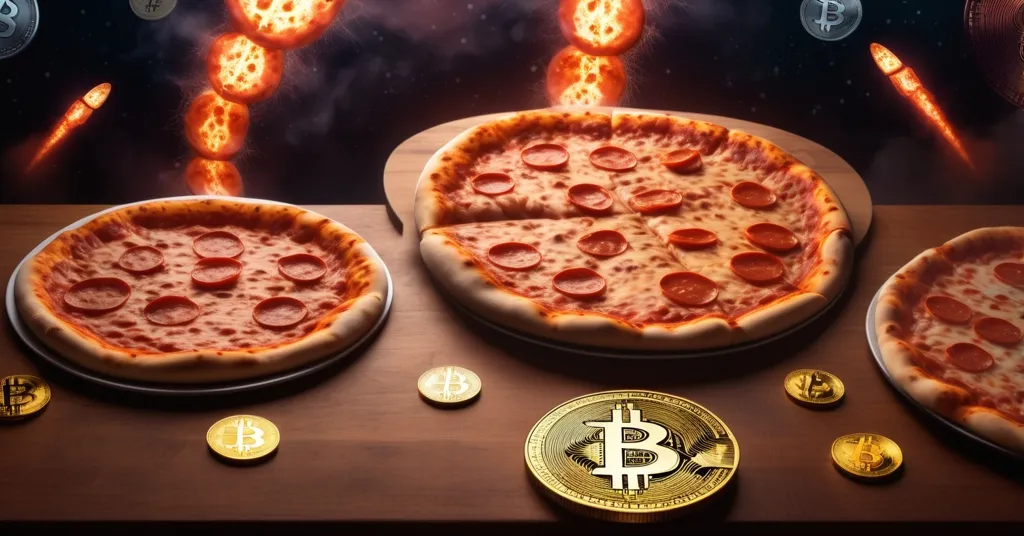
Every May 22, Bitcoin fans celebrate the day software developer Laszlo Hanyecz paid 10,000 BTC for two Papa John’s pizzas in May 2010. The coins were worth about $41 at the time. At today’s prices, that same stack would be worth more than $767 million, and at Bitcoin’s October 2025 all-time high of around $126,000, it briefly crossed $1.2 billion.
That number is ridiculous enough to make anyone wince. It also misses the point if the only takeaway is “wow, expensive pizza.” The transaction was more than a meme before memes were even a serious thing. It was the first widely recognized proof that Bitcoin could be used for real-world commerce, not just mined, hoarded, or discussed in cryptography forums by people who probably owned three keyboards and too many opinions.
Why the pizza purchase mattered
In 2010, Bitcoin was tiny. Network activity was extremely limited, with only a few hundred transactions per day. There was almost no infrastructure, no institutional money, no ETF circus, no treasury strategy decks, and certainly no serious talk of governments holding Bitcoin on reserve. Bitcoin was still a weird, fragile, decentralized digital asset mostly known to a small circle of early adopters.
That’s why the pizza order mattered so much. It gave Bitcoin a price in the real world and, more importantly, a use case. As one account of the moment put it, “the exchange proved that a decentralized digital asset could facilitate real commerce.”
Another way to say it: Bitcoin stopped being just an idea. It became spendable money, even if the economics looked hilariously cursed in hindsight.
Bitcoin advocate Nischal Shetty of WazirX captured that significance well, noting that the transaction showed Bitcoin could support actual commerce. That was the breakthrough. Not the pizza, the proof.
“The transaction was more than a quirky footnote.”
Exactly. The cultural joke is fun, but it papers over how important that first purchase really was. For a monetary network to matter, it has to do something besides exist. It has to move value from one person to another. That’s what happened here.
What Bitcoin Pizza Day says about Bitcoin price history
The Bitcoin price comparison is what turns this into legend. A $41 purchase becoming a nine-figure amount is the kind of appreciation that makes traditional finance look like it’s moving through wet concrete. But the real lesson is not just price volatility or missed gains. It’s that Bitcoin’s market value grew because the network slowly earned credibility as a scarce, censorship-resistant asset.
That growth did not happen in a vacuum. It came from years of development, exchange growth, custody solutions, merchant adoption, institutional interest, and an increasingly loud global argument over whether Bitcoin is money, property, a risk asset, or all three depending on who is talking.
For newcomers, here’s the simple version: Bitcoin as money means using it to store and transfer value without needing a bank in the middle. That’s very different from a stablecoin, which is usually designed to track a fiat currency like the U.S. dollar. Bitcoin is the hard, volatile asset. Stablecoins are the digital dollar wheels that grease a lot of actual payments. Annoying? Sometimes. Useful? Absolutely.
Bitcoin adoption is no longer just about pizza
The anniversary now lands in a much bigger conversation. “Nation-state adoption of Bitcoin has become the new frontier for crypto advocates…” That line would have sounded delusional in 2010. Today it’s a legitimate policy topic, even if the results are uneven and often overhyped.
Governments are not suddenly becoming Bitcoin-maximalist saints. Let’s not get carried away. But Bitcoin has entered the same room as reserve policy, trade settlement, tax treatment, and geopolitics. That alone is a huge shift.
In the United States, lawmakers have pushed for a strategic Bitcoin reserve through the ARMA bill. The basic idea is simple: a government would hold Bitcoin similarly to how it holds other reserve assets, such as gold or foreign currency reserves. Supporters see that as a hedge against monetary debasement and a signal that Bitcoin has graduated from internet experiment to strategic asset. Critics see it as volatile, politically messy, and potentially foolish if treated like a magic balance-sheet cheat code. Both reactions have merit.
Some U.S. states are also moving to exempt Bitcoin payments from certain taxes. That matters because taxes can make or break everyday use. If paying with Bitcoin triggers an annoying tax event every time you buy coffee, the whole thing becomes a bureaucratic trap instead of money. Lowering that friction is one of the few ways to make Bitcoin payments actually usable instead of just theoretically cool.
Iran, tolls, and the gap between headlines and usage
One of the more eye-catching examples of “Bitcoin adoption” came from Iran. In April 2026, Iran announced that ships crossing the Strait of Hormuz could pay tolls in Bitcoin, US dollar stablecoins, or Chinese yuan.
On paper, that sounds like a major milestone: a strategic shipping chokepoint accepting digital money. In practice, the evidence was much murkier. According to Sam Lyman, head of research at the Bitcoin Policy Institute, no onchain evidence had been found showing any oil toll was actually paid in Bitcoin. And in the real world, Tether’s USDT remained the dominant payment method.
That distinction matters a lot. “Onchain evidence” means public transaction records visible on Bitcoin’s blockchain. If payments were really being made in Bitcoin, there should be some trace of that activity. Without it, the announcement looks more like a policy flex than confirmed adoption.
And this is where the crypto industry needs to stop sniffing its own exhaust. A government press release is not the same thing as actual usage. Sometimes the market gets a headline and a whole lot of nothing behind it. Shocking, I know. Bureaucrats love looking futuristic almost as much as marketers do.
That doesn’t mean the Iran example is meaningless. It does show that state actors are willing to talk publicly about Bitcoin and stablecoins as payment options. But the dominance of USDT tells a different story: when money needs to move quickly and predictably, people often reach for a stablecoin rather than Bitcoin itself.
Bitcoin versus stablecoins: different jobs, different tools
This is where a lot of commentary gets sloppy. Bitcoin and stablecoins are not interchangeable. They serve different roles.
Bitcoin is the scarce, decentralized asset. It’s the hard-money bet. It’s the network people turn to when they want resistance to censorship, debasement, and centralized control.
Stablecoins like USDT are typically used for transactional convenience. They track fiat value, reduce volatility, and make settlement easier for trade and payments. They are not Bitcoin, and pretending they are is how you end up with confused analysis and bad arguments.
So when someone says “Bitcoin adoption,” the useful question is: adoption for what? Reserve asset? Treasury asset? Settlement layer? Day-to-day payments? Store of value? The answer is often different depending on the use case.
Bitcoin may be the more important monetary invention, but stablecoins often win the ugly, unsexy battle for practical payments. That is not a failure of Bitcoin. It’s just a reminder that money is a toolbox, not a religion.
The bigger shift: from meme to monetary policy
The fact that Bitcoin Pizza Day now sits alongside reserve policy and trade settlement debates says everything about how far Bitcoin has come. The same asset that once bought two pizzas now shows up in conversations about national balance sheets and international payments.
That doesn’t mean the mission is complete. Far from it. Bitcoin is still volatile, still misunderstood, and still used far more often as a store of value than a day-to-day payment network. But its role has expanded in a way few expected back in 2010.
“What began as a $41 experiment is now a global conversation about national reserves, international trade, and the future of money itself.”
That’s the real meaning of Bitcoin Pizza Day. It marks the point where Bitcoin became real enough to spend, and the point where the world started slowly, awkwardly, and sometimes cynically realizing that the thing might actually matter.
The price of those pizzas is now the joke. The joke is that the world once had a chance to dismiss Bitcoin as internet weirdness and instead ended up with a monetary asset that governments, traders, and policy wonks can’t stop arguing about. Not bad for dinner.
Key questions and takeaways
What is Bitcoin Pizza Day?
It marks the first known real-world Bitcoin purchase, when 10,000 BTC bought two pizzas in 2010.
Why is the pizza transaction so famous?
Because it showed that Bitcoin could be used as money, not just mined, held, or traded.
How much were those 10,000 BTC worth?
About $41 in 2010, more than $767 million at the prices cited here, and briefly over $1.2 billion at Bitcoin’s October 2025 peak.
Did Bitcoin have much usage back then?
No. The network was tiny, with only a few hundred transactions per day and very little infrastructure.
Is Bitcoin being used by governments now?
Some governments and lawmakers are exploring it, including reserve policy ideas and tax changes, but much of the talk is still ahead of actual usage.
Was Bitcoin actually used for Iran’s oil tolls?
No onchain evidence was found for that, and USDT remained the dominant payment method.
Does Bitcoin replace stablecoins for payments?
Not usually. Bitcoin is better suited as a scarce reserve asset and settlement asset, while stablecoins are often more practical for fast payments.
What’s the big debate now?
Whether Bitcoin becomes a true reserve and settlement asset for states and trade, or mainly stays a store of value while stablecoins handle most transactional activity.
What does Bitcoin Pizza Day really prove?
That money only becomes real when people use it. In Bitcoin’s case, two pizzas helped prove the point before billions of dollars of market cap did the heavy lifting.