Kraken’s Fed Master Account Approval Sparks Debate: Win or Risk for Crypto?
 LTB
LTB Rep. Waters Presses Kansas City Fed Over Kraken’s Master Account Approval: Crypto’s Big Win or Regulatory Blunder?
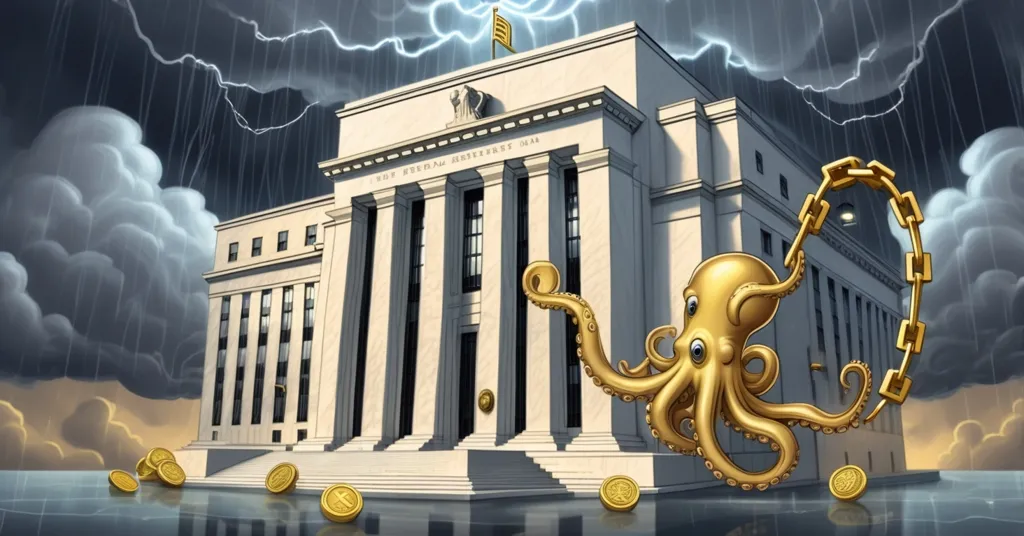
A bombshell decision by the Federal Reserve Bank of Kansas City to grant a Master Account to Kraken, one of the heavyweight cryptocurrency exchanges, has ignited a firestorm of debate. Representative Maxine Waters, a staunch critic of digital assets, is demanding answers, spotlighting the fragile balance between innovation in decentralized finance and the iron grip of financial oversight. This could be a landmark moment for crypto’s legitimacy—or a reckless step into uncharted risks.
- Kraken gains rare Master Account access, linking directly to Federal Reserve payment systems.
- Rep. Maxine Waters slams the decision, citing systemic risks and regulatory gaps.
- The move highlights U.S. crypto policy fragmentation and the clash between freedom and control.
What’s a Master Account, and Why Does It Matter for Crypto?
For those new to the financial plumbing, a Federal Reserve Master Account is like a VIP pass to the central bank’s transaction network. It lets an entity—traditionally a bank—move money directly through the Fed’s payment and settlement systems, think real-time transfers and instant settlements, without relying on middleman banks that often charge hefty fees or impose delays. For Kraken, a crypto exchange founded in 2011 and known for its vast trading volume across Bitcoin, Ethereum, and beyond, this access is a game-changer. It means faster deposits and withdrawals for users, lower operational costs, and a shiny badge of credibility in a sector often viewed as the Wild West of finance. But it also thrusts a decentralized player into the heart of a centralized system, raising eyebrows and red flags alike.
Historically, the Fed has kept its doors tightly shut to non-traditional players like crypto firms. The stringent criteria for a Master Account—robust risk management, airtight compliance, and financial stability—are tailored for legacy institutions, not volatile digital asset platforms. Kraken’s approval by the Kansas City Fed is a rare breach of that wall, potentially signaling a shift in how regulators view crypto’s role in the financial ecosystem. But at what cost?
Kraken’s Leap Forward: Credibility or Compromise?
For Kraken, this Master Account isn’t just a technical upgrade; it’s a middle finger to years of being sidelined by traditional finance. Crypto exchanges have long battled for banking access, often getting de-banked or slapped with delays as skittish intermediaries shy away from the perceived risks of digital assets. Direct Fed access could slash those barriers, letting Kraken settle transactions in real-time and position itself as a bridge between decentralized finance (DeFi) and the old-school banking world. Imagine a retail trader depositing fiat to buy Bitcoin and seeing the funds clear instantly—that’s the kind of user experience boost we’re talking about.
Yet, Kraken isn’t without baggage. While it’s one of the more reputable exchanges, boasting stringent anti-money laundering (AML) and know-your-customer (KYC) protocols, its track record isn’t spotless. In 2023, the U.S. Securities and Exchange Commission (SEC) hit Kraken with a $30 million settlement over its staking program, alleging it offered unregistered securities. If they’re shaky on securities law, can we trust them to handle the systemic responsibility of Fed access? Kraken’s PR machine likely touts compliance as their golden ticket, but let’s see the receipts. The crypto space is still riddled with outlaws—Kraken might be the sheriff in town, but the saloons are full of scam artists waiting for an opening.
Waters’ Critique: Valid Concerns or Knee-Jerk Skepticism?
Enter Representative Maxine Waters, chair of the House Financial Services Committee and a longtime thorn in crypto’s side. She’s pressing the Kansas City Fed hard for justifying this approval, and her concerns aren’t baseless, as detailed in a recent report on her pushback (Rep. Waters’ challenge to Kraken’s Fed approval). Waters fears that integrating a crypto exchange into the Fed’s core infrastructure could expose the broader financial system to wild price swings—think volatility spillover, where a Bitcoin crash drags down connected markets. She’s also likely worried about money laundering and fraud, persistent shadows over crypto despite KYC efforts. Her past crusades, like grilling Facebook over its Libra (later Diem) project for potential systemic risks, show she’s not one to let innovation slide without scrutiny.
But let’s play devil’s advocate: Is Waters overreacting? If Kraken’s compliance is as robust as claimed, and if the Fed has ring-fenced risks (isolating crypto volatility from traditional systems), this could be a controlled experiment in inclusion. The counterpunch, though, is brutal—even the tightest compliance can’t predict black-swan events. Post-FTX, Terra, and countless rug pulls, the crypto graveyard is proof that “trust us” isn’t enough. Waters’ skepticism, while sometimes sounding like “ban first, ask later,” carries weight in a sector where one bad actor can spark a crisis. Her pushback is a necessary gut check, even if it frustrates the hodlers among us.
Kansas City Fed’s Maverick Move: Why This Branch?
Here’s where it gets spicy: why did the Kansas City Fed, of all 12 regional Federal Reserve Banks, greenlight this? Each Fed branch has some autonomy, but they generally toe the line under federal guidelines. The Fed as a whole has been notoriously cagey about granting Master Accounts to non-banks, as seen with Custodia Bank—a crypto-friendly institution—whose application was denied in 2023 amid concerns over risk and oversight. So, what’s Kansas City’s deal? Some speculate this reflects a regional appetite for innovation, perhaps driven by leadership more open to fintech experiments. Others see it as a rogue move exposing the Fed’s lack of a unified crypto stance.
This inconsistency isn’t just academic—it’s a clown show. U.S. crypto policy is a mess, with states like New York enforcing strict BitLicense rules while Wyoming rolls out the red carpet for blockchain firms. The Kansas City Fed’s decision might be a bold bet on integrating crypto under controlled terms rather than letting it fester unchecked on the margins. But without clear federal direction, it risks turning the Fed into a patchwork of gatekeepers, some swinging doors open while others slam them shut. This fragmented approach is a glaring weak spot in regulating a borderless technology like blockchain.
Crypto’s Regulatory Quagmire in the U.S.
Zooming out, Kraken’s saga is just one skirmish in a larger war over crypto regulation in the United States. Post-FTX collapse in 2022, lawmakers and agencies have been scrambling to plug gaping holes in oversight. The SEC, under Gary Gensler, treats most digital assets as securities, cracking down with lawsuits, while the Commodity Futures Trading Commission (CFTC) argues for a commodities framework, creating a turf war that leaves firms like Kraken in limbo. Legislative efforts, such as the Lummis-Gillibrand Responsible Financial Innovation Act, aim to carve out clearer rules, but progress is glacial.
Rep. Waters sits at the heart of this mess, often pushing for stringent consumer protections that some in the crypto community view as stifling. Her grilling of the Kansas City Fed isn’t just about Kraken—it’s a proxy for broader fears that decentralized tech is outpacing the guardrails meant to protect the system. Yet, stifling innovation risks driving talent and capital overseas, where jurisdictions like Singapore or Switzerland are more welcoming. The U.S. is stuck between a rock and a hard place: embrace crypto and risk chaos, or clamp down and lose the future of finance.
Bitcoin vs. Altcoins: Ideological and Practical Stakes
As a Bitcoin maximalist with a soft spot for effective accelerationism (e/acc)—pushing tech forward at warp speed—I’m torn on this. Bitcoin was forged to dismantle centralized control, a middle finger to the very system Kraken is now joining. Satoshi Nakamoto didn’t envision exchanges shaking hands with the Fed; the whole point was peer-to-peer freedom, bypassing intermediaries altogether. Seeing crypto cozy up to central banks feels like a betrayal of that ethos, even if it accelerates mainstream adoption. Would Satoshi approve of Kraken becoming “Fed-certified”? I doubt it.
That said, altcoins and other blockchains like Ethereum play roles Bitcoin shouldn’t or can’t. Ethereum’s smart contracts fuel DeFi protocols—think decentralized lending or automated trading—that Bitcoin’s simplicity doesn’t touch. Stablecoins like USDC, often traded on Kraken, could benefit from Fed integration by smoothing fiat-to-crypto ramps. This Master Account might legitimize broader blockchain ecosystems, not just Bitcoin, potentially turbocharging niches outside BTC’s purview. But it also risks dragging the entire space into a centralized chokehold, where privacy and autonomy get traded for a seat at the table. It’s a devil’s bargain.
Risks and Rewards of Fed-Crypto Integration
Let’s break down the stakes with no sugarcoating. Granting a crypto exchange like Kraken direct Fed access comes with a mixed bag of outcomes:
- Reward: Operational Efficiency – Real-time settlements and direct fiat access could make Kraken a seamless gateway for users, cutting costs and delays that plague crypto banking today.
- Reward: Industry Legitimacy – Fed approval signals to skeptics that crypto can play by big-boy rules, potentially easing regulatory headwinds for other firms.
- Risk: Volatility Spillover – Crypto’s infamous price swings (think Bitcoin dropping 50% in a week) could ripple into traditional markets if not isolated, spooking stability-obsessed regulators.
- Risk: Fraud and Illicit Activity – Despite KYC, crypto remains a magnet for money laundering; Fed access might amplify vulnerabilities if oversight lags.
- Risk: Precedent for Bad Actors – If Kraken gets in, what stops less scrupulous exchanges from lobbying for the same, flooding the system with unvetted players?
Balancing these is a tightrope act. Innovation demands risk-taking, but one misstep—say, a Kraken hack or crash—could give Waters and her allies ammo to double down on crackdowns. The crypto community needs to prove it can handle this responsibility without begging for bailouts when the inevitable storm hits.
What’s Next for Kraken and the Crypto Industry?
Looking ahead, the Kansas City Fed’s gamble on Kraken could go one of two ways. If Kraken operates flawlessly, it might embolden other exchanges like Coinbase or Binance to push for similar access, slowly weaving crypto into the financial fabric. But if cracks emerge—be it a security breach or regulatory lapse—expect Waters and others to pounce, potentially reversing the approval or triggering a wave of restrictive policies. This isn’t just Kraken’s fight; it’s a litmus test for whether decentralized tech can coexist with centralized oversight without losing its soul. The road to disrupting the status quo was never meant to be easy, and frankly, it shouldn’t be.
Key Takeaways and Questions on Kraken’s Federal Reserve Access
- What triggered Rep. Maxine Waters’ challenge to the Kansas City Fed?
She’s alarmed by potential systemic risks, inadequate crypto regulation, and the sector’s track record of volatility and fraud, reflecting her deep skepticism of digital assets’ readiness for traditional finance integration. - Why is a Federal Reserve Master Account a big deal for Kraken?
It provides direct access to central bank payment systems, slashing costs and delays while boosting credibility, though it raises serious questions about whether a crypto exchange can handle such responsibility. - Could this approval reshape the U.S. crypto industry?
Yes, it might pave the way for other exchanges to seek Fed access, legitimizing the sector but inviting heavier scrutiny and potential regulatory backlash if things go south. - What are the main risks of crypto integrating with the Federal Reserve?
Key dangers include market volatility impacting traditional finance, gaps in oversight enabling fraud, and setting a precedent that could let dubious players into the system. - How does Kraken’s move impact Bitcoin’s core ethos?
Bitcoin was built to reject centralized control, so Fed integration feels like a compromise to maximalists, even if it accelerates adoption—altcoin ecosystems like Ethereum’s DeFi might gain more practical benefits from this shift.