Bitcoin Miners Pivot to AI Data Centers as Mining Stocks Outpace BTC
 LTB
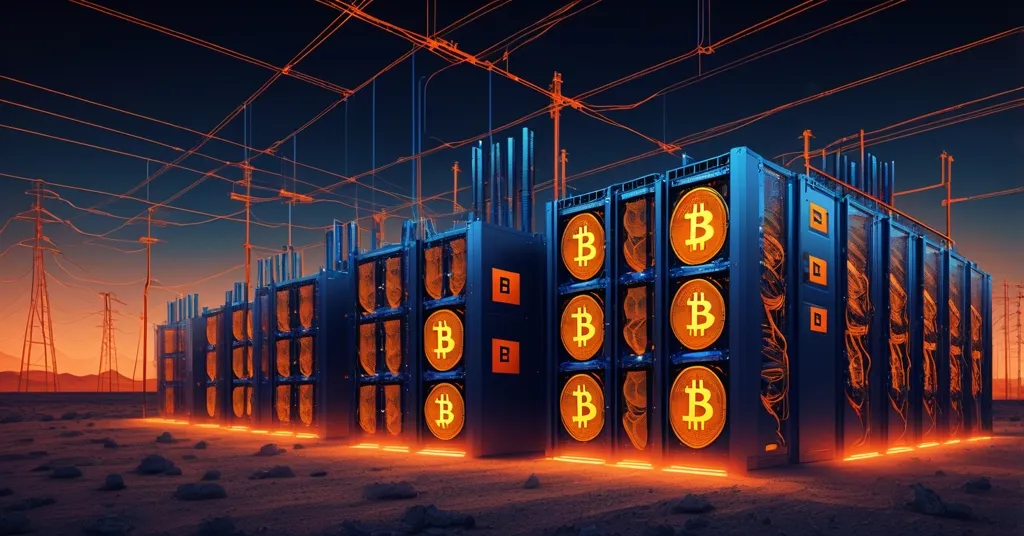
LTB Bitcoin miners are increasingly turning into AI data centers, as explained in why Bitcoin miners are quietly becoming AI data centers, and the market is rewarding that pivot even as BTC itself struggles.
- Bitcoin fell about 17% in early 2026 while mining stocks surged
- AI and high-performance computing contracts are replacing volatile block rewards
- Debt, BTC treasury sales, and hashrate shifts are the price of the transition
Bitcoin mining companies are no longer being valued mainly on how many blocks they can mine. Investors are looking at power capacity, long-term contracts, and whether a miner can host AI workloads for hyperscalers like Microsoft. That’s a very different game, and it’s why mining stocks have ripped while Bitcoin has lagged.
Bitcoin dropped roughly 17% in early 2026, but a basket of crypto mining equities rose more than 50%, with one tracked basket up 56% year-to-date. TeraWulf reportedly gained more than 73%. The message from Wall Street is blunt: the old “mine BTC and hope” model is getting shoved aside by predictable revenue from AI data centers and high-performance computing, or HPC.
HPC means high-performance computing: large-scale, power-hungry compute used for tasks like AI model training, inference, and other enterprise workloads. In plain English, it’s the sort of stuff that burns through electricity and hardware like a pissed-off furnace. And miners already own one of the scarcest inputs in that business: large blocks of power capacity with grid access, land, cooling, and buildings that can handle serious heat.
That is why mining companies are suddenly in demand. They have the power, the real estate, and the infrastructure. AI firms want all three, fast. Bitcoin miners spent years optimizing for cheap watts and industrial-scale uptime; now the AI boom is paying them to repurpose those same assets into utility-scale data centers.
The numbers are hard to ignore. Public Bitcoin miners have announced more than $70 billion in cumulative AI and HPC contracts. Hut 8 signed a 15-year, $9.8 billion lease for a 352-megawatt facility in Texas. TeraWulf says it has locked in $12.8 billion in contracted AI revenue. IREN secured a $9.7 billion deal with Microsoft for 76,000 NVIDIA GPUs. Galaxy Digital and others are also lining up long-term compute commitments tied to AI demand.
Those are not minor side hustles. These are giant, power-intensive commitments that look a lot more like infrastructure than crypto speculation. A miner with a 15-year AI lease is not living and dying by the next halving cycle. It has contracted revenue, which means investors can model cash flow instead of squinting at BTC price action and praying the spreadsheet holds together.
“Bitcoin miners are abandoning Bitcoin, or at least demoting it, to become artificial intelligence data centers.”
“The companies built to mine Bitcoin are becoming something else entirely, and they are selling their Bitcoin to pay for the transition.”
That last part is where things get messy. This pivot is not free, and it is definitely not clean. Publicly listed miners have sold more than 15,000 BTC from corporate treasuries to fund the transition. Core Scientific sold $175 million worth of Bitcoin, or about 1,992 BTC, in March 2026. IREN holds zero Bitcoin in treasury by design, which is about as clear a signal as you can get that the company is all-in on the new model. It also reportedly has about $3.7 billion in convertible notes.
TeraWulf carries around $5.7 billion in total debt. Cipher Digital issued $1.7 billion in senior secured notes, and interest expense jumped sharply as a result. That matters because leverage is a lovely thing until the music slows down. Debt can accelerate growth, but it also creates pressure to keep filling campuses, keeping customers happy, and selling whatever assets are available if the market turns. In crypto, that usually means selling BTC.
The economics behind the pivot are straightforward. Bitcoin mining is brutal: rewards fall with the halving, difficulty rises when more hashpower joins the network, and margins get squeezed by energy costs and hardware competition. AI data centers, by contrast, can lock in long-term contracts with wealthy customers that need compute right now. Predictable cash flow beats a lottery ticket most days of the week, especially when treasury yields and macro uncertainty make speculative assets less appetizing.
That is why the market is re-rating these companies less like flaky crypto proxies and more like infrastructure businesses. Investors are not just buying Bitcoin exposure anymore. They are buying power capacity, grid connections, and contracted revenue streams tied to AI growth. It’s boring, capital-intensive, and very possibly smarter than the old model. Also, unlike the usual crypto circus, the invoices actually get paid.
Texas is becoming a major battleground in this shift. Cheap power, wide-open land, and utility-scale sites make it perfect for large data centers. Hut 8’s Nueces County lease and IREN’s Childress campus are part of the same story: power is the scarce asset, and the companies that already control it now have leverage in two booming industries at once. Bitcoin opened the door. AI kicked it wide open.
The hardware side matters too. NVIDIA GPUs are the core of many AI deployments, and reference architecture around things like NVIDIA GB300 and DSX shows just how dense and specialized these facilities are becoming. This is not rack-and-stack colocation for a bunch of web servers. It’s industrial compute, with serious cooling and serious grid demand.
That grid demand is one reason the pivot has a darker side. Bitcoin saw its first first-quarter hashrate drop in six years, partly because some miners are redirecting capacity toward AI. Hashrate is the total computing power securing Bitcoin. When miners leave for better economics elsewhere, Bitcoin’s hashrate growth can slow or even dip. That does not kill the network — Bitcoin’s difficulty adjustment is designed to keep block production stable — but it does change the security and incentive picture.
Short term, the network is still fine. Long term, the symbolism matters. Miners were the people most economically aligned with Bitcoin’s survival because they were paid in BTC and often held a chunk of it. If more of that class becomes data center operators first and Bitcoin miners second, the industry’s conviction gets diluted. Bitcoin does not need every miner to be a maxi, but it does benefit when the people protecting the network have skin in the game beyond a lease agreement and a quarterly earnings call.
Industry projections suggest listed miners could derive up to 70% of revenue from AI by the end of 2026, up from around 30% today. That is a huge shift in a very short period. It also raises a simple question: if most of the money comes from AI contracts, are these still Bitcoin mining companies in any meaningful sense?
The market answer seems to be no, or at least not primarily. These are becoming hybrid utility businesses with Bitcoin as a flexible secondary load. That setup has earned the nickname “mullet data center” — business in the front, party in the back. It’s a funny phrase, but it captures the reality: AI pays the bills, Bitcoin fills in spare capacity. The orange coin becomes the backup plan, not the headline act.
There is a real bull case here, and it should not be ignored. A miner that can convert stranded power into contracted AI revenue may become far stronger financially than one that survives only by hoping BTC stays elevated. Better balance sheets can mean less forced selling during downturns, more stable cash flow, and a more durable business. That is healthy for the companies involved, even if it bruises the old mythology of mining as pure Bitcoin-first conviction.
But the risks are equally real. The pivot is being priced by the market as a near-certain win, and that is a dangerous assumption. AI demand could cool faster than expected. Capital costs could stay high. Regulation could get uglier, especially around grid demand and local power politics. Overbuild is a genuine threat too. When everyone rushes into the same shiny new theme, the hangover tends to show up right on schedule.
There is also the concentration risk nobody likes to talk about. A miner with a massive deal from Microsoft or another big counterparty may have strong contracted revenue, but it also becomes dependent on a handful of giant customers. That is a different kind of fragility. It is not the old Bitcoin volatility, but it is still a dependency. One boom can replace another and still leave you holding the bag if the music stops.
For Bitcoin, the tradeoff is mixed. On one side, some miners are becoming more resilient businesses with better cash flow. On the other, Bitcoin treasury sales add selling pressure, and a portion of industrial compute is being pulled away from network security. The chain will keep running, but the mining sector is changing shape around it. Bitcoin is not dying here. It’s just watching part of its industrial base get repurposed under its nose.
Key questions and takeaways
What is happening to Bitcoin miners?
They are increasingly becoming AI and HPC data center operators instead of relying mainly on block rewards. The shift is driven by better economics and strong demand for power-rich compute infrastructure.
Why are Bitcoin mining stocks outperforming Bitcoin?
Because investors are valuing long-term contracted AI revenue and utility-style cash flow more than volatile Bitcoin mining income. Predictable revenue is easier to price than a halving-driven gamble.
Why are miners making this pivot?
Bitcoin mining is volatile, margin-squeezed, and exposed to halvings, while AI contracts can lock in multi-year revenue. Power capacity, which miners already control, is suddenly worth a lot more in the AI boom.
Which companies are leading the shift?
Hut 8, TeraWulf, IREN, Core Scientific, Galaxy Digital, and Cipher Digital are among the names pushing hardest into AI infrastructure and hosted compute.
How are miners financing the transition?
Mostly with debt and Bitcoin treasury sales. That creates leverage risk and adds BTC selling pressure to the market.
Does this hurt Bitcoin?
Potentially, yes. It can mean slower hashrate growth, more BTC sold from corporate treasuries, and a mining sector that is less tightly aligned with Bitcoin’s long-term security model.
Is the shift reversible?
Not easily. Long-term leases, debt, and customer contracts make the transition sticky. Once a miner builds around AI revenue, going back to pure BTC mining is not exactly a weekend project.
What does “mullet data center” mean?
It describes a hybrid setup where AI is the front-facing business and Bitcoin mining runs in the back as a flexible secondary workload. Business in the front, party in the back.
The blunt reality is that power is the scarce asset, and miners already have it. Bitcoin gave these companies the blueprint, but AI is offering a fatter paycheck. Whether this becomes a durable reinvention or a debt-fueled overbuild binge will depend on how long the AI boom keeps roaring. For now, a big chunk of Bitcoin mining is turning into something else, and the market is pricing that in fast.